Massad mystery at Harvard

Joseph Massad, the student-abusing extremist who’s left an indelible stain on Columbia, is back from leave to teach this semester. According to Massad, this is to be a banner year for him: in the spring, the University of Chicago Press will publish his new book, Desiring Arabs.

Wait a minute… Just last year, Massad told Columbia that Harvard University Press would publish that book. In his March 2005 statement to the Columbia ad hoc committee that investigated the charges against him, he announced proudly that “my recent work on sexuality and queer theory is also taught across the country, and a book length study on the subject is forthcoming from Harvard University Press.” The Nation, covering the Columbia controversy last year, also reported that Desiring Arabs “is forthcoming from Harvard.” (Its conclusion: such “scholarly output would seem to make him a viable candidate” for tenure.) Indeed, as far back as May 2004, Massad was telling readers of his Ahram Weekly columns that Desiring Arabs was “forthcoming from Harvard University Press.”

I don’t know what’s expected of faculty at Columbia. But in my neck of the academic woods, you don’t go around telling the world that your next book is forthcoming from Harvard, unless it’s really forthcoming from Harvard. That doesn’t mean a friendly chat with an editor in Cambridge. It means an acceptance letter, presumably based on a completed manuscript and readers’ reports. As it turns out, Massad described as “forthcoming” a book he hadn’t even finished. The Columbia Spectator reported last fall that Massad was “spending this semester in Cairo, Egypt, finishing his book on homosexuality in the Arab world.” If so, it could hardly have been “forthcoming from Harvard.” According to an article in the Chronicle of Higher Education on academic terminology, “forthcoming” indicates that a work has been completed and accepted for publication. (“Under submission” or “under review” refers to completed work that’s been submitted but not accepted. “In preparation” describes work that’s neither been completed nor accepted.)

This isn’t nitpicking. Last spring, Columbia promoted Massad to associate professor, a rank from which he could be tenured. Did the list of publications he submitted include Desiring Arabs as forthcoming from Harvard? If so, on what basis? What went wrong for Massad at Harvard University Press? And is Chicago really going to publish the book in the spring? (It’s not on their website.)

Since Massad paraded the Harvard credential when he needed it, he should explain why it’s evaporated. And if the elusive book figured in Columbia’s promotion decision, the university should investigate Massad’s conduct–again.

Update: It’s 2007 now, and the book is on the University of Chicago Press website.
Martyrs get tenure at Columbia?

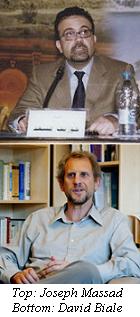
Yesterday the press reported that Columbia University has promoted Joseph Massad to associate professor. Massad, a Palestinian extremist and protégé of the late Edward Said, was the prime culprit in last year’s student abuse scandal. His most famous contribution to the store of human knowledge is his ingenious discovery that Zionism isn’t just racism, it’s antisemitism. Read his latest excretion, a review of Steven Spielberg’s Munich, and ask yourself how in the world Columbia entrusted him to teach the Israeli-Palestinian conflict. If Edward Said hadn’t been pulling all the strings on Morningside Heights, Massad probably would have ended up teaching in a community college. Now he’s one step away from tenure at a leading university.

If he’s ultimately tenured, who will bear the responsibility? In December, David Biale, Emanuel Ringelblum Professor of Jewish History at University of California Davis, published an article on campus controversies in J., a Jewish newspaper based in San Francisco. I don’t have the patience to rebut every claim or factual error in this text; Professor Biale really should stick to Jewish history. But there’s one claim that relates to Massad’s tenure, and that demands elucidation. Professor Biale writes:

When Palestinian professor Joseph Massad at Columbia University addressed an Israeli student in a fashion that certainly deserved censure, those eager to find an anti-Semitic conspiracy ended up turning him into a martyr and guaranteeing him tenure. Colleagues at Columbia have told me that their prior doubts about this instructor were drowned out by the din of external propaganda.

This is a very serious charge—not against the makers of “external propaganda,” but against Columbia University. If Professor Biale believes that mere “martyrdom” is sufficient to get someone tenure at Columbia—that Columbia, like Hamas, puts shahids on a permanent pedestal—he should step forward immediately to deplore Columbia for betraying the basic principles of academic integrity. I propose he begin by announcing publicly that he won’t lend his name to any appointment or promotion procedure at Columbia. He should urge others to do the same.

However, yesterday’s report indicated that Massad’s tenure isn’t guaranteed, which means that it may not be too late to block him. If Professor Biale and his “colleagues at Columbia” relieve me of the responsibility of making the case against Massad, I’ll be glad to defer to them. I merely await their explicit assurance. I’m particularly eager to learn who these “colleagues” are, and what sort of “doubts” they’re willing to express.

Should they not have the courage to step forward, preferring to stay securely locked behind their office doors, they should keep silent about “external propaganda.” It will be the only thing standing between Massad and tenure. I’m quite willing to conduct it, and I’ll expect Professor Biale’s tacit support.

Update: David Bernstein (The Volokh Conspiracy and a law prof at George Mason) thinks I don’t give enough credit to community colleges: “I can’t imagine any self-respecting community college would give [Massad] a job.” He’s probably right.

Bernstein has gone back to Massad’s review of Munich, which compares Spielberg’s latest to the film Exodus:

Here is how Massad describes [Exodus‘s] plot: “Exodus tells the story of the Zionist hijacking of a ship from Cyprus to Palestine by a Zionist Haganah commander.” This is analogous to saying that Schindler’s List was a movie about Jews taking a working vacation in Poland.

We’re all familiar with Holocaust denial; no respectable university would hire a Holocaust denier for its faculty. So why would any elite university like Columbia retain, much less promote, someone who similarly intentionally falsifies Jewish history (indeed, in this case, the history of Holocaust survivors) for political ends?

I think this is a perfect opportunity for Professor Biale to show a bit of grit. I urge him to come forward with an authoritative critique of Massad’s distortions of Jewish history. Isn’t this precisely why he was tenured (and chaired)? To counter falsehood with truth? As Professor Biale teaches the Holocaust, he has a unique responsibility, and far more authority than any blogger. (Read his many credentials.) Come forward!

MESA jumps in Massad’s trench

You remember Joseph Massad (how could you not?), the assistant professor who’s been at the heart of Columbia’s Middle Eastern studies scandal. Last spring, a university panel investigated allegations that he intimidated a student over her politics. Massad denied it, but the panel found the student credible, and a cloud hangs over his tenure prospects.

Massad is one of Edward Said’s less successful clones. Once, on a flight, I ended up watching a film called Multiplicity. It’s a light comedy about a man who can’t meet all his responsibilities at work and home, so he allows a mad geneticist to clone him twice. Alas, each clone is a bit like a photocopy–distorted and not quite up to the original. Then one of the clones has himself cloned, producing a total idiot. Massad’s doings, writings, and posturings are like an Edward Said gone really bad. So bad, in fact, that while Said achieved Columbia’s highest rank, of University Professor, Massad strikes me as falling far below the minimal requirements for tenure.

But the Middle East Studies Association (MESA) has a stake in Massad. Why? Beyond fealty to Said and collegial solidarity, MESA once gave Massad its award for outstanding doctoral dissertation. Not a single MESA-acclaimed dissertation has made for a lasting and influential book, and Massad’s was no exception. The resulting tome, soaked in the impenetrable prose of postcolonial theory, isn’t on anyone’s must-read list. But MESA’s reputation is now invested in Massad, as he himself emphasized in his response to the findings of Columbia’s panel:

An attack on my scholarship therefore is not only an attack on me and on MEALAC [his department at Columbia] but on Columbia’s political science department [which graduated him], on prestigious academic presses, including Columbia University Press [which published his thesis], and on the Middle East Studies Association (MESA), an opinion expressed by Martin Kramer who also condemns Middle East Studies at Columbia and MESA itself.

Massad couldn’t be more right. All those who have accredited, acclaimed, and published him have scraped bottom, and that applies especially to Columbia University and MESA.

Columbia may redeem itself yet, by spitting him out. But MESA, it’s now clear, is digging itself an even deeper hole. Without fanfare, it has just added Massad to the editorial board of its flagship journal, the International Journal of Middle East Studies. That is, it has anointed him formally as an arbiter of quality in scholarship. This effectively destroys whatever credibility the journal still had (after the damage it sustained under the editorship of Juan Cole). Even if this appointment is a mere honorific, Massad’s name on the masthead brings disrepute.

But the mandarins of MESA have gone further. Each fall, MESA’s rank-and-file elect a new president and two members of its six-member board of directors. A nominating committee selects the candidates. Lo and behold, among this year’s candidates for the board is Joseph Massad. He’s a mere assistant professor, with only one book (two more are said to be forthcoming), but he’s being offered to MESA’s members for possible selection as one of the pillars of the field.

Personally, I wish Massad luck in the race. I endorse him. His victory would make the efforts of critics like me even easier. (And I thought it would be hard to surpass Juan Cole’s election last year as MESA’s president. That shows how little I know.) The MESA elections run through October 28. As we get closer to that date, I’ll make my prediction.

Oh, and yes, I’ve also noticed that Zachary Lockman of New York University and Mark Tessler of Michigan are the two candidates for the presidency of MESA. I’ve written about Lockman, and he’s written about me. I intend to come back to that race later in the fall.

Disappointment: Massad’s long-awaited book, The Persistence of the Palestinian Question, has been announced by its publisher, Routledge, and I’m disappointed. It’s just a collected volume of his essays. “The essays, which have been previously published in a variety of academic journals, are brought together with a new introduction and conclusion.” So this won’t be an integrated sequel to Said’s famous Question of Palestine. Like I said: the clone’s never up to the original.