Juan Cole’s noble enterprise

Professor Juan Cole, the blogging sensation, is at it again, claiming that he objected to the “terrible idea” of the Iraq war back in 2002 and 2003. Proof? “I can produce witnesses to my having said that if the UN Security Council did not authorize the war, I would protest it.” This new posting echoes one that Cole made last November, when he claimed to have “said repeatedly in 2002 and early 2003” that “it was a bad idea to invade Iraq.” Apparently it’s important to Cole, who’s an anti-war icon, to demonstrate that he opposed war from the get-go.

Tony Badran responded last autumn with a devastating posting, comprised of various quotes from Cole’s own weblog. Here are some of them. Cole, before the war (February 11, 2003): “I am an Arabist and happen to know something serious about Baathist Iraq, which paralyzes me from opposing a war for regime change in that country.” Cole, start of the war (March 19, 2003): “I remain convinced that, for all the concerns one might have about the aftermath, the removal of Saddam Hussein and the murderous Baath regime from power will be worth the sacrifices that are about to be made on all sides.” Cole, after the war (July 30, 2003): “I refused to come out against the war. I was against the way the war was pursued the innuendo, the exaggerations, the arrogant unilateralism. But I could not bring myself to be against the removal of that genocidal regime from power.” Some “terrible idea.”

But since Professor Cole still needs help with his memory, let me add this quote to the litany (April 1, 2003):

I hold on to the belief that the Baath regime in Iraq has been virtually genocidal (no one talks about the fate of the Marsh Arabs) and that having it removed cannot in the end be a bad thing. That’s what I tell anxious parents of our troops over there; it is a noble enterprise to remove the Baath, even if so many other justifications for the war are crumbling.

You’ve got the mise-en-scene? The much-titled expert reassures anxious parents of service personnel that their sons and daughters are risking their lives in a “noble enterprise.” Now read this passage, which Cole wrote over a year later (April 23, 2004):

I would not have been willing to risk my own life to dislodge Saddam Hussein from power. And, I would certainly not have been willing to see my son risk his.

So apparently the “noble enterprise” wasn’t that noble, at least in retrospect. For it’s only in retrospect that Cole came to see the “noble enterprise” as a “terrible idea.” Only in retrospect did a war to depose Saddam look to him like a “bad idea,” since at the time he thought it “cannot in the end be a bad thing.” When war began, he thought it would be “worth the sacrifices.” Only in retrospect did he decide it wasn’t even worth the risks.

Cole shows neither courage nor integrity in fudging his past position. While he flays others for selective memory and shifting their rationales, he commits precisely the same offenses. Would it damage his ego or his reputation for punditry to admit that the “noble enterprise” didn’t turn out quite like he expected? What’s he afraid of? After all, he wasn’t regarded as any great expert on Iraq going into the war. Even a true expert, Peter Sluglett, has admitted he overestimated U.S. chances of getting Iraq right: “Perhaps I was naive.” Why does Cole, an Iraq novice in comparison, insist on his own prescience?

Finally, there’s Cole’s claim that he was going to “protest” the war if it didn’t get a U.N. Security Council resolution. He says he’s got witnesses. Well, they’d better be good, because here is Cole on the record (February 4, 2003):

My own knowledge of the horrors Saddam has perpetrated makes it impossible for me to stand against the coming war, however worried I am about its aftermath. World order is not served by unilateral military action, to which I do object. But world order, human rights and international law are likewise not served by allowing a genocidal monster to remain in power.

That sounds like an overwhelming moral case for unilateral action, with apologies to the UN.

So that’s Juan Cole—the historian who can’t even get his own history straight. His “noble enterprise” belongs to the same category as President Bush’s “mission accomplished,” with this difference: President Bush may have been sincere. With Cole, you never know.
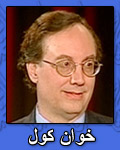
His Arabic is not free of Colecisms

Juan Cole responds to the suggestion that his command of Arabic is less than commanding, after opting for English during an Iraqi elections roundtable on Al-Jazeera:

I know three kinds of Arabic Modern Standard, Lebanese dialect and Egyptian dialect. My Arabic is not free of solecisms because I didn’t start it until I was an adult, and sometimes something from one of the three slips into the other. But I did live in the Arab world nearly six years altogether, and do speak the language.

No one doubts that Cole speaks it. But speaking Arabic, and speaking it on television, involve very different levels of proficiency. A few Westerners, like the French scholar Gilles Kepel and the former U.S. diplomat Christopher Ross, have no problem going on television and gabbing away in the language. I won’t mention names, but I’ve heard that a few more non-Arab Americans can do it, and there are a couple of people on my own hallway who learned Arabic as adults and speak it on Al-Jazeera regularly. Cole prefers not to, and he gives this explanation:

I said I preferred to speak English because the subject required exactitude. I have given more than one interview in Arabic, including on Radio Sawa Iraq. In this instance I felt it was important to have absolute control of nuance, which can only be had in one’s mother tongue.

Three things can be said about that. First, it’s not clear why a give-and-take on Iraqi elections would require an absolute control of nuance, especially if you’re just a pundit with nothing at stake. Second, what’s the point of achieving absolute control of nuance, if it means turning over the reformulation of your entire message to some guy who writes subtitles in Arabic? What if he dents your credibility in the eyes of Arab viewers?

Third, and perhaps most telling, why does Cole think that absolute control of nuance is limited to one’s mother tongue? I know quite a few Arabs whose command of English is better than their command of Arabic, because they’ve taken the trouble to master it. The late Elie Kedourie once caught Arnold Toynbee in some bit of nonsense similar to Cole’s, and he dismissed it as “nativism.” Kedourie:

This nativism cannot possibly account for the rise of such languages as Arabic or English to the status of world languages. Innumerable people received these languages as a result of conquest or commerce or migrations and have learnt to speak and to write them with ease and elegance, and to express, through their medium, the most difficult and elusive ideas, and the most complex and evanescent feelings.

Talking about electoral politics would be the least of it. Kedourie, by the way, spoke the Baghdadi Jewish dialect at home, French as a youngster at school, and only later developed an English that was elegant and precise. His English style was my model, and my own mother tongue is English.

Three factors explain why so few American Middle East experts have paid Arabic the compliment of achieving a high level of expression. First, the language is difficult. Second, there are plenty of polyglot Arabs willing to translate and interpret, at minimal cost. Third, perfect Arabic is less important to career advancement than mastering all the right academic jargon and professing all the right disciplinary dogmas with absolute control of nuance. The first two factors are beyond anyone’s control, but the last can be affected, if government refocuses the Title VI subsidy program for area studies back on languages. I urge Cole, as president-elect of the Middle East Studies Association, to join me in supporting just that.

Finally, Cole offers this supposed behind-the-scenes testimonial from Fouad Ajami:

When we were bantering before the show in Arabic, and I explained how I felt to Fouad Ajami and the others [about speaking in Arabic on television], Fouad quipped that my Arabic was better than some (highly westernized) Arab rulers.

Leave it to Cole to retail a tongue-in-cheek quip made by the quip-master at the expense of American-schooled or London-loving Arab rulers as a compliment to himself. Really.

Commander of Arabic

Juan Cole has taken some delight in smashing pundit Jonah Goldberg, who ventured a one-paragraph criticism of Cole’s take on the Iraqi elections. Cole hammered back that Goldberg knows no Arabic, has no Iraq expertise, hasn’t lived in an Arab country, etc. The spat has been all over the weblogs. Cole draws this analogy:

If you saw an hour-long piece on al-Jazeerah about the reality of the United States, with English subtitles, and the reporter speaking on the U.S. had never been to America, had never read a book about America, did not know a word of English, and moreover said all kinds of things that were complete fantasy and altogether wrong, would that man be someone you would recommend to others as having an important opinion on the matter that millions of people should be exposed to on NPR and CNN every other day?

Quite right. But I see that Cole appeared the other day on Al-Jazeera to discuss the Iraqi elections with Fouad Ajami and an Iraqi opposition figure. Cole decided to speak in English, apologizing to his Arab viewers that “the subject requires precision.” So I guess they gave his remarks Arabic subtitles. Now I wouldn’t dare to speak Arabic on Al-Jazeera either, but then I don’t make the boast that Cole makes: “Unlike a lot of American specialists in the Middle East, who did one Fulbright year and now find their language is rusty, I kept up my Arabic.” His bio also claims that he “commands Arabic.” I guess his Arabic, like mine, doesn’t always obey. I’m a bit disappointed.

Cole also writes in his bio that he’s “lived in a number of places in the Muslim world for extended periods of time,” which is an enviable credential. But the Muslim world is an awfully big place, and to the best of my knowledge, Cole has never been to Iraq. (Ajami, Michael Rubin, and a host of academics have made the trek, some of them repeatedly, over the past couple of years.) So all things considered, I wonder what millions of Arabs who watch Al-Jazeera make of Cole as an expert on the reality of Iraq.

(Here’s an addendum, but only if you know Arabic. It’s a joke I heard ages ago from the late Charles Issawi, a man with an impish sense of humor. I’m sure it’s as old as the Pyramids, but here it is anyway. A Western orientalist goes to Egypt, and strikes up a conversation in Arabic with his taxi driver. The poor driver, after straining to understand his passenger, plaintively asks him how he came to know Arabic. Ana mustashriq! the orientalist answers proudly. In reply to which, the taxi driver mutters: Wa’ana mustaghrib…)

Updates: Read about how Ajami took Cole to task for not visiting Iraq here.

Another update: Cole responds to some of this. Details here.