Here’s a small selection of my latest short pointers from Facebook and other social media. I’ll send these to Sandbox subscribers every other month or so. (If you prefer to receive them by email as they appear, subscribe here.)
• The Middle East Studies Association (MESA) protests the New York Times’s removal of ISIS documents from Iraq. They belong to Iraq’s cultural heritage, and should be returned. Times correspondent Rukmini Callimachi says Iraqi forces who accompanied her “gave permission to take the documents,” but MESA asserts they were “unlikely” to have had the authority to do so. Well, that’s just a guess, isn’t it? After all, has the Iraqi government protested? No. Perhaps it wanted the Times to publish. Perhaps it doesn’t regard ISIS as part of Iraq’s “cultural heritage.” So the MESA letter is based on an unsubstantiated premise. (Just like MESA itself: the false premise that it’s a scholarly association.)
• The Embassy of Israel in Washington has named Bernard Lewis one of the “70 greatest American contributors to the US-Israel relationship” on Israel’s 70th anniversary. “Lewis never combined his natural scholarly sympathy for the Arab and Muslim peoples of the region with an antipathy towards Zionism and the Jewish people. Indeed, he has been a life-long Zionist and a friend to Israel.” (I’m mentioned in passing.)
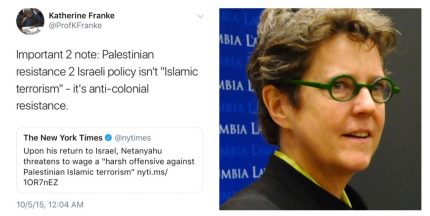
• Katherine Franke is a Columbia law prof and self-important campus radical. She landed in Tel Aviv on a smear-Israel junket, and was promptly deported. Roger Cohen at the New York Times thinks that’s terrible, that she’s just a “tough critic” who “thinks differently” about Israel. But Franke isn’t just wasting her time promoting BDS. See this 2015 tweet, re: knifings of Israeli civilians. Sorry, you can’t excuse terrorism against everyday Israelis, and expect to stroll into Israel whenever you damn please. To me, Franke is just a variation on Sheikh Qaradawi, who’s banned from the US and the UK for preaching what she tweeted. That’s not “thinking differently,” it’s incitement. Keep out.
• Brendan O’Neill: “If you only criticise Israel, or you criticise Israel disproportionately to every other state, and if your criticism of Israel is loaded with Holocaust imagery and talk of bloodletting, and if you boycott Israel and no other nation, and if you flatter the dark imaginings of the far right and Islamists and conspiracy theorists by fretting over a super powerful Israel Lobby, and if the sight of an Israeli violinist is too much for you to stomach, then, I’m sorry, that has the hallmarks of anti-Semitism.” Read it all.
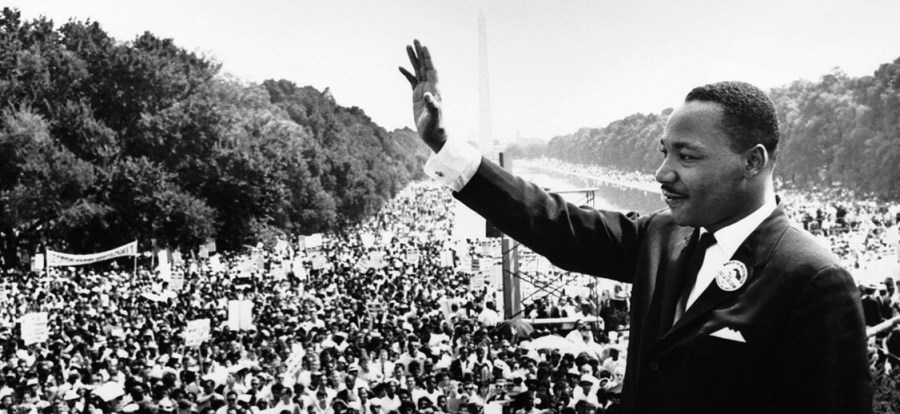
• It is fifty years to the 1968 assassination of Dr. Martin Luther King, Jr. Some years ago, I did a series of posts about his attitude to Israel from the Six-Day War until his death. Later, for my book The War on Error, I tied them all together in an article. Now, courtesy of my publisher, that article appears here. The next time someone quotes MLK on Israel or the Palestinians, save yourself the trouble and refer them to the link.
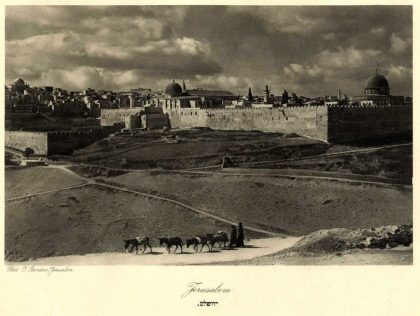
• From my Instagram feed: Jerusalem in the 1920s, photograph by pioneer photographer and cinematographer Yaacov Ben-Dov.

 Martin Kramer on the Middle East
You must be logged in to post a comment.