Oppenheimer’s ‘very late’ bar mitzvah

Everywhere about us was the sense of the pioneer, and of courage, which is never remote in Israel.

—J. Robert Oppenheimer, December 1958

On April 26, 1967, the Board of Governors of the Weizmann Institute of Science convened in Rehovot, Israel. The new president of the Institute, Meyer Weisgal, lieutenant of the late Chaim Weizmann, had a scoop for the press. “Had fate not intervened,” reported the newspaper Ma’ariv, “the president standing before the Board might have been the ‘father of the atomic bomb,’ Dr. Robert Oppenheimer.”

Weisgal revealed that six months prior to Oppenheimer’s death, he had conducted “secret” talks with the famed physicist, offering him the presidency of the Weizmann Institute. (At the time, Weisgal was trying to fill the vacancy at the top with someone other than himself.) In Weisgal’s telling, Oppenheimer accepted the offer, provided the Institute met certain conditions. “Conditions accepted,” Weisgal had replied. But “fate,” in the form of throat cancer, had stolen Oppenheimer away. He died on February 18, before anyone learned of the plan.

Weisgal repeated his account in a bit more detail in his memoirs, published in 1971:

I asked Oppenheimer if he would consider accepting the presidency of the Institute. We talked about it, alone, and then with his wife, Kitty. Shirley [Weisgal’s wife] and I visited them a number of times and continued the conversation. Finally he said: “I will accept the job on the following conditions. One, I must come back to the United States three months every year because I don’t want to give the impression of running away after what has happened; two, I will not do any entertaining. You will have to do it for me but I will be present whenever you call me; three, I will want to continue to do some physics.” I accepted all three conditions and we made a date to meet a few months later when I would again be in New York. When I returned and called his secretary I was given the shocking news that he was dying of cancer. No one could see him. A few months later he died. His funeral was one of the saddest experiences in my life.

(After Oppenheimer died, and one or two other candidates fell through, Weisgal reluctantly assumed the presidency of the Institute.)

It’s a remarkable story. But is it true? It’s not mentioned in any study of Oppenheimer. You won’t find it in Kai Bird and Martin Sherwin’s Pulitzer Prize-winning biography of Oppenheimer, American Prometheus (on which the 2023 Oscar-winning movie is based), or in Mark Wolverton’s A Life in Twilight: The Final Years of J. Robert Oppenheimer. I’ve found no other evidence for it, either in Oppenheimer’s private papers or in the archives of the Weizmann Institute. At this point, the sole source for the story is Weisgal.

In the absence of corroboration, Weisgal’s account can’t be verified. But is there any sense in which that account might be plausible? Does any evidence suggest that Oppenheimer might have thought to write one last chapter in his life, as president of the Weizmann Institute in Israel?

The pursuit begins

Any answer must begin with Meyer Weisgal, an irrepressible impresario and charming schmoozer whose contributions to Zionism and Israel haven’t received their due. Elie Wiesel found him to be “high in color, picturesque, even flamboyant,” a “trouble-shooter” and “amateur in all things” who “brings to mind a character of the Renaissance.” Isaiah Berlin called him “a man of farouche independence of character, whom nothing can bend or divert from the fixed purposes of his life, his Zionism.”

In these years, Weisgal pursued one paramount goal: winning international recognition for the young Weizmann Institute as a powerhouse of science. After Chaim Weizmann’s death in 1952, Weisgal took over the management on an “acting” basis. He was not a scientist, but he could map scientific excellence and sell it to Jewish donors who knew no physics, chemistry, or mathematics. Experience had also taught him to identify a Jew in distress. That description fit Oppenheimer perfectly in the early 1950s, when the architect of the Manhattan Project, now director of the Institute for Advanced Study in Princeton, lost his security clearance in the midst of the Red Scare.

Weisgal sought to draw Oppenheimer to the Weizmann Institute as early as June 1954, on a visit to Princeton. “The very day I was to meet him,” he recalled, “the New York Times carried a seven column news story: ‘Oppenheimer Declared Security Risk.’” At that first meeting, Weisgal invited Oppenheimer to visit Israel in the fall. Oppenheimer demurred; he doubted he’d be allowed to leave the country. But Weisgal didn’t give up: “If you find it impossible to arrange to come to Israel this year, the invitation is hereby extended without statute of limitation. Any time or any season, no matter for how long or how short a stay, you will, I assure you, be a most honored and welcome guest in Israel and the Weizmann Institute.”

Weisgal kept inviting Oppenheimer every year, and his persistence finally paid off. In May 1958, Oppenheimer made his first trip to Israel, to help inaugurate a new building for nuclear science in Rehovot. (I recently published his Rehovot speech for the first time, here.) In November, the Weizmann Institute Board of Governors elected Oppenheimer a member, and in December he delivered another speech at an Institute fundraiser in New York City. (I republished part of that speech as well, here.) Oppenheimer returned to Israel a second time in 1965, for a meeting of the Board of Governors. During the intervening years, Weisgal continued to cultivate Oppenheimer. They addressed one another in increasingly familiar terms in their letters, and Weisgal befriended Oppenheimer’s wife, Kitty.

So it’s not hard to document Oppenheimer’s growing ties to the Weizmann Institute from 1954 to 1965. It’s amply attested in the press and in his own papers.

A Jewish spark?

There is also some anecdotal evidence that Israel stirred a sense of solidarity in Oppenheimer. Weisgal described him as “strangely alien to Jewish life and all its implications, but Rehovot and Israel fascinated him…. During one of our conversations, he spoke to me about his impressions of Israel. I don’t remember his words but I remember clearly that his voice was choked and there were tears running down his face.” Prime Minister David Ben-Gurion, who met with Oppenheimer during his 1958 visit, told the Israeli cabinet that “when I briefly met Oppenheimer in Rehovot, I had the impression, though I can’t be sure, that some sort of Jewish spark lit up the man.”

It might be argued that Weisgal and Ben-Gurion were primed to detect even the faintest hint of sympathy. One finds firmer evidence in the actual words spoken by Oppenheimer in an interview he gave to a Ma’ariv writer (and future politician) Geulah Cohen, during his 1965 visit. (Although it was published in Hebrew, the Weizmann Institute archives preserve a copy of the text in the English, which I’ll presume to be his words and not a translation. I’ll quote it directly.)

“I should like to confess,” Oppenheimer told his interviewer, “I am not a believer. Not that I am an atheist or that I claim that there is no God. I am an agnostic, I do not know.” Question: did he believe the return of the Jews to Zion and sovereignty “are prerequisites for the fulfillment of the Jewish destiny?” “I’m not sure about that from a cultural point of view,” Oppenheimer answered.

After all, Judaism was preserved, and thrived even in Exile, but—who knows, it may be possible for Judaism to contribute even more within this sovereign framework. Please understand me. I greatly esteem the deep feelings you have here, and I even envy them. But I don’t share them myself. Anyway, I’m here, and not just because I like long air-flights. What I meant to say before was only that I do not think that the Law which will save the world must necessarily come from Zion.

So the reader was left hanging: Oppenheimer was not a Jew by belief or a Zionist by ideology, yet here he was.

Hope and nostalgia

Perhaps there is a further hint in the two public speeches Oppenheimer delivered for the Weizmann Institute in 1958. On both occasions, he spoke of Israel as a preserve of a certain spirit that had gone missing in the West. “As an outsider coming from America,” he said in his Rehovot speech,

I can say that the whole world sees in Israel a symbol, and not just a symbol of courage, and not just a symbol of dedication, but of faith and confidence in man’s reason, and a confidence in man’s future, and in the confidence in man, and of hope. These are all now largely and sadly missing in those vast parts of the world which not so long ago were their very cradle.

Israeli society, he told his New York audience a few months later, was “forced by danger, by hardship, by hostile neighbors, to an intense, continued common effort.” As a result, “one finds a health of spirit, a human health, now grown rare in the great lands of Europe and America, which will serve not only to bring dedicated men and dedication to Israel, but to lead us to refresh and renew the ancient sources of our own strength and health.”

This notion that Israel preserved a sense of purpose that had been lost in the West also arose in Oppenheimer’s conversation with Ben-Gurion, as reported by Ben-Gurion nine years later, just after Oppenheimer had died. Ben-Gurion was interviewed on the NBC television program Meet the Press. The interviewer asked: “Can you tell us why any American Jew should leave this rich, prosperous country to come to the Negev?”

Ben-Gurion said he’d already put just that question to Oppenheimer: would American Jewish scientists come to Israel? “McCarthy is gone,” Ben-Gurion had told him, “and a Jew is not being discriminated now. Will they come?”

[Oppenheimer] said yes. I said, why? He said, I will tell you. There are two types of human beings. One, this is the majority, who wants to take, to get. There is another type, yet a minority, who has a great deal to give, to create. And this is the meaning of life. There is no meaning of life in America, in England and France, that’s what he said. I asked is there meaning of life here in Israel? He said before I came I was told there is and when I came I saw there is.

The intimacy of science in the small state of Israel also seemed to appeal to Oppenheimer. He explained this in his New York speech:

Part of the nostalgia which touches the foreign visitor to Israel lies in the sense that in Israel still, despite its great growth, there is a human community of manageable size. Men can talk together as friends, and need not deal with one another through committees, delegations, memoranda, and the inevitable proliferation of pigeon holes and clerks.

By contrast, “we in the super powers, in one way or another, are entangled in this problem of size.” Israel, he imagined, would eventually face the same problem as its needs grew. But “as of today Israel still has a reprieve from the curse of bigness, and serves to remind us what a small band of devoted men can do when they can understand one another as friends, and can build a common purpose on a common experience and shared knowledge.”

The resort to the word “nostalgia” is telling here, although it isn’t clear whether Oppenheimer was harking back to a lost Arcadia before the world war, or the “devoted” (but still very large) community he built during the war at Los Alamos. In any event, this ideal of “quiet intimacy” stood in clear contrast to the “big science” of the post-war, and Israel seemed to embody it.

Israel also lavished attention on Oppenheimer, and this may have had an effect. On that 1958 visit, not only did he meet publicly and privately with Ben-Gurion. He was received by Israel’s president, Yitzhak Ben-Zvi, and met the foreign minister, Moshe Sharett. In 1965, he was received by Levi Eshkol, Ben-Gurion’s successor as prime minister. On that visit, Oppenheimer was flown to Eilat by military plane, accompanied by Ernst David Bergmann, the head of Israel’s Atomic Energy Commission, along with Shimon Peres, then director-general of the defense ministry. (“Yesterday, I flew over the Dead Sea,” he told Geulah Cohen. “I saw Sodom and I thought how easy it was to live then, in a world where all the evil was limited to one place.”)
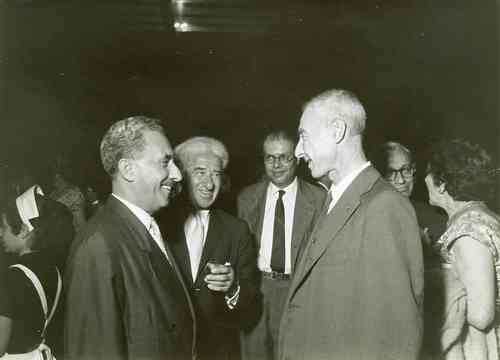
Oppenheimer (r) meets Moshe Sharett (l); between them, Meyer Weisgal. Source.

And it wasn’t just the political elite that embraced him. An observer in 1958 wrote that Oppenheimer had “captured the heart and mind of Israel…. Wherever he appeared he was surrounded by autograph hunters. His lectures on purely scientific subjects were crowded to capacity. Men and women, young and old, literally fought for admission.”

That Oppenheimer warmed to Israel over time seems indisputable, although the reasons appear idiosyncratic. They seem wholly unrelated to Judaism or Zionism; nor did Oppenheimer ever adduce the Holocaust.

That it happened at all was due primarily to the mediation of Meyer Weisgal, “To know him,” said Oppenheimer, “and above all in his beloved Rehovot, is one of the very good things of this world.” This was no small irony. Elie Wiesel once wrote of Oppenheimer that “he remained at a distance from Yiddishkeit.” But in allowing Weisgal to befriend him, he closed some of the gap. Weisgal hailed from the other side of the Jewish world. “Like most Jews,” Weisgal wrote in his memoirs, “I was born in Kikl,” a typical Polish shtetl, and he perfectly preserved its qualities. One interviewer called him “one of the few genuine shtetl Jews still extant.”

Weisgal’s genius was that he could lay a bridge between shtetl and science for others to cross. Thus, for example, did Oppenheimer find himself addressing that Weizmann Institute fundraiser in New York, where “the applause was most voluptuous when artists sang chasidic tunes in Yiddish.”

A departure and a vacancy

That brings us back to Weisgal’s specific claim that he’d successfully recruited Oppenheimer to join him in Rehovot, to preside over the Weizmann Institute. It was one thing for Oppenheimer to be of occasional service to the Institute or broadly sympathetic to Israel. But the commitment alleged by Weisgal went far beyond both.

It obviously depended on some seating changes. First, Oppenheimer had to become a free agent. That happened in the spring of 1965, when he decided he would end his reign as director of the Institute for Advanced Study after 19 years. His term would conclude in June 1966. When Oppenheimer attended the Weizmann Institute’s Board of Governors meeting in October 1965, everyone in the room knew he’d called it quits. (It had been reported in the Israeli press too.)

In 1958, Oppenheimer had come as a guest. In 1965, he had responsibilities. Weisgal convened the meeting in crisis mode, prompted by a cash crunch that would require “a radical reorganization and financial retrenchment.” The government might step in, but only if the research agenda focused more on its needs. Oppenheimer conveyed the urgency to the press: “I came because Mr. Weisgal phoned me and told me that this was going to be a very important meeting.” According to another press report, Oppenheimer plunged into the deliberations, making ten interventions and dissecting the planned budget.

His interview in Ma’ariv, his first to an Israeli newspaper, raised his profile still further. General interest in him also ran high: his visit corresponded with a Tel Aviv production of Heinar Kipphardt’s play about him (one he detested). His name was in the newspapers every day.

And there was that flight to Eilat. Oppenheimer didn’t need Bergmann and Peres to show him around the scruffy desert town. This was quality time on a military aircraft, spent with the two leading architects of Israel’s nuclear program, while flying close to Israel’s secret equivalent of Los Alamos: Dimona. Perhaps in future, a classified document will reveal more about this day trip. But public word of it was clearly meant to show official interest in Oppenheimer.

Still, setting Weisgal in motion required a second seat change. That occurred when Abba Eban, who had served as the titular president of the Weizmann Institute since 1959, announced his impending departure. (He would become Israel’s foreign minister in January 1966.) The vacancy at the top sent Weisgal into full search mode; this time he resolved to find a scientist for the position.

According to his memoirs, he didn’t start with Oppenheimer. He first tried to recruit Victor Rothschild, 3rd Baron Rothschild, whose name nearly said it all, except that he was a zoologist and therefore a scientist too. But Victor kept eluding him (indeed, his authorized biography is entitled The Elusive Rothschild) and so Weisgal moved on to Oppenheimer. This time he succeeded.

“The shocking news…”

Or did he? Weisgal, when he first revealed the story, placed the negotiation six months before Oppenheimer died—that is, during the summer of 1966. This is where the trouble begins.

The previous February, Oppenheimer had been diagnosed with throat cancer. In March he underwent an operation and cobalt radiation therapy. (Word of his illness reached Chaim Pekeris, a mathematician and physicist at the Weizmann Institute and a personal friend. Pekeris wrote to him in April about the “sad news,” wishing him a speedy and full recovery.) In July Oppenheimer seemed better, and he informed the Weizmann Institute that he would attend the next board meeting in Israel, scheduled for the end of April 1967. Kitty would accompany him. He died well before that.

So is it plausible that in 1966, Oppenheimer, grappling with an aggressive cancer while growing visibly weaker, said yes to the Weizmann Institute and life in Israel? Not only is there no corroboration for Weisgal’s account. In Weisgal’s own (apparent) last letter to Oppenheimer, written on July 25, there is no hint of any pending or urgent business:

I shall not be back in the States until sometime in October. May I get in touch with you then? I was very happy to see among my correspondence that you are coming to our meeting next spring. That will be wonderful.

Neither is there the expression of concern over Oppenheimer’s health that one would expect from a close associate. Weisgal, back from fundraising abroad, breezily complained about the need “to extract money from unwilling pockets,” told him that the Weizmann Institute had installed a swimming pool, and ended with his “warmest personal regards” in a matter-of-fact way. Weisgal seems not to have known of Oppenheimer’s condition. (He basically admitted as much in his memoirs: “When I returned and called his secretary I was given the shocking news that he was dying of cancer…. A few months later he died.”)

If it didn’t happen the way Weisgal said it did, might he have imagined or fabricated the whole thing? Here, too, there is a problem. According to him, one other person was privy to the “secret” negotiation: Kitty Oppenheimer. “We talked about it, alone, and then with his wife, Kitty.” When Weisgal first told his story in 1967, and published it in his memoirs in late 1971, she was still alive. (She died of an embolism in October 1972.) Would he have risked being contradicted by Oppenheimer’s widow? That, too, seems improbable.

In sum, Weisgal has left us a mystery. There are intermediate scenarios that might fill in the gaps, but they are all speculative. One might as well quote Oppenheimer, from his Ma’ariv interview: “I don’t believe it is ever possible to describe complete truth: man always compromises.” Or Weisgal from his memoirs: “Everybody has his own version of history, of the truth, of what really happened.”

In mid-October 1966, Meyer Weisgal was elected president of the Weizmann Institute. (“It was, at best, another stop-gap measure,” he wrote.) If there ever was an Oppenheimer option, it had vanished.

Need for revision

Oppenheimer “had his ‘Bar Mitzva’ very late, actually through his association with the Weizmann Institute.”

So wrote Amos de-Shalit, a nuclear physicist and Weisgal’s number-two, to the Institute’s representative in Europe in April 1967. “As you may know, four months before his death he actually agreed to take on the position of a President of the W.I.” De-Shalit and Weisgal thought to memorialize Oppenheimer by naming a lab after him. That would require a donation of a million dollars. “It must be done fast,” wrote de-Shalit.

I am sure we are not the only laboratory which intends to set up a memorial for Oppenheimer, and being outside the US, we cannot be second or third. To people who did not know of Oppenheimer’s return to Judaism it would smell too much of  ‘me too.’

In fact, no one would have known of Oppenheimer’s “return to Judaism,” because it never happened in the way that phrase is commonly used. But if bar mitzvah is understood in the sense of assuming responsibilities as a member of the Jewish people, it’s not an unreasonable description of what Oppenheimer underwent “very late” in his life. If so, then the usual portrait of Oppenheimer as utterly alienated from his Jewish origins needs some revision, at least for his last years.

There has been much discussion of Oppenheimer’s fascination with the Bhagavad Gita, which he’d studied with a Berkeley Sanskritist. There are virtually no references to his knowledge of the Hebrew Bible. There is a passage in the Ma’ariv interview that fills that empty space, in a modest and belated way.

Only a few days ago in California, I awoke unusually early in the morning, on a day I was due to lecture at the University. I was shivering with fear. I picked up a Bible and began to read Ecclesiastes. Suddenly I felt the blood returning to my veins, warming my heart. I had discovered Ecclesiastes. It is a tremendous book. A marvelous book! It contains a combination of the two elements essential to life in our world—the idea of Man’s duty, that all is determined, that Man has no choice, that he must fit himself into the closed circle of regulation. And, also, it has a lofty humor: From your little place in the world, you look out, in sadness tempered with a smile, perhaps even a chuckle. It is a chuckle which seems to say: ‘You will have to fit into the circle anyway, so better smile and go round with it willingly, but do not for a minute think that it is you who powers the circle.’

Oppenheimer had “discovered Ecclesiastes” at the age of 61, in tandem with his discovery of Israel. What else might he have discovered, if given more time, of the people, the tradition, and the land of his forebears? One can only imagine.

Main sources: Meyer Weisgal, Meyer Weisgal… So Far; An Autobiography (London: Weidenfeld and Nicolson, 1971), 359-60 [the claim about Oppenheimer]; Ma’ariv, April 26, 1967 [first version of the same claim]; Ma’ariv, October 29, 1965 [Geulah Cohen’s interview with Oppenheimer]; Weizmann Institute Archives, file 14-75(5) [English version of Cohen interview, typescript]; Lawrence E. Spivak, prod., Meet the Press, March 5, 1967 (New York, NY: NBCUniversal, 1967), video file (29 min.) [Ben-Gurion recalls Oppenheimer on Jewish scientists]; J. Robert Oppenheimer, Science and Statecraft (New York: American Committee for the Weizmann Institute of Science, 1958) [Oppenheimer’s 1958 speech to New York fundraiser for Weizmann Institute]; J. Robert Oppenheimer Papers, Manuscript Division, Library of Congress, box 287, folder 7 [Oppenheimer’s 1958 speech in Rehovot; also here]. Acknowledgement:  Special thanks to the Weizmann Institute Archives (Mati Beinenson).

“No Democratic president has ever strong-armed Israel”

Whenever the United States has put serious, sustained pressure on Israel’s leaders—from the 1950s on—it has come from Republican presidents, not Democratic ones…. Despite the Republican Party’s shrill campaign rhetoric on Israel, no Democratic president has ever strong-armed Israel on any key national security issue.

— Efraim Halevy, “Who Threw Israel Under the Bus?,” New York Times, October 24

Former Mossad head Efraim Halevy likes Barack Obama and dislikes Mitt Romney. He’s entitled to his opinion. What he isn’t entitled to do is make categorical statements that do violence to the historical record.

I’m teaching a graduate course this semester on relations between Israel and the United States, and one of my purposes in following a historical approach is to fortify my students against people who misrepresent the past for some present purpose. Just the other week, we spent two hours discussing how President John F. Kennedy (yes, a Democrat) put the screws on Israeli Prime Minister David Ben-Gurion and his successor, Levi Eshkol, over Israel’s nuclear end-run. The story has been told at considerable length elsewhere, most ably by Avner Cohen, Zaki Shalom, Michael Karpin, and Warren Bass, so I’ll just recap it here. It’s relevant not only as a corrective to Halevy’s erroneous claim. It’s essential background to the renewed debate over Israel’s nuclear posture that the Obama administration has helped to prompt.

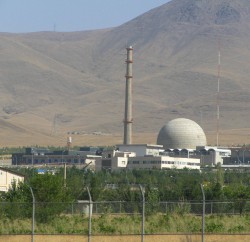
When Kennedy entered the White House in January 1961, the CIA had just concluded that the facility under construction in Dimona, with French assistance, was destined to become a nuclear reactor. U.S. intelligence had been one to two years behind the curve on the pace of Israel’s nuclear program, and Kennedy was worried. He had campaigned on a promise to stop proliferation. In his third debate with Richard Nixon, he had warned that “there are indications because of new inventions, that 10, 15, or 20 nations will have a nuclear capacity, including Red China, by the end of the Presidential office in 1964. This is extremely serious.” The CIA would soon list Israel right behind China as a potential proliferator.

In May 1961, just months after his inauguration, Kennedy raised the issue of Dimona with visiting Israeli Prime Minister David Ben-Gurion, and received a boilerplate assurance that the project had a peaceful purpose. Kennedy and his advisers continued to suspect otherwise, given the size of the plant. Israel allowed informal visits, but they were far from thorough, and in May 1963, Kennedy finally decided to press the issue and insist on regular inspections. He wrote a letter to Ben-Gurion (May 18), warning that an Israeli weapon would throw open the gates of proliferation everywhere:

We are concerned with the disturbing effects on world stability which would accompany the development of a nuclear weapons capability by Israel. I cannot imagine that the Arabs would refrain from turning to the Soviet Union for assistance if Israel were to develop a nuclear weapons capability—with all the consequences this would hold. But the problem is much larger than its impact on the Middle East. Development of a nuclear weapons capability by Israel would almost certainly lead other larger countries, that have so far refrained from such development, to feel that they must follow suit.

Then came the threat. Kennedy, noting the ways the United States had assisted Israel, warned Ben-Gurion that the U.S. commitment to his country “would be seriously jeopardized in the public opinion in this country and in the West as a whole if it should be thought that this Government was unable to obtain reliable information on a subject as vital to peace as the question of the character of Israel’s efforts in the nuclear field.” Years later, Yuval Ne’eman, the physicist who helped Ben-Gurion write his replies, told a journalist that “Kennedy was writing like a bully. It was brutal.” Kennedy’s “Scylla and Charybdis-like letter,” writes Zaki Shalom, “made it absolutely clear that he wanted Israel to accede to his demands unconditionally and immediately, and a request of this sort from the pinnacle of American power, in language so blunt, left Israel no space for maneuvering.”

Within a month, Ben-Gurion had resigned. He had already been weakened politically, but there has long been a suspicion that Kennedy’s pressure contributed to his decision. (Ne’eman believed it was the main cause.) Kennedy did not relent, and after allowing Levi Eshkol ten days to settle in as new prime minister, he reissued his threat (July 5). Kennedy demanded of Eshkol that the United States be allowed to conduct visits

as nearly as possible in accord with international standards, thereby resolving all doubts as the the peaceful intent of the Dimona project…. As I wrote Mr. Ben-Gurion, this Goverment’s commitment to and support of Israel could be seriously jeopardized if it should be thought that we were unable to obtain reliable information on a subject as vital to peace as the question of Israel’s effort in the nuclear field….. It would be essential… that our scientist have access to all areas of the Dimona site and to any related part of the complex, such as fuel fabrication facilities or plutonium separation plant, and that sufficient time be allotted for a thorough examination.

Avner Cohen writes of this letter: “Not since President Eisenhower’s message to Ben-Gurion, in the midst of the Suez crisis in November 1956, had an American president been so blunt with an Israeli prime minister…. Since the United States had not been involved in the building of Dimona and no international law or agreement had been violated, Kennedy’s demands were unprecedented. They amounted, in effect, to an ultimatum.” Israeli journalist Michael Karpin writes that “no American president had ever threatened an Israeli prime minister so bluntly during political negotiations in time of peace.”

Inevitably, Eshkol agreed to the inspections. He had little choice; to borrow Halevy’s words, he had been “strong-armed.” But the change in administration following Kennedy’s assassination in November created a gap that Israel exploited. During the course of the 1960s, Israel succeeded in turning the U.S. “inspections” of Dimona into hurried affairs scheduled well in advance. Parts of the facility were concealed from American scrutiny. By 1968, the CIA had concluded that Israel had built a bomb. It was Richard Nixon (a Republican) who finally sat down with Israeli Prime Minister Golda Meir on September 26, 1969, to finalize the U.S.-Israel understanding that exists to this day. Israel would keep its capabilities under wraps—nuclear “ambiguity” or “opacity”—and the United States would look the other way. The United States would not pressure Israel to sign the Non-Proliferation Treaty (NPT). Thus was born the Israeli exception to the American rule.

Why is this relevant now? The debate over Israel’s nuclear exception is about to be renewed in full vigor. Kennedy wrote to Ben-Gurion: “Development of a nuclear weapons capability by Israel would almost certainly lead other larger countries, that have so far refrained from such development, to feel that they must follow suit.” Now Iran is cast in the role of the “larger country,” and the idea of a nuclear-free zone in the Middle East is gaining momentum. Israel would be called upon to disarm, in exchange for Iran’s disavowal of its nuclear ambitions. Obama’s own vision of a “nuclear-free world,” articulated in 2009, is the context.

An American-supported “Middle East WMD-Free Zone Conference” (with the unpronounceable acronym MEWMDFZ) may or may not take place in December as scheduled. The head of Israel’s own nuclear energy agency has described the conference initiative as “futile,” and the meeting may be postponed. But as former Shin Bet head Ami Ayalon has said, “after the U.S. elections, this issue of the Middle East as a nuclear-free zone will be back on the table.” And Israel’s leading authorities on the subject believe that in light of Obama’s commitment to non-proliferation, Israel “might face new pressure from the administration down the line.”

I’m reasonably certain that Halevy knows the history. Perhaps as a former head of the Mossad, he’s barred from discussing it. That’s understandable, but it’s inexcusable to pretend that the battle over Dimona never happened, and to do so for a purpose—playing American partisan politics—that’s unseemly for a man in his position. I’m now immersed in teaching precisely this subject, and I detect no systemic difference in the approaches of Democratic and Republican presidents to Israel. But when it comes to “strong-arming” Israel on the “key national security issue” of its nuclear posture, the unsurpassed record is held by a Democrat.

If Iran Gets the Bomb

Michael J. Totten, probably the most widely read blogger on the Middle East, has just published an interview with me, conducted in September.

Iran

I sought out Martin Kramer in Jerusalem because I knew he would give me an analysis well outside-the-box on Iranian nuclear weapons. He’s a scholar, not a politician or pundit. And while he certainly has his opinions, he doesn’t conveniently fit into anyone’s ideological box.

I was not disappointed, and I don’t think you will be either. What he has to say is different from anything you’ve read from anyone in the media, including me.

MJT: I assume you read Jeffrey Goldberg’s article in The Atlantic this summer. He asked dozens of Israeli decision-makers and analysts if they think Israel will strike Iran’s nuclear weapons facilities, and the concensus seems to be that the odds are greater than fifty percent that it will happen before the middle of summer in 2011. What do you think?

Martin Kramer: It’s in Israel’s interest to convince the world that the decision-makers are leaning in that direction. The idea is to prompt somebody else to take action, in particular the Obama administration. So there’s a debate about whether or not Jeffrey has been spun.

MJT: Yes, and he mentioned that himself.

Martin Kramer: The whole purpose of spinning Jeffrey Goldberg—assuming that’s what happened—was to prod the United States into taking a more forward position. Americans are taking a forward position already, but the idea here would be to multiply the effect.

But I don’t know. I haven’t spoken to all the people Jeffrey talked to, and there are a lot of variables that we don’t know yet. The timeline is open to question. The intelligence is also being debated. So while I wouldn’t put a percentage on it, plans are definitely on the table. If the United States doesn’t act, the moment will come when a decision will have to be made. We don’t know what the arguments will be or in which ways the calculations will shift between now and then. Israel has the option, though, and it’s on the table. I wouldn’t say the odds are greater than fifty percent, but it’s a credible option.

MJT: What do you think Iran would actually do with a nuclear bomb?

Martin Kramer: The Iranians have a structural interest in creating doubt and uncertainty in the Persian Gulf. They have a larger population than any other Gulf state, and they don’t have the share of oil resources that Saudi Arabia has. So their first objective would be to create a climate of uncertainty.

Now, the Persian Gulf has been—since the United States took over from the British—a zone that is essentially under an American security umbrella. It is as crucial to American security as Lake Michigan. The United States doesn’t use most of the oil coming out of the Gulf, but its allies do, so the stability of the Gulf has been associated with a steady flow of oil and a price that moves within a predictable range.

Iran wants to create uncertainty there because oil is the only thing it has. Iran has nothing else—some carpets and pistachio nuts, and that’s it. Their population continues to grow, their needs continue to grow, and their grand ambitions continue to grow. So this, I think, is the first thing they would do with it. All it takes is to create a crisis or a succession of crises.

Iran knows it can’t wrest sole hegemony in the Gulf from the United States, but it wants to create a kind of dual hegemony shared with the United States. Nobody knows where the lines would run, but they wouldn’t run just five to ten miles off the coast of Iran into the waters of the Persian Gulf. Iran would like to see its share extend to both sides of the Gulf, to effectively create a kind of push and shove between the United States and Iran.

A lot of people on the Arab side of the Gulf will say they feel Iran’s breath on their faces. The United States is there now, but the British were there once, too, and now they’re gone. The Persians are always there and will always be there. So we’ll see a lot of hedging. Iran would be perceived as the rising power and the United States a declining power.

Don’t assume that in the Persian Gulf they don’t hear what we say about this. Obama was famously photographed holding a copy of Fareed Zakaria’s book The Post-American World during the election campaign. And don’t assume they don’t hear Americans talking about imperial overstretch.

MJT: You’re talking about the Arabs here.

Martin Kramer: Yes, the Arabs. And this creates a dynamic where if Iran also has nuclear weapons they will increasingly hedge. Things they allow Americans now—such as basing rights for operations in the Persian Gulf and beyond—will become more and more difficult to negotiate if Iran opposes them. So we would see an erosion of the American position in the Persian Gulf.

I think Iran is a lot less interested in justice for the Palestinians than in establishing their command over the gulf they call Persian.

MJT: We call it the Persian Gulf, too.

Martin Kramer: For reasons of geographic exactitude and custom. But Americans don’t mean it should be dominated by Iran.

MJT: Right.

Martin Kramer: The Iranians do. That’s the longer term objective. And like I said, they’re less interested in justice for the Palestinians than they are in this. They remind me a bit of Saddam Hussein. He said at one point that he would burn half of Israel, yet turned around and instead burned a lot of Kuwait. He wasn’t as interested in being admired by the Palestinians as he was about controlling resources. The Gulf is always very much a resource game. So that would be the first objective of the Iranians. But, of course, Iran also wants to wage proxy wars elsewhere.

MJT: They do have interests in the Levant [the Eastern Mediterranean].

Martin Kramer: They have interests in the Levant, but there’s nothing here that can solve their fundamental problems, which is the mismatch of population and resources. Their game in the Levant is to get around America’s flank. They see Israel as an extension of America, but it’s not their primary area of interest.

Obviously, though, they have an ideological interest here, and they’re willing to fight Israel to the last Lebanese Shiite, but it’s an open question how much they’d be willing to sacrifice themselves directly.

So that’s why I think Iranian nuclear weapons are a world problem as much as, or even more than, they are an Israeli problem.

MJT: The Persian Gulf is certainly more of a world problem than an Israeli problem.

Martin Kramer: Israel has to take it seriously, though. After listening to Iran’s discourse, Israel can’t rule out the possibility that even a small faction could get their finger on the trigger.

It’s a world problem, though, and the world has to ask itself if it can tolerate a nuclear-armed Iran deliberately creating uncertainty, instability, and doubt surrounding the great reservoir of the world’s energy. If a coalition ever comes together to stop Iran, this will be the reason.

MJT: What do you think will happen in the Levant if Iran builds a bomb? Will wars with Hezbollah and Hamas be more or less likely, and peace with the Palestinians more or less likely?

Martin Kramer: Those are two separate issues.

MJT: Yes, but they’ll both be affected.

Martin Kramer: Right. It will certainly create a situation where there would be an expectation among the supporters of Hezbollah and Hamas that Iran would act to come to their defense by using its nuclear capabilities to threaten Israel, but I’m not sure Iran wants to do that. We saw during the last Lebanon war that the timing of the crisis was not to Iran’s liking. The Iranians would not have chosen the summer of 2006 to have Hezbollah in a crisis with Israel.

MJT: They were angry about it.

Martin Kramer: They view the Levant as an arena that can be integrated into their larger strategy, not so they can support a strategy that has been independently formulated by Hezbollah. Hezbollah doesn’t deliberately formulate an independent strategy, but Hamas certainly does.

If Iran decides to take the route that Israel and Japan have taken—either nuclear ambiguity or being one screw away from having a bomb—it would be less subject to moral extortion by the extremists in the Levant who would act unilaterally and expect Iran to come to their aid. So an ambiguous scenario wouldn’t increase the possibility of warfare, but if Iran becomes an explicit and open nuclear state, that’s a different story. Even the United States and the Soviet Union went on nuclear alert over an Arab-Israeli war [in 1973]. But you never know. Knowing in advance that it could lead to that kind of escalation, there might be mechanisms which would kick into action before things reached that level.

I do think a nuclear Iran creates a dynamic where Israel, from a strategic point of view, is compelled to keep a tight grip on Jerusalem and a large swath of the West Bank for the simple reason that it creates a deterrent to an Iranian attack. If all our strategic assets are concentrated on the coastal plain around Tel Aviv, we’re vulnerable. An Iranian ayatollah, Rafsanjani, has already noted that Israel is vulnerable to one strike. So how to we change that calculation?

A big country like the United States disperses its assets across a vast continent when facing nuclear adversaries. A small state can’t do that. But within this small state is a prime Muslim holy place, the liberation of which is championed by the Iranians, and it’s in Jerusalem.

So if Israel faces a real nuclear adversary that threatens its destruction and has Islamic fervor as the basis of its ideology—one that holds up Jerusalem as a symbol—it will make all the sense in the world to concentrate every strategic asset it can right next to it.

The Israeli leadership has built a duplicate command center in Jerusalem exactly like the one it has in Tel Aviv in the Ministry of Defense. So why stop at the top brass and the political leadership if you know that over the long term we’ll face a hostile nuclear adversary? It makes sense to load up Jerusalem with strategic assets which would themselves serve as a deterrent to a future exchange. And it’s a lot easier to do than position submarines in the Persian Gulf or the Indian Ocean.

So the long term effect would be to make Jerusalem central to Israel not only for political and cultural reasons, but also for strategic reasons. That doesn’t mean all kinds of arrangements can’t be made on the ground between Israelis and Palestinians about the day-to-day running of the city.

In the past, Israel was concerned about holding the Jordan Valley as its eastern front against an invading conventional army. In a nuclear scenario Jerusalem itself would become crucial to preventing an adversary from striking a decisive blow which would render it no longer viable as a state. The idea is to persuade that adversary that even if there is a strike against Israel’s concentration of population, Israel will still remain viable.

MJT: It sounds, though, like this would make resolving the conflict with the Palestinians much more difficult.

Martin Kramer: Yes.

MJT: I figured we’d agree, but can you explain why you think that’s the case?

Martin Kramer: If there’s a shift of Israel’s assets from Tel Aviv to Jerusalem, the struggle over real estate up here becomes even more acute. There will be less leeway for Israeli concessions. Concessions are difficult to make in any case. Local security issues can be, in one way or another, finessed, but once they play out in this mega arena of confrontation between nuclear states, flexibility diminishes quickly. It would create tremendous pressure on Israel to maintain its right to decide the future of different pieces of turf close to the city.

In the past we had the idea that in order for Israel to remain viable we had to settle the Negev Desert and the Galilee because they have large Arab populations. That was never for religious reasons, it was always for strategic reasons. A nuclear Iran would create strategic calculations for Jerusalem that weren’t there before. There were always other strategic calculations for Jerusalem, but this would create a powerful new one. What would the Israelis and Palestinians discuss at the table once that became a factor?

Linkage is a big issue, but there’s a debate over which way linkage runs. Some say a resolution to the Israeli-Palestinian conflict would make it much easier for the United States to deal with Iran. But I think the absence of a solution to the Iranian nuclear dilemma places a high premium on Israel holding if not the totality of the occupied territories, at least a sizable bit of real estate around Jerusalem as a strategic reserve.

I say this as someone who has always believed there would be some way to compromise over Jerusalem, but when I see the prospect of a nuclear Iran on the horizon threatening Israel, I say to myself that I want as many of Israel’s strategic, demographic, industrial, and technological assets in and around the city as possible.

MJT: So what do you say to people who prioritize the Israeli-Palestinian conflict over Iranian nuclear weapons?

Martin Kramer: I’d like to know more about how this is supposed to affect Iran’s calculations. I don’t think it will. I think they decided long ago that they want to have a hegemonic role enhanced by nuclear capability. A resolution of the conflict here wouldn’t deter them or persuade them from that ambition. On the contrary, they would believe that Israel would grow stronger and would be even more of a threat than it is today. They’re going to pursue this track no matter what.

The theory is that a resolution to the conflict would make it easier to mobilize Arab support.

MJT: Right.

Martin Kramer: But how much Arab support does the United States need that it doesn’t already have? Support from the Gulf Arabs is already guaranteed. They see Iran as a threat directed more at them than at anyone else.

MJT: They do.

Martin Kramer: The Arabs who could conceivably be swayed are the Arabs of Egypt and the Levant, but it’s difficult to envision a solution to the Israeli-Palestinian conflict that would satisfy all of them. Quite a few formulas will alienate lots of them.

And the question is: are they really necessary? Is it that important to have the so-called Arab street? It’s extremely difficult to turn the Arab street into a strategic asset. Nasser tried to do it. Saddam Hussein tried to do it. Ahmadinejad is trying to do it. Erdogan is trying to do it. It’s flattering, I suppose, to have your poster on walls here and there, but nobody has found a way to turn that into something they can use, and I don’t think the United States has much prospect of doing so either. It’s an intangible.

A nuclear Iran, on the other hand, would be tangible. So I think linkage, in fact, runs the other way.

The Israeli-Palestinian conflict only has a chance of being resolved if the Levant can be disconnected from the Gulf. So we have to deal with the Iranian issue first.

Look at the history of the Middle East since the creation of Israel to the present. We have had two separate periods. The first lasted from 1948 until the late 1970s. During this period we had a war between Israel and the Arabs every decade. The Gulf region was stable. The British were there. There was always a concern that the conflict between Israel and the Arabs might create a ripple effect in the Gulf, and it finally happened in 1973 when they cut off the oil.

Then the United States changed its policy. The Americans said they were going to support Israel so staunchly that the Arabs would despair of ever achieving victory and would therefore have no choice but to sign peace agreements. And that’s what happened.

Since 1973 there has been no state-to-state war in the Levant. We’ve had intifadas, we’ve had wars between Israel and non-state actors, but we haven’t had the devastation of a state-to-state war. And the oil hasn’t been shut off since then. The oil only gets cut off as an act of solidarity between states, not as an act of solidarity with the PLO, Hamas, or Hezbollah.

So we now have an architecture that works in the Levant, but the Gulf has experienced a succession of wars. The Gulf now destabilizes the region. It has seen the Iran-Iraq war, the Iraqi invasion of Kuwait, the latest Iraq war, and who knows what’s to come. And we’ve seen that the instability in the Persian Gulf region has a ripple effect in the Levant. It goes the other way now, and it’s a consequence of the Iranian Revolution in 1979.

Israel is the stake that has been planted in the Levant. Because it’s powerful, it puts a high premium on rationality among all those who surround it. It serves as the basis for the security architecture.

When the British left the Gulf in the early 1970s, the Americans weren’t in a position to pick it up because they were busy in Vietnam. They had their dual pillars in the Gulf, Iran and Saudi Arabia, but one of them collapsed in 1979. And since that collapse, there has been no equivalent of Israel in the Gulf which the United States could use as a fulcrum around which to organize a region. So the pillar of stability has been the American deployment of its own forces again and again and again. They’ve put millions of boots on the ground, and it’s still not enough.

So here in the Levant we’re feeling the wash from the long-term destabilization of the Gulf. It is America’s primary interest to keep these as two separate regions. The regional hegemon needs to make sure there is no cross-contamination between them.

The regions used to be separate. During the British time, the Levant was run from London and the Persian Gulf from India. The Levant was called the Near East, and the Gulf was called the Middle East. These were two distinct zones. We’ve conflated them in the meantime, and it’s in the interest of the United States to disaggregate them again and to keep them disaggregated. Any attempt to project power from one into the other undermines the position of the regional hegemon. That was true when Saddam Hussein fired missiles at Israel, and it’s true when Iran sends missiles to Hezbollah. It’s always the radicals who do the bridging. The same was true with Nasser.

And it compels others to do the same. If Israel acts over the head of the United States against Iran, it will be just the latest example. It’s something the United States can’t afford. It means that every time we have a problem in the Levant, it will create problems for the United States in the Gulf, and vice versa.

MJT: How can the United States drive a wedge between the two regions?

Martin Kramer: That’s easy. The U.S. just has to say that it supports its Israeli ally to keep order in its arena, and the U.S. will take responsibility for keeping order in its arena. Just effectively divide responsibility. If the U.S. flags in its resolve to do that, it will be under pressure from those who are tempted to act outside their arena.

My friend Steve Rosen at Harvard once said it would be shameful if the United States were to leave it to Israel to do what it should do in the Gulf. The Persian Gulf is an area of world interest where America plays the guarantor role.

If Israel has to act as the guarantor in the Gulf, it will be a sign that America has dodged its responsibility.

MJT: The Gulf Arab states are not-so quietly hoping Israel will do it if the U.S. does not.

Martin Kramer: They’re looking for someone, anyone, to do it.

MJT: They’re the ones who should be the most worried. We don’t hear much about this from the Arab states in North Africa. They don’t have as many reasons to be concerned.

Martin Kramer: That’s a separate area altogether.

MJT: Egypt is sort of a bridge, though, isn’t it? Cairo sides to a certain extent with Israel against Hamas, and we know Mubarak isn’t thrilled about what’s happening in Tehran.

Martin Kramer: The main problem with Egypt is that its own regional role has been so much diminished. Not only can Egypt no longer project power beyond its borders as it did in Nasser’s days, it can barely control events inside its national borders as we’ve seen in the Sinai. Egypt clearly resents the rise of Iranian power. They don’t necessarily trust anyone as a counterweight. Their approach all along has been that they don’t want a nuclear Iran, but that the way to go about it is to de-nuclearize Israel as part of a grand bargain. They would achieve two goals at once. Both Iran and Israel would be cut down a peg.

MJT: Do you think that’s their sincere approach? Egyptian officials will say this in public, but what do they really think?

Martin Kramer: I think there’s no question they’d like the United States to play the role. They’d much rather have the U.S. take the lead than Israel. They know what everyone knows—the United States would do it much more effectively.

MJT: Of course.

Martin Kramer: There would be nothing worse than a botched or half-complete operation. There’s a very strong preference that the U.S. take care of this, among the Gulf Arabs and the Egyptians.

MJT: And, of course, among the Israelis.

Martin Kramer: It’s absolutely central to the strategy to maintain this division. And the only way to maintain it is for the United States to demonstrate tomorrow that it will not allow Iran to acquire nuclear weapons or to allow Israel to act unilaterally. The Gulf is a zone of American dominance, and the only way to assert that is to do what Carter did with the Carter Doctrine, when the Soviet Union invaded Afghanistan. He said there should be no outside power or local power that is allowed to challenge the United States in the Gulf. And a nuclear Iran clearly crosses that line.

If even Jimmy Carter was compelled to issue a doctrinal statement in the wake of the Soviet invasion of Afghanistan about the Persian Gulf, one would think that Barack Obama would see the need to do something similar. Obama should especially feel compelled to do so because there’s a question mark there. He should declare the Persian Gulf a nuclear-free zone. It’s too much to talk about the Middle East as a nuclear-free zone at this time, but the Persian Gulf is nuclear-free now, and it’s time for the United States to come out and say it should remain nuclear-free.

MJT: I have a hard time imaging Obama doing anything of the sort.

Martin Kramer: Yeah. Well.

MJT: But I suppose one never knows.

Martin Kramer: It would be an astonishing lapse if a man who promised to roll back nuclear proliferation watched proliferation develop in one of the least stable parts of the world, a place where the United States has only been able to maintain even a modicum of stability by a massive projection of its own forces. The region is of prime interest to the entire world for its energy resources. If it becomes nuclearized, it will be the one thing for which Barack Obama would always be remembered by history, and he would be remembered by history as a failure.