The day the Mufti died

Fifty years ago, on July 4, 1974, Hajj Amin al-Husayni, the “Grand Mufti” of Jerusalem, passed away in Beirut, Lebanon, at the American University Hospital. At age 79, he died of natural causes. The Mufti had faded from the headlines a decade earlier. In 1961, his name had resurfaced numerous times during the Jerusalem trial of Adolf Eichmann. But a couple of years later, the Palestinian cause gained a new face in Yasser Arafat. With that, the Mufti entered his final eclipse.

When he died, the Supreme Muslim Council in Jerusalem asked the Israeli authorities for permission to bury him in the city. Israel refused the request. Any Palestinian who wanted to attend the funeral in Lebanon would be allowed to do so, but the Mufti of Jerusalem would not be buried in Jerusalem. Instead, the Mufti was laid to rest in the Palestinian “Martyrs’ Cemetery” in Beirut.

The Mufti was appointed to his position by the British in 1921. Within the British Empire, authorities preferred to work through “native” institutions, even if they had to create them on the fly. So they established a supreme council for Palestine’s Muslims and placed the Mufti at its helm. Although he lacked religious qualifications, he came from a leading family and appeared capable of striking deals.

In fact, he used his position to oppose the Jewish “National Home” policy of the Mandate. The “Arab Revolt” of 1936 finally convinced the British that he had to go, and in 1937 he fled the country.

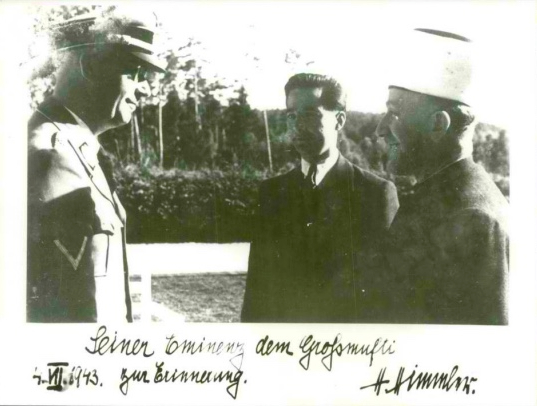
After a period in Lebanon, he ended up in Iraq, where he helped foment a coup against the pro-British regime. When British forces suppressed the coup, he fled again, making his way through Tehran and Rome to Berlin. There, the Nazi regime used him to stir up Arabs and Muslims against the Allies. He was photographed with Hitler and Himmler, recruited Muslims to fight for the Axis, and attempted to secure promises of independence for colonized Arabs and Muslims. None of his efforts met with much success. His role, if any, in the Holocaust is a contested matter. Hitler and his henchmen hardly needed any prompting to execute their genocidal plans. Clearly, though, the Mufti rooted for Jewish destruction from the fifty-yard line.

After the Nazi collapse, he fell into French hands, and spent a year in comfortable house detention near Paris. Later, he fled to Egypt and subsequently moved in and out of Syria and Lebanon. Following the Arab debacle of 1948, Egypt established an “All Palestine Government” in the refugee-choked Gaza Strip, leaving the presidency open for the Mufti. It didn’t last long. He continued to maneuver through Arab politics, but he was yesterday’s man to a new generation of Palestinians born in exile. During the Eichmann trial, the prosecution sought to implicate the Mufti as an accomplice. Yet the Mossad never came after him, and he didn’t die a martyr’s death.

Man without a country

The Mufti was a formidable politician. In 1951, a State Department-CIA profile of him opened with this evocative enumeration of his many talents, which is worth quoting at length:

King of no country, having no army, exiled, forever poised for flight from one country to another in disguise, he has survived because of his remarkable ability to play the British against the French, the French against the British, and the Americans against both; and also because he has become a symbol among the Arabs for defending them against the Zionists. His suave penchant for intrigue, his delicate manipulation of one Arab faction against another, combined with the popularity of his slogan of a united Muslim world, has made him a symbol and a force in the Middle East that is difficult to cope with and well nigh impossible to destroy. The names of Machiavelli, Richelieu, and Metternich come to mind to describe him, yet none of these apply. Alone, without a state, he plays an international game on behalf of his fellow Muslims. That they are ungrateful, unprepared, and divided by complex and innumerable schisms, does not deter him from his dream.

Profilers would later write similar things about Arafat, but the Mufti had none of Arafat’s cultivated dishevelment. He was manicured, even chic:

The Mufti is a man of striking appearance. Vigorous, erect, and proud, like a number of Palestinian Arabs he has pink-white skin and blue eyes. His hair and beard, formerly a foxy red, is now grey. He always wears an ankle length black robe and a tarbush wound with a spotless turban. Part of his charm lies in his deep Oriental courtesy; he sees a visitor not only to the door, but to the gate as well, and speeds him on his way with blessings. Another of his assets is his well-modulated voice and his cultured Arabic vocabulary. He can both preach and argue effectively, and is well versed in all the problems of Islam and Arab nationalism. His mystical devotion to his cause, which is indivisibly bound up with his personal and family aggrandizement, has been unflagging, and he has never deviated from his theme. For his numerous illiterate followers, such political consistency and simplicity has its advantages. The Mufti has always known well how to exploit Muslim hatred of ‘infidel’ rule.

So why did the Mufti fade into obscurity? (By 1951, he was on his way out.) Many mistakenly believe his collaboration with Hitler and the Nazis discredited him. It didn’t. Not only did the Arabs not care, but Western governments eyed the Mufti with self-interest. The general view in foreign ministries held that he had picked the wrong side in the war, but not more than that.

The above-quoted American report expressed this view perfectly: “While the Zionists consider him slightly worse than Mephistopheles and have used him as a symbol of Nazism, this is false. He cared nothing about Nazism and did not work well with Germans. He regarded them merely as instruments to be used for his own aims.” If so, why not open a discreet line to him and let him roam the world unimpeded?

Nakba stigma

What finally discredited the Mufti in Arab opinion, where it mattered most, was his role in the 1948 war. It was a war he wanted and believed his side would win. In late 1947, the British sent someone to see if there might be some behind-the-scenes flexibility in his stance on partition, which he had completely rejected. There wasn’t. He explained:

As regards the withdrawal of British troops from Palestine, we would not mind. We do not fear the Jews, their Stern, Irgun, Haganah. We might lose at first. We would have many losses, but in the end we must win. Remember Mussolini, who talked of 8,000,000 bayonets, who bluffed the world that he had turned the macaronis back into Romans. For 21 years he made this bluff, and what happened when his Romans were put to the test? They crumbled into nothing. So with the Zionists. They will eventually crumble into nothing, and we do not fear the result, unless of course Britain or America or some other Great Power intervenes. Even then we shall fight and the Arab world will be perpetually hostile. Nor do we want you to substitute American or United Nations troops for the British. That would be even worse. We want no foreign troops. Leave us to fight it out ourselves.

This underestimation of the Zionists proved disastrous, even more so than his overestimation of the Axis. He later wrote his memoirs, blaming “imperialist” intervention, Arab internal divisions, and world Zionist mind-control for the 1948 defeat. To no avail: his name became inseparable from the Nakba, the loss of Arab Palestine to the Jews. His reputation hit rock bottom, along with that of the other failed Arab rulers of 1948.

Upon his death in 1974, he received a grand sendoff in Beirut from the PLO, Arafat presiding. In 1970, Arafat had transferred the PLO headquarters from Jordan to Lebanon, and the funeral finalized his status as the sole leader of the Palestinian people. Four months later, Arafat addressed the world from the podium of the UN General Assembly, achieving an international legitimacy that the Mufti could never have imagined.

The PLO then dropped the Mufti from the Palestinian narrative; nothing bears his name. Even Hamas, which inherited his uncompromising rigidity and Jew-hatred, doesn’t include him in their pantheon. (Their man is Izz al-Din al-Qassam, a firebrand “martyr” killed by the British in 1935.)

If anyone still dwells on the Mufti, it’s the Israelis, including their current prime minister, who find him useful as a supposed link between the Palestinian cause and Nazism. One can understand Palestinians who push back on this; the Mufti was no Eichmann. But that doesn’t excuse Palestinian reluctance to wrestle candidly with the Mufti’s legacy. He personified the refusal to see Israel as it is and an unwillingness to imagine a compromise. Until Palestinians exorcise his ghost, it will continue to haunt them.

Highlights from the funeral of the Mufti. Yasser Arafat appears in his trademark keffiyeh.

Header image: “To His Eminence the Grand Mufti as a memento. H. Himmler. July 4, 1943.” Israel State Archives.
MLK: The Six-Day War interview

As happens each year on Martin Luther King Day, King is quoted to justify this or that position in the present. Many haven’t waited for today, and he’s been fully mobilized since October 7 by supporters of Israel and the Palestinians, who claim to know what he would say now if he hadn’t been assassinated then, fifty-six years ago.

My work on King’s views is often cited, because I did the most thorough study of the subject, from a wide range of sources. If you’re interested, you can follow this link to read all my contributions.

This year, I want to introduce a text that I quoted years ago: an interview of King on ABC’s news program Issues and Answers, June 18, 1967. King, asked whether Israel should return the territory it had taken earlier that month, said this: “I think that for the ultimate peace and security of the situation it will probably be necessary for Israel to give up this conquered territory because to hold on to it will only exacerbate the tensions and deepen the bitterness of the Arabs.”

The Israel-Hamas war has led some to seize upon this quote, and insist that King stood up for Palestinian rights. Garrison Hayes, a reporter for Mother Jones, suggested as much in November. “We don’t have to imagine what King thought about Israel’s relationship with the Palestinian people,” he wrote. “He spoke for himself.” Hayes then highlighted the ABC quote. I corresponded with Hayes before and after he published his piece, and I don’t doubt his sincerity. But I think he’s put an impossible burden on the quote.

“What are your views?”

To understand why, you have to read the whole exchange, which you won’t find today anywhere on the internet. The interviewers were Tom Jarriel (ABC Atlanta bureau chief) and John Casserly (ABC Washington correspondent). The questions about the Middle East followed a discussion of the Vietnam war.

Q: Let’s go to the other war for a moment, Dr. King. What are your views as a Nobel Peace Prize winner on the complex situation in the Middle East?

MLK: Well, it is certainly a very complex situation. I think first that we must work passionately and unrelentingly through the United Nations to try to grapple with this years-old problem in the Middle East. I would hope that the Middle East will not become an arena for power politics, whether we refer to Soviet Russia here, or the United States of America. We have got to achieve peace in the Middle East and in the Middle East achieving peace means two things.

Peace for Israel means security. The world and all people of good will must respect the territorial integrity of Israel. We must see Israel’s right to exist and always go out of the way to protect that right to exist. We must also see that Israel is there and any talk of driving the Jews into the Mediterranean, as we have heard over the last few weeks or the last several years, is not only unrealistic talk but it is suicidal talk for the whole world and I think also it is terribly immoral. We must see what Israel has done for the world. It is a marvelous demonstration of what people together in unity and with determination, rugged determination, can do in transforming almost a desert into an oasis.

But the other side is this, that peace in the Middle East means something else. It means for the Arabs development. After all the Arab world is that third world, a part of that third world of poverty and illiteracy and disease and it is time now to have a Marshall Plan for the Middle East. I think this is going to be finally the only answer. So long as people are poor, so long as they find themselves on the outskirts of hope, they are going to make intemperate remarks. They are going to keep the war psychosis alive. And what we need to do now is to go all out to develop the underdeveloped, and we must see that there is a grave refugee problem that the Arabs have on their hands and the United Nations through all of the nations of the world must grapple very constructively and forthrightly with these problems.

Q:  Should Israel in your opinion give back the land she has taken in conflict without certain guarantees, such as security?

MLK: Well, I think these guarantees should all be worked out by the United Nations. I would hope that all of the nations, and particularly the Soviet Union and the United States, and I would say France and Great Britain, these four powers can really determine how that situation is going.

I think the Israelis will have to have access to the Gulf of Aqaba. I mean the very survival of Israel may well depend on access to not only the Suez Canal, but the Gulf and the Strait of Tiran. These things are very important. But I think for the ultimate peace and security of the situation it will probably be necessary for Israel to give up this conquered territory because to hold on to it will only exacerbate the tensions and deepen the bitterness of the Arabs.

Q: But Israel indicates, Dr. King, that for its own security it should keep certain territory, particularly in Syria, the approaches to Israel, in order to maintain its own security.

MLK: Well, there again I am putting my hope in the United Nations. And I know the United Nations will not be effective if these major powers will not cooperate with it, so I am hoping that they will cooperate with it and that the UN itself will place a peacekeeping force there, so that neither of these forces, whether it is the Israeli forces or the Arab forces, will continue to engage in these brutal battles. And the other thing, I think there is a great need for greater disarmament, not only in the Middle East but all over the world.

The first striking thing about this exchange is King’s exquisite care in formulating his answers. He knew that every word carried meaning in the charged moment, and he carefully crafted a response. As I showed elsewhere, those who now claim that King didn’t know enough about the conflict miss the mark. He had an informed and nuanced grasp of all its aspects.

Second, King’s position on Israel is forthright: “Peace for Israel means security.” Not only did he praise “marvelous” Israel, he defended Israel’s “territorial integrity” and its “right to exist,” while rejecting the “unrealistic,” “suicidal,” and “terribly immoral” call to destroy it.

The third striking thing, from today’s perspective, is that he didn’t mention the Palestinians. That’s because in 1967, the Palestinians weren’t an independent party to the war. The territories occupied by Israel in 1967 belonged to Egypt (Sinai and Egyptian-administered Gaza), Syria (the Golan Heights), and Jordan (the West Bank and East Jerusalem). At the time, all proposals for Israeli return of territories meant giving them back to these states. King specifically emphasized the conditions for Israel’s return of the Sinai to Nasser’s Egypt, Egypt being the leading Arab state and Israel’s primary enemy.

Palestinians, however, had a different demand. For nearly twenty years, they had insisted on their return to Israel proper, from which they’d departed as refugees in 1948. King avoided saying anything that could be construed as endorsing that “right.” He acknowledged that there was a “grave refugee problem,” but the solution lay in economic development, promoted by “the United Nations through all of the nations.” (Later, in September, he alluded to the Palestinian demand as “a stubborn effort to reverse history.”)

So it’s rather misleading to state that the ABC interview reveals “what King thought about Israel’s relationship with the Palestinian people,” or that “King said that Israel should return Palestinian lands.” Neither then nor at any time did he speak of “the Palestinian people,” but only of “refugees.” Nor did he ever use the term “Palestinian lands.” King spoke of Israel “probably” returning territories taken from Egypt, Jordan, and Syria earlier that month, with international guarantees for Israel, as a pragmatic measure to alleviate “tensions” and “bitterness.”

A blind eye?

King was right: 1967 “deepened[ed] the bitterness of the Arabs” of all nationalities. But as he knew (from visiting Beirut, East Jerusalem and Cairo in 1959), they were bitter before that. To make peace, they too would have to change. That’s where he’s fallen short in the eyes of Palestinians. A prime example was the Palestinian thinker Edward Said, who said this in a 1993 interview:

With the emergence of the civil rights movement in the middle ’60s—and particularly in ’66-’67—I was very soon turned off by Martin Luther King, who revealed himself to be a tremendous Zionist, and who always used to speak very warmly in support of Israel, particularly in ’67, after the war.

Said’s nephew, the historian-activist Ussama Makdisi, put it more bluntly: King “turned a blind eye to the plight of the Palestinians.” These formulas do sound bitter, but I can see why Palestinian activists like Said and Makdisi would make them.

In any case, much has happened since 1967, and it’s idle to speculate what King would say today. It’s not unreasonable to take some inspiration from his words, and draw contemporary conclusions based on a personal understanding of them. That’s why the wall behind his monument in Washington is etched with quotes. We’re invited to read them as points of departure for thinking about the present.

But it’s quite another thing to put words in King’s mouth. And there’s one word he never uttered: “Palestinian.” We will have to get through the present crisis without his specific guidance.

Header image created by DALL-E, OpenAI’s image generation model.

The Nazi case for Hamas

Rashid Khalidi, the Edward Said Professor at Columbia University, is no fool. He started out as a spokesperson for the PLO in Beirut in the 1970s, and he’s been at it ever since. A New Yorker by birth, he knows something about perceptions of the conflict in America. And he knows that terrorism has set back the Palestinian cause time and again. That’s why he’s spent much of his career trying to anesthetize America to terrorism, divert attention from it, or minimize it. The horrific massacre of Israeli men, women, and children committed by Hamas on October 7 has made his mission much harder. “The current sentiment,” he told an Arab interviewer (in Arabic),
politically, popularly, and in the media, is overwhelmingly negative. This contrasts sharply with the past decade, which saw growing support for Palestinian political rights and strong opposition to Israeli policies…. They’re capitalizing on the deaths of Israeli civilians during the Al-Aqsa Storm operation…. Having lived in the U.S., particularly New York, for over half my life, I’ve never seen such an onslaught of lies and crude propaganda that are actually making an impact.
Khalidi recommends a number of talking points to his followers. He’s dropped some in reaction to new and awful evidence, but one remains constant. Here is how Khalidi has made it, on two separate occasions:
There are ways of making war, which advanced technological societies employ, which involve the killing of huge numbers of civilians, who are never somehow counted in the calculus. Oh, that’s collateral damage. Oh, we didn’t mean to do it. If a pilot does it from 1,000 feet, and kills fifty people, or some somebody with a gun comes in and murders fifty people, there is a difference, obviously, but in the last analysis, if this is a violation of the rules of war on the one hand, it’s a violation of the rules of war on the other hand… One kind of killing of civilians—only that kind—is called terrorism and another kind of systematic killing of civilians, with much higher death counts, is simply ignored.
And here, another formulation of the same talking point:
Israeli lives should be considered civilian lives, should be considered important, obviously. Any civilian death should be mourned. But all people are supposedly equal…. The 900 or 1,000 Israeli civilians who died starting on the seventh of October, are now matched by a mountain of two or three times—it will soon be four times—as many Palestinians, again, like the Israelis, innocent civilians…. The rest of the world… do[es] not see the difference between Hamas or other militants coming out of Gaza killing civilians, and Israeli pilots, or Israeli gunners, or Israeli gunboats killing civilians. Killing civilians is killing civilians, especially in these numbers…. The world sees that, even as the American and European… media, which seem to move in lockstep with their governments, may distort this.
This talking point has become standard in many attempts to “contextualize” October 7. Queen Rania of Jordan made it in abbreviated form in a television interview seen by millions: “Are we being told that it is wrong to kill a family, an entire family at gunpoint but it’s OK to shell them to death? I mean, there is a glaring double standard here. And it is just shocking to the Arab world.” Embed from Getty Images

The ‘Dresden defense’

I am a historian (like Khalidi), interested in the origins of ideas and arguments. It turns out that Khalidi’s premier talking point has a very specific genesis. It figured in the case for the defense in the Einsatzgruppen Trial, conducted by the Nuremberg Military Tribunal from late 1947 to the spring of 1948. The Einsatzgruppen were the paramilitary death squads of Nazi Germany, which carried out mass murder by shooting in Nazi-occupied Europe. They destroyed well over a million Jews, and two million people all told. After the war, their surviving senior commanders were put on trial at Nuremberg, charged with crimes against humanity and war crimes. The chief defendant, SS-Gruppenführer Otto Ohlendorf, had been commander of Einsatzgruppe D, which carried out mass murders in Moldova, southern Ukraine, and the Caucasus. An economist and father of five, he had supervised the killing of 90,000 Jews. Ohlendorf imagined that he had a moral conscience. The killers under his command, he told a U.S. Army prosecutor, were prohibited from using infants for target practice, or smashing their heads against trees. Embed from Getty Images During trial testimony, the prosecutor pressed Ohlendorf: “You were going out to shoot down defenseless people. Now, didn’t the question of the morality of that enter your mind?” Ohlendorf referred to the Allied bombings of Germany as a context:
I am not in a position to isolate this occurrence from the occurrences of 1943, 1944, and 1945 where with my own hands I took children and women out of the burning asphalt myself, and with my own hands I took big blocks of stone from the stomachs of pregnant women; and with my own eyes I saw 60,000 people die within 24 hours.
A judge immediately pointed out that his own killing spree preceded those bombings. But this would become known as the “Dresden defense,” to which Ohlendorf resorted still another time, in this exchange:
Ohlendorf: I have seen very many children killed in this war through air attacks, for the security of other nations, and orders were carried out to bomb, no matter whether many children were killed or not. Q: Now, I think we are getting somewhere, Mr. Ohlendorf. You saw German children killed by Allied bombers and that is what you are referring to? Ohlendorf: Yes, I have seen it. Q: Do you attempt to draw a moral comparison between the bomber who drops bombs hoping that it will not kill children and yourself who shot children deliberately? Is that a fair moral comparison ? Ohlendorf: I cannot imagine that those planes which systematically covered a city that was a fortified city, square meter for square meter, with incendiaries and explosive bombs and again with phosphorus bombs, and this done from block to block, and then as I have seen it in Dresden likewise the squares where the civilian population had fled to—that these men could possibly hope not to kill any civilian population, and no children.
Ohlendorf thought this defense so powerful that he invoked it yet another time:
The fact that individual men killed civilians face to face is looked upon as terrible and is pictured as specially gruesome because the order was clearly given to kill these people; but I cannot morally evaluate a deed any better, a deed which makes it possible, by pushing a button, to kill a much larger number of civilians, men, women, and children.
(The chief prosecutor, an American, called this particular iteration “exactly what a fanatical pseudo-intellectual SS-man might well believe.”) At Nuremberg, this sort of tu quoque defense (“I shouldn’t be punished because they did it too”) wasn’t admissible. Still, in the verdict of the Einsatzgruppen Trial, the judges chose to refute it. “It was submitted,” the judges wrote, “that the defendants must be exonerated from the charge of killing civilian populations since every Allied nation brought about the death of noncombatants through the instrumentality of bombing.” The judges would have none of it:
A city is bombed for tactical purposes… it inevitably happens that nonmilitary persons are killed. This is an incident, a grave incident to be sure, but an unavoidable corollary of battle action. The civilians are not individualized. The bomb falls, it is aimed at the railroad yards, houses along the tracks are hit and many of their occupants killed. But that is entirely different, both in fact and in law, from an armed force marching up to these same railroad tracks, entering those houses abutting thereon, dragging out the men, women and children and shooting them.
The tribunal sentenced Ohlendorf to death. He was hanged in June 1951.

“In the last analysis”

Nuremberg enforced a fundamental distinction. All civilian lives are equal, but not so all ways of taking them. The deliberate and purposeful killing of civilians is a crime; not so the taking of civilian lives that is undesired, unintended, but unavoidable. The errors made by a bomber squadron cannot be deducted from the murders committed by a death squad. It’s a difference compounded many times over when those civilian men, women, and children are subjected to torture, rape, and mutilation before their murder. To borrow Khalidi’s phrase, “in the last analysis,” this distinction is what separates modern civilization from its predecessors. More disturbing is the thought that it separates the contemporary West from its peers. Otto Ohlendorf and the regime he served did all they could to conceal their deeds from Western eyes. Nazi Germany still operated in a West founded on Enlightenment values. So massive a violation of a shared patrimony needed to be hidden from view. In contrast, Hamas initially sought to publicize its deeds, assuming they would win applause, admiration, or at least tacit acceptance in the Arab and Muslim worlds. Here they succeeded beyond their expectations. The many millions who don’t share the West’s patrimony, and who know next to nothing about the Holocaust or Nuremberg, do see things as Khalidi says they see them. (So, too, does a sliver of alienated opinion in the West, where such views are cultivated and celebrated.) Finally, and still more disturbing, is the fact that Ohlendorf’s defense has been revived to frame the massacre of Jews. Let’s be clear: this isn’t a world war. October 7 isn’t the Holocaust continued: in three months of 1942 alone, on average, the Nazis killed more than ten times the amount of Jews killed on October 7, every single day (Operation Reinhard). And Gaza is not Dresden, Hamburg, Pforzheim, Kassel, or any of the other German cities bombed so intensively that they literally burst into flames. The Israel-Hamas war is a skirmish by comparison. But the Ohlendorf and Hamas defenses are the same, and so is the identity of their victims. That’s why it’s important that Israel take some of the Hamas masterminds alive, and place them on trial, Nuremberg-style. Israel owes it to the dead and wounded, their families, all Israelis, and all Jews. But it’s the Arabs and Muslims who most need to see the evidence, hear the testimonies, and weigh the arguments. No part of the world is further from drawing the line drawn at Nuremberg. October 7 is the place to start.