The NIC of time

The National Intelligence Council (NIC) has just published its fifth long-term prognostication, Global Trends 2030: Alternative Worlds. This is an officially sponsored guessing game, but much of what government does has long lead times, so long-term projections need to be made by somebody.

By their nature, these hedged predictions say as much about present politics as future probabilities. One prediction (p. 71) is particularly striking, touching as it does on the drivers of anti-Americanism in the Muslim world:

Although al-Qa’ida and others have focused on the United States [as] a clear enemy, the appeal of the United States as the “great enemy” is declining. The impending withdrawal of US forces from Iraq and decreases in US forces in Afghanistan help to reduce the extent to which terrorists can draw on the United States as a lightning rod for anger. Soon, US support for Israel could be the last remaining major focus of Muslim anger.

It’s a peculiar assessment. After all, when al-Qa’ida attacked the United States on 9/11, there were no US forces in Iraq or Afghanistan. The 9/11 attacks undoubtedly did resonate in the Muslim world, and that couldn’t have been the result of an American boots-on-the-ground presence in the region. So what drove anti-Americanism back then? Is there a suggestion here that US support for Israel was already the “major focus”? What about American support for authoritarian regimes? We are told again and again how deeply Muslims have resented such support, and they could resent it even more in 2030, should the oil-saturated monarchies of Saudi Arabia and the Persian Gulf last that long.

And what happened to the assessments in past reports, which cited “globalization” as the source of Muslim anger against the West in general, and the United States in particular? The report issued in 2000, anticipating 2015, offered this: “Popular resentment of globalization as a Western intrusion will be widespread. Political Islam in various forms will be an attractive alternative for millions of Muslims throughout the region, and some radical variants will continue to be divisive social and political forces.” Right on the mark, as evidenced by events unfolding before our eyes. Why isn’t such “intrusion” likely to continue to inflame the Muslim world?

Such resentment has a long history, and so does its neglect by Western analysts. The British historian Arnold Toynbee, in his 1922 book The Western Question in Greece and Turkey: A Study in the Contact of Civilisations, offered a striking allegory to illustrate the West’s effect upon the East:

Savages are distressed at the waning of the moon and attempt to counteract it by magical remedies. They do not realise that the shadow which creeps forward till it blots out all but a fragment of the shining disc, is cast by their world. In much the same way we civilised people of the West glance with pity or contempt at our non-Western contemporaries lying under the shadow of some stronger power, which seems to paralyse their energies by depriving them of light. Generally we are too deeply engrossed in our own business to look closer, and we pass by on the other side—conjecturing (if our curiosity is sufficiently aroused to demand an explanation) that the shadow which oppresses these sickly forms is the ghost of their own past. Yet if we paused to examine that dim gigantic overshadowing figure standing, apparently unconscious, with its back to its victims, we should be startled to find that its features are ours…

It is difficult for us to realise the profound influence on the East which we actually, though unconsciously, exercise… and the relationship described in my allegory cannot permanently continue. Either the overshadowing figure must turn its head, perceive the harm that unintentionally it has been doing, and move out of the light; or its victims, after vain attempts to arouse its attention and request it to change its posture, must stagger to their feet and stab it in the back.

The attacks of 9/11 were just such a stab in the back, and the confusion that ensued over Muslim enthusiasm for them arose precisely from America’s failure to grasp how thoroughly its revolutionary example undermines traditional orders everywhere. Where Toynbee erred, of course, was in his assumption that the West could simply “move out of the light,” thus liberating those in its shadow. No doubt there are still those who believe that if only we were to stand aside or step back, our profile would diminish, and with it the resentment against us. It was the historian and political thinker Elie Kedourie—a relentless critic of Toynbee as historian and seer—who added the necessary refinement.

In his view, the damaging effect of the West upon the East had nothing to do with what the West did. It was an inevitable effect of what the West was, and no amount of sidestepping or backtracking could mitigate the consequences. The West, Kedourie asserted, “cannot help being what it is. By the very fact of its existence, it was a destabilizing force for the Middle East.” And he employed a different allegory: “Someone who has influenza is not really responsible for the fact that someone else catches his disease.” The West could not be blamed for being what it is: the carrier of an aggressive virus that ravages all traditions.

So the suggestion in the NIC report, that Muslim anger against the United States might soon be reduced to a kernel of resentment over US support for Israel, is a species of wishful thinking. The United States will continue to infect the Muslim world, even if its willingness or ability to project hard power declines. The so-called “Arab Spring,” which is so often hailed as the product of indigenous processes, is in fact an inflammation produced by the most contagious of all viruses: the idea of freedom, now linked inseparably to American-style democracy. As long as Muslim societies remain internally divided over freedom and democracy, there will be governments and factions that will stoke hatred of America. In some places, American flags will be waved, but in others American embassies will be burned. In either case, the United States will be regarded, favorably or unfavorably, as the grinding wheel of change in the world.

There is another odd assertion in the report (p. 75):

Resolution of the Israeli-Palestinian conflict would have dramatic consequences for the region over the next two decades. For Israel, a permanent resolution to the conflict could open the door to regional relationships unthinkable today. The end of Palestinian conflict would provide a strategic setback to Iran and its resistance camp and over time undermine public support for militant groups such as Hizballah and Hamas.

This is the myth of linkage, and it echoes almost precisely a claim made by President Obama when he was still a candidate in 2008. “All these issues are connected,” Obama said.

If we can solve the Israeli-Palestinian process, then that will make it easier for Arab states and the Gulf states to support us when it comes to issues like Iraq and Afghanistan. It will also weaken Iran, which has been using Hamas and Hezbollah as a way to stir up mischief in the region.

This thesis (the theatrical NIC version reads like “New Middle East” circa 1995) seems less persuasive with each passing month, as many other “dramatic consequences” unfold, eclipsing or competing with the long-running Israel-Palestine show. The reassertion of linkage here is thoroughly political. It is not a measured assessment, but it is the sort of statement that stands a chance of being echoed by a high administration official, if not by the President himself. And it draws rebuttals from people like me—which helps to keep the NIC, a poor cousin to the agencies that deal in hard intelligence, in the limelight and on a budget line. After all, this was an agency that the Obama administration first thought to entrust to the ministrations of Chas Freeman (click here in case you’ve forgotten). That wasn’t exactly a token of high regard for the institution.

But if one really does believe in linkage, and in the “dramatic consequences” that an Israeli-Palestinian agreement would have for the region, why not reverse it? If such an agreement promises to be so transformative, shouldn’t its pursuit justify delivering hammer blows to Iran, Hezbollah, and Hamas, to keep them from obstructing it? The linkage thesis has dual uses—and abuses—which make it the favorite concept behind all sorts of reductionist approaches to the Middle East. It’s a pity to see it surface in a report that pretends to nuance and sophistication.

Israel’s national interests (not only for Chinese)

On September 7, I addressed a group of visiting Chinese international relations and Middle East experts, who had come to Israel under the auspices of SIGNAL (Sino-Israel Global Network and Academic Leadership). The topic: Israel’s national interests in the Middle East. It’s a challenge to explain the dilemmas of a small state to an audience accustomed to thinking big. Here is the text of my remarks.

Map of Israel in Chinese

I don’t intend to give you my own personal view of Israel’s national interests. My view is not especially important. I do want to suggest what I think most Israelis believe about Israel’s core national interests. These are basic things—I would call them the lowest common denominators. But they define the political center in Israel. Over time, Israeli policy doesn’t drift too far away from them.

In the Israeli national anthem, there is a phrase that expresses the purpose of Zionism and the Jewish state: our hope is “to be a free people in our land, the Land of Zion and Jerusalem.” “Free people” here isn’t a reference to democracy. It refers to the collective freedom of sovereignty. The Jews, through their state, and on their ancestral land, will gain the freedom to determine their own destiny, and not have it determined by others; to act in history, and not only be acted upon; to defend their lives, and not rely on the mercy of others.

The core national interest of the state of Israel is to preserve and enhance this freedom to act independently. How much freedom is enough? If Israel were a vast country with a large population like China, this freedom could be in rough proportion to Israel’s size. But because Israel is small in size and population, because its borders are very narrow and its population is that of one Chinese city, this is not enough. To be free, Israel must have capabilities that are disproportionate to its size and population. Otherwise it would be vulnerable to large neighbors, some of which have ten times its population and even more times its size.

A key national interest, then, is building Israel’s disproportionate power, so that Israel can remain the dominant actor in its own neighborhood—not the only actor, of course, but the dominant actor. This power is military, political, economic, and social. And Israel does have such power—partly due to the weaknesses of its neighbors, but mostly by virtue of its own ingenuity.

Another key Israeli national interest is an alliance with the most effective power of the day. Again, this is a function of Israel’s smallness in size and population. In the period before the creation of the state, this power was Great Britain, which provided the shelter in which the Jews built up their strength prior to 1948. Eventually, with Britain’s decline, Israel’s key ally became the United States. This was facilitated greatly by the fact that the United States is home to the largest number of Jews outside Israel, and the fact that Jews in America have flourished.

The U.S.-Israel relationship is complex, because no two states have identical interests. Neither is it exclusive, on either side. But Israel seeks, and will always seek, a primary relationship with the greatest power in a unipolar world, or one of the great powers in a multi-polar world. Since power ebbs and flows, even at the top level, and because great powers rise and decline, a key interest of Israel, like Zionism before it, is to anticipate such changes in advance.

Another key Israeli national interest is to prevent Israel’s enemies from forming effective coalitions against it. Israel is located in a fragmented part of the world. Although it is surrounding by hundreds of millions of people who speak Arabic and even more who profess Islam, they are divided into numerous states, sects, and tribes, many of them in conflict with one another. Israel is not the cause of these divisions—many of them are quite ancient—but it benefits from them, since these conflicts drain the power of Israel’s enemies.

The most dangerous threats lie in those ideologies that have united Israel’s enemies despite their differences. The two prime examples are Arab nationalism in its golden era of the 1950s and 1960s, and Islamism since the 1980s. The coalitions based on these ideas work to make war with Israel thinkable, despite Israel’s preponderance of power. Israel’s interest is to undermine them and highlight their internal contradictions. Israel can bring these contradictions to the surface by military operations, peace processes and treaties, and many other strategies. But the objective is the same: never to face a large number of adversaries at one time.

The same objective applies to the Palestinians, who constitute Israel’s nearest adversary. History has divided the Palestinians into many fragments—West Bank, Gaza, Israel, Jordan, refugee camps, diaspora. Were they unified, they could impinge on Israel’s own freedom to act. However, each fragment has its own interests, which prevents the Palestinians from forming a unified front. Historical circumstances have worked against Palestinian unity, as have certain weaknesses in Palestinian identity formation. Israel’s interest is to accommodate these divisions, by engaging separately with each Palestinian formation on the basis of its own distinct interests. In some instances, this engagement might be military, in others diplomatic.

Finally, a key national interest is the maintenance of a high degree of internal cohesion. Israel’s Jews constitute a very diverse population, with a large immigrant component, drawn from Europe, Asia, Africa, and America. There are other divisions as well, in approaches to modernity and religion.

It is remarkable how effective Jewish identity has been, in binding very different people to the new Israeli nation. Of course, there are many subcultures in Israel, from secular modernists to religious traditionalists, from Arabs to settlers, from the European-descended to the Ethiopian-born. It is one of the miracles of Israel—and a prime proof for the existence of the Jews as a people—that these subcultures not only coexist in peace, but cooperate at moments of war. The army itself is one of the chief mechanisms for building this solidarity, as is the democratic system.

So how has Israel performed of late in upholding its core national interests? As far as its dominance, Israel’s military and economic power has continued to grow relative to its neighbors, especially in the aftermath of the so-called Arab Spring. Arab peoples are largely turned inward, as struggles for power and resources unfold within each country. Since these revolutions are incomplete, these internal struggles will continue, with all their economic and political costs.

Iran seems to have suffered a setback in its nuclear program, which may be at least partly Israel-induced. Turkey has become more assertive, but it isn’t clear that there is an overriding Turkish national interest in playing that role. Israel, by building its strength, by its self-reliance, probably has as much freedom to act as ever.

As for Israel’s relationship with the United States, while there is no chemistry between Israel’s prime minister and America’s president, and there is some friction on strategy, the relationship remains solid, and has an expanding base in large sectors of American society. The question for Israel is whether the United States will remain the greatest power, both in absolute and relative terms. No one knows whether the present difficulties of the United States, exemplified by the debt crisis, are transitory or the beginning of a gradual decline. In any event, Israel continues to diversify its ties with rising powers (of which China is one).

The neighbors around Israel remain divided. The Arab Spring has particular potential for aggravating the Shiite-Sunni schism along an arc reaching from Lebanon through Syria and into the Persian and Arab Gulf. This would be to Israel’s advantage. But in the past, revolution has set the stage for the rise of charismatic leaders and unifying ideologies. Nasser in his day, and Khomeini in his, created ideological coalitions poised against Israel. The possibility of a populist leader emerging from the present turmoil to forge a coalition against Israel is not unthinkable. There are rising elements in each of the Arab Spring countries, including Egypt and Syria, which are hostile to Israel and linked to one another by transnational Islamism. (The Turkish leadership also has some links to them.) Israel will have to work especially hard to find the fissures in these still-weak formations and expand them.

As for the Palestinians, they remain thoroughly divided. The Palestinians have not joined the Arab Spring, and Israel has succeeded in preserving the status quo vis-à-vis each Palestinian formation Israel faces. So far, challenges to that status quo—most recently, the cross-border attacks from Egypt—have not undermined it. The statehood maneuver by the Palestinians at the UN will be another test. How that will end, one cannot predict, but so far Israel has been very agile in preventing Palestinians from coalescing in a way that would produce, for example, another intifada.

The internal cohesion of Israel has come under some stress, as a result of distortions that have accompanied Israel’s rapid economic growth. The protest movement under the slogan of “social justice” has had much momentum. But this hasn’t been as polarizing as past protest movements, because of its diffuse character. There have been much more polarized moments, from the Lebanon invasion to the Oslo Accords to the Gaza disengagement. Absent a serious peace process, it is unlikely that Israel’s internal cohesion will be tested anytime soon.

During your visit, you will hear many different views. You should understand that it is our habit to express strong opinions and debate loudly. But beneath this, there is a broad consensus on what Israel needs to survive and flourish, and a long-term record of success in creating the conditions that have made Israel the strong state you see today. I hope I have given you some understanding of those deeper considerations at play.

Start with two Palestinians

In an interview in February 2003, Edward Said said this:

An outrageous Israeli, Martin Kramer, uses his Web site to attack everybody who says anything he doesn’t like. For example, he has described Columbia as “the Bir Zeit [university] on the Hudson,” because there are two Palestinians teaching here. Two Palestinians teaching in a faculty of 8,000 people! If you have two Palestinians, it makes you a kind of terrorist hideout. This is part of the atmosphere of intimidation that is McCarthyite.

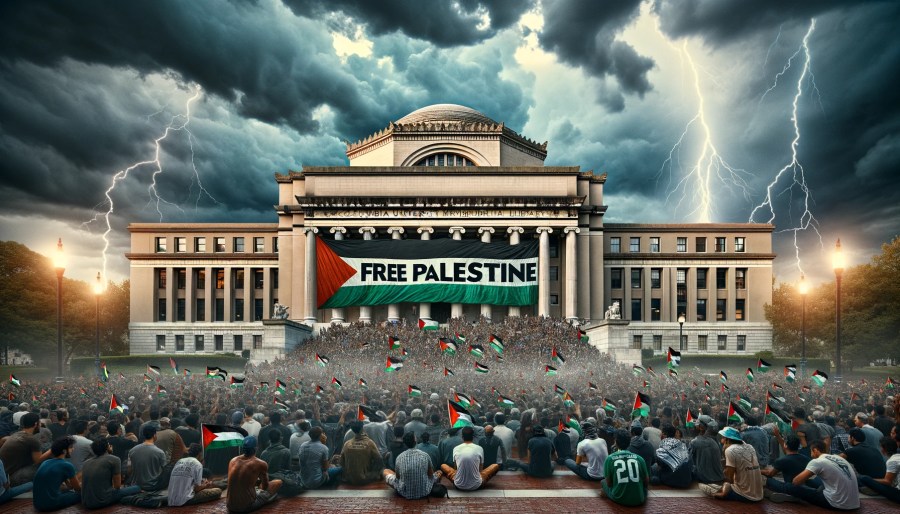
Flash forward seven years later, to last week’s formal inauguration of the new Center for Palestine Studies at Columbia University. From its website:

Founded in January 2010, the Center for Palestine Studies is the first such center to be established in an academic institution in the United States. Columbia University is currently the professional home to a unique concentration of distinguished scholars on Palestine and Palestinians, as well as to award-winning supporting faculty in a variety of disciplines.

So how did Columbia go so rapidly from “two Palestinians teaching in a faculty of 8,000 people!” to “a unique concentration of distinguished scholars on Palestine and the Palestinians”? Don’t be shocked, but Edward Said was out to deceive in that 2003 interview. Obviously there were more than two Palestinians back then. But I didn’t invent the nickname Bir Zeit-on-Hudson because of their number. It was meant to evoke precisely the atmosphere of intimidation—anti-Israel intimidation—that would later come to light in the “Columbia Unbecoming” affair.

Now that Columbia boasts of being home to “a unique concentration of distinguished scholars on Palestine” (who “will have a national and global reach”), Bir Zeit-on-Hudson hardly sounds far-fetched. By that, I don’t mean a “terrorist hideout”—those were Said’s words, not mine—but a redoubt of militant Palestinian nationalism in the guise of scholarship. And I mean militant: the affiliates of the new center aren’t only engaged in the positive affirmation of Palestinian identity, but are activists in the campaign to negate Israel. This is obviously the case in regard to Joseph Massad and Nadia Abu al-Haj—their field isn’t Palestine studies, it’s anti-Israel studies—but it’s increasingly true of the new center’s co-director, Rashid Khalidi, Columbia’s Edward Said Professor, an enthusiastic spokesman for the PLO in its terrorist phase and a severe critic of the same leadership in its present phase.

For now, Khalidi is cleverly doing what Said did with his “two Palestinians” shtick. “We have absolutely no money,” Khalidi said at the launch (attended by an overflow crowd). “What our little modest center will be able to do may be some narrow, specific things,” he reassured a journalist from the Jewish Forward. I’m not buying it, and I think that the moniker Bir Zeit-on-Hudson is too modest to convey the scope of the ambition behind this project. So I’m working on an alternative. For a preview, click on the thumbnail or here.