Obama’s Mideast priorities

On April 22, I appeared on a panel organized by The Washington Institute for Near East Policy, entitled “The Obama Administration and the Middle East: Setting Priorities, Taking Action.” Fellow panelists: Thomas Friedman, William Kristol, and David Makovsky. The proceedings have just been published, and they can be downloaded here. Below, my initial statement; go to the full proceedings for more.

I’m at a distinct advantage because I’m on a panel with partisan journalists, and I’m an academic. I’m entirely objective. [Laughter.] And I’m interested very much in ideas. You see, I don’t have any sources whispering in my ear. I just have to read texts and what people say and reach my best understanding of them.

This has been an interesting conference because we’ve heard a lot of reassurances, especially from General [Jim] Jones last night, that all of the administration’s priorities are in proper alignment. And I don’t want to question anyone’s good faith, but the fact is there are a lot of mixed messages coming out of this administration. And no one really knows whether this mixing reflects a clever strategy or is just a sign of confusion.

President Obama himself does it. A good example was his visit to Israel during the presidential campaign back in mid-2008. While in Sderot, he said, “A nuclear Iran would be a game-changing situation, not just in the Middle East but around the world. Whatever remains of our nuclear non- proliferation framework I think would begin to disintegrate.” That was a very powerful statement. And I call that “Obama 1.0.” We heard echoes of it last night in General Jones’s speech as well.

But then Obama, on the same trip, went off to Jordan and met with King Abdullah. And he came back and appeared on Meet the Press, where he said the following:

I think King Abdullah of Jordan is as savvy an analyst of the region and player in the region as there is. And one of the points he made and that I think a lot of people made is that we’ve got to have an overarching strategy recognizing that all these issues are connected.

If we can solve the Israeli-Palestinian process, then that will make it easier for Arab states and the Gulf states to support us when it comes to issues like Iraq and Afghanistan. It will also weaken Iran, which has been using Hamas and Hizballah as a way to stir up mischief in the region. If we’ve gotten an Israeli-Palestinian peace deal, maybe at the same time peeling Syria out of the Iranian orbit, that makes it easier to isolate Iran so that they have a tougher time developing a nuclear weapon.

Ladies and gentlemen, that is the Obama policy formulated then, down to the letter. And I call it “Obama 2.0” because look at the shift that took place. The game-changer in the Middle East is no longer Iranian nuclear capabilities, but the peace process. This shift is one in which Iran essentially becomes subordinate to the peace process.

To my knowledge, Obama has not repeated the phrase “game-changing” since he made it in 2008 to describe the effect of Iranian nuclear weapons. In 2008, he said it was an extraordinary priority to stop Iran. Last month, he said it’s one of our highest priorities to make sure that Iran doesn’t possess a nuclear weapon. And the other day, Adm. Mike Mullen said that Iran has been a priority of this administration from the outset. So stopping Iran has gone from being an extraordinary priority to one of our highest priorities to a priority.

And then Bill [Kristol] had a very interesting piece the other day—I see it in front of him—about Admiral Mullen saying the following: “Iran getting a nuclear weapon would be incredibly destabilizing. Attacking them would also create the same kind of outcome.” Now, obviously, if the outcome from doing something and from doing nothing is the same, that’s a pretty powerful argument for doing nothing. But of course, it isn’t the same outcome. I’ll leave it to Bill to explain, perhaps, why this is what he has called a false equivalence—unless you’ve decided that a nuclear Iran is not a game-changer, but instead just a really big hassle.

Now, I admired Obama 1.0 for what I thought was a very clear-sighted vision. A nuclear Iran does change the game for the Middle East and for the world, as he said. Obama 2.0 seems to me very confused about priorities. And that’s because an Israeli-Palestinian deal, for whatever merits it has and whatever limitations it’s obviously going to have, doesn’t change the game. It rearranges the pieces on the board, possibly to give one a slight advantage.

For example, the spat over housing in Jerusalem looks to me like something totally out of proportion. Excuse me for saying so, but the controversy over Ramat Shlomo—1,600 building units in Jerusalem—made Obama look like the captain of a ship rearranging 1,600 deck chairs on a vessel headed straight toward an iceberg. And that’s how I would describe the first year of the Obama administration. We’re on a ship. The iceberg is straight ahead. Everyone can see it. And the administration has been busy rearranging the deck chairs. [Applause.]
Smear intifada

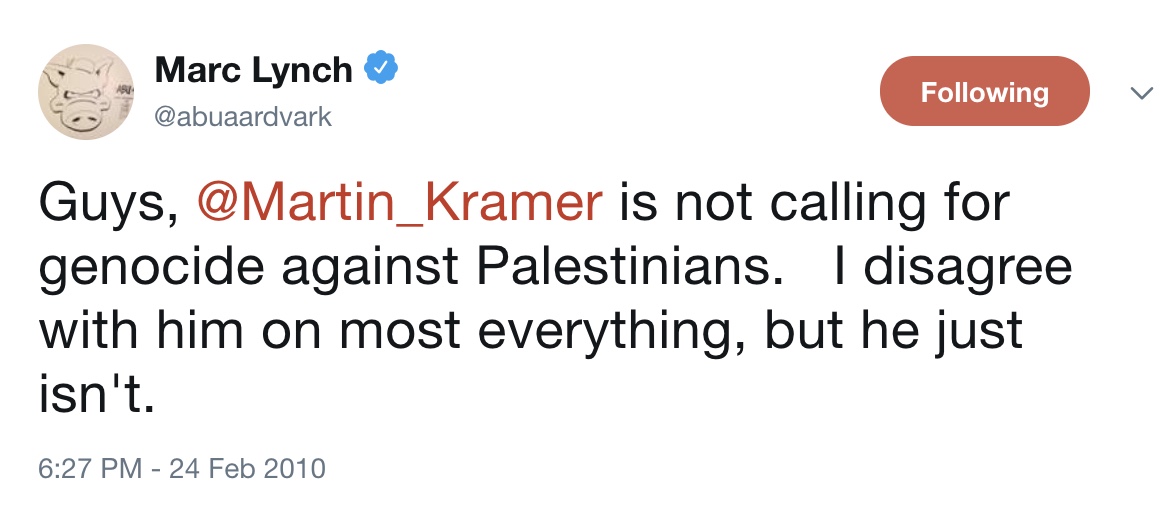
Electronic Intifada, a death-to-Israel website run by Ali Abunimah, says that in my Herzliya Conference speech, which I posted two weeks ago, I “called for ‘the West’ to take measures to curb the births of Palestinians, a proposal that appears to meet the international legal definition of a call for genocide.” According to the site, “Kramer proposed that the number of Palestinian children born in the Gaza Strip should be deliberately curbed, and alleged that this would ‘happen faster if the West stops providing pro-natal subsidies to Palestinians with refugee status.'” The usual suspects, Philip Weiss and M.J. Rosenberg, have jumped on the bandwagon. Being accused of advocating genocide by people who daily call for Israel to be wiped off the map of the Middle East is rich.

In my speech, I made no such “proposal.” The full quote:

Aging populations reject radical agendas, and the Middle East is no different. Now eventually, this will happen among the Palestinians too, but it will happen faster if the West stops providing pro-natal subsidies for Palestinians with refugee status. Those subsidies are one reason why, in the ten years from 1997 to 2007, Gaza’s population grew by an astonishing 40 percent. At that rate, Gaza’s population will double by 2030, to three million. Israel’s present sanctions on Gaza have a political aim—undermine the Hamas regime—but if they also break Gaza’s runaway population growth—and there is some evidence that they have—that might begin to crack the culture of martyrdom which demands a constant supply of superfluous young men. That is rising to the real challenge of radical indoctrination, and treating it at its root.

I didn’t propose that Israel take a single additional measure beyond the sanctions it now imposes with the political aim of undermining Hamas. And I didn’t call on the West to “deliberately curb the births of Palestinians.” I called on it to desist from deliberately encouraging births through pro-natal subsidies for Palestinian “refugees,” which guarantee that Gazans will remain both radicalized and dependent.

The Electronic Intifada claims that “neither the UN, nor any other agencies, provide Palestinians with specifically ‘pro-natal subsidies.'” This is a lie: UNWRA assures that every child with “refugee” status will be fed and schooled regardless of the parents’ own resources, and mandates that this “refugee” status be passed from generation to generation in perpetuity. Anywhere in the world, that would be called a deliberate pro-natal policy. Electronic Intifada: “Kramer appeared to be equating any humanitarian assistance at all with inducement for Palestinians to reproduce.” Appears to whom? A pro-natal subsidy is a national or international promise to support the yet-unborn, not humanitarian assistance to the living. The pro-natal subsidy in Gaza is the unlimited promise of hereditary “refugee” status to future generations.

(Stopping pro-natal subsidies isn’t an original idea, and I credit Gunnar Heinsohn for making a much more detailed case for it, in his January 2009 Wall Street Journal Europe article, “Ending the West’s Proxy War Against Israel: Stop funding a Palestinian youth bulge, and the fighting will stop too.” He also coined the phrase “superfluous young men.”)

Of course, Palestinian extremists and their sympathizers are quick to throw the “genocide” charge against Israel, and so are some Israelis. The late Tanya Reinhart once accused Israel of “slow genocide” against the Palestinians—which, if it were Israel’s policy, must be counted its most dismal failure, since population and life expectancy in the West Bank and Gaza have grown by an astonishing rate since 1967. The rise didn’t all result from Western subsidies (Heinsohn calls them “unlimited welfare”), and employment of Palestinians in Israel played a crucial role as well. But now the responsibility lies primarily with the West. I will leave the final word to Heinsohn (who, by the way, heads an institute for comparative genocide research):

As long as we continue to subsidize Gaza’s extreme demographic armament, young Palestinians will likely continue killing their brothers or neighbors. And yet, despite claiming that it wants to bring peace to the region, the West continues to make the population explosion in Gaza worse every year. By generously supporting UNRWA’s budget, the West assists a rate of population increase that is 10 times higher than in their own countries. Much is being said about Iran waging a proxy war against Israel by supporting Hezbollah and Hamas. One may argue that by fueling Gaza’s untenable population explosion, the West unintentionally finances a war by proxy against the Jews of Israel.

If we seriously want to avoid another generation of war in Gaza, we must have the courage to tell the Gazans that they will have to start looking after their children themselves, without UNRWA’s help.

Overnight addendum: I’m amused by my sudden overnight promotion to Harvard preeminence (by bloggers—why not?), but I have to disappoint. I’m not a “Harvard prof” (Rosenberg) or a “distinguished Harvard professor” (Richard Silverstein). My own homepage records that I’m presently a visiting scholar at Harvard’s Weatherhead Center (in the National Security Studies Program). The purpose of visitorships is to facilitate joint research between Weatherhead faculty and non-Harvard colleagues; a visiting scholar must hold a regular academic appointment somewhere else. I enjoy my Harvard research and library privileges. But I’ve never taught at Harvard, I’m not there now, and I don’t use the Harvard affiliation as an identifier on this Sandbox blog. For that, I rely solely on my permanent affiliations. So my rapid promotion at Harvard is really just a stunt by demagogues to attract attention, and the wild exaggeration is of a piece with all they produce. (Still, it was flattering…)

Further update: The directors of the Weatherhead Center at Harvard: “Accusations have been made that Martin Kramer’s statements are genocidal. These accusations are baseless.” Full text here.

More commentary:  Harvard Crimson editorial:

The blogosphere clearly overreacted in perpetuating the genocide meme created by Electronic Intifada and others. While the 1948 U.N. Convention does delineate “measures intended to prevent births” as a form of genocide, Kramer was not advocating an ethnic cleansing of Gaza’s citizens, but rather a shift in the average age of their population with the intention of, in his opinion, benefiting them in the long run. Considering the content of Kramer’s speech, labeling his policy as “genocide” is unfair, and steers the debate away from his actual argument.

Although we disagree with Kramer’s politics, creating a thriving marketplace of ideas among academic Fellows at Harvard can only benefit the University as a whole. Indeed, a major goal of the Weatherhead Center is to promote “vigorous, sustained intellectual dialogue” within the Harvard community, and a diverse view like Kramer’s will certainly foster the sort of debate the center seeks to promote. Although we question Kramer’s judgment, we refrain from questioning his continued presence at the Center and the legality of his statement in light of the U.N. Convention on Genocide. We encourage the blogosphere to follow suit.

Article by Jeremy Patashnik in the Harvard Political Review: 

Kramer’s remarks were not softly worded, and there are plenty of good reasons to reject his conclusions, but to call his proposal genocidal is, quite simply, absurd. This is not merely a semantic question of hyperbole gone awry. When M.J. Rosenberg, and others, label legitimate ideas as morally repugnant without rationally refuting them, it creates an environment of hyper-political correctness where people become afraid to share new–sometimes controversial–ideas for fear of being branded “radicals”…

It’s good that Kramer’s remarks have caused controversy. If people disagree with him, they ought to make their opinions known, and Kramer should, in turn, defend the ideas he put forth. Much of what Kramer said deserves to be rejected, but there are also parts that can contribute to the ongoing dialogue on the Israeli-Palestinian conflict. Perhaps ending pro-natal subsidies is morally unpalatable, but that doesn’t mean a discussion of how Palestinian population growth affects the conflict shouldn’t enter into the picture. Rosenberg does this important topic a disservice by irrationally branding ideas he doesn’t like “genocide.” Political correctness serves its role in society, but when it’s taken too far, it inhibits creative thinking.

Update, 2018: Read “A Controversy at Harvard,” my retrospective on this affair.

Superfluous young men

You get six minutes at the Herzliya Conference to say something memorable (and there is a clock ticking away at your feet, facing the audience). So I made a memorable argument for the role of population growth in radicalization, a clip of which is embedded below. It’s memorable—but not at all original. I first encountered the idea (and the phrase “superfluous young men”) in the stimulating work of Gunnar Heinsohn (here is one example of many). My discussion of the Palestinian angle isn’t original either. See Heinsohn’s “Ending the West’s Proxy War Against Israel: Stop funding a Palestinian youth bulge, and the fighting will stop too” (here).

There is also one error in my popularized recycling of his thesis. Heinsohn’s rule of thumb is that when 30 percent or more of the total male population is between 15-29 (fighting age), violence ensues. In my talk, I added that I would put it higher, at 40 percent. But that 40 percent should be of the total adult male population (15-64). I doubt that in any of the countries of the region, the 15-29 range accounts for 40 percent of total male population. Heinsohn is right.

An excellent compendium of demographic data on age structure in the Middle East, and a valuable discussion of it, may be found in the Stanford Center for Longevity’s “Critical Demographics of the Greater Middle East: A New Lens for Understanding Regional Issues” (here).

Update, February 22: See my rejoinder to critics of this presentation. It’s entitled “Smear Intifada.”

Update, February 23: The directors of the Weatherhead Center at Harvard: “Accusations have been made that Martin Kramer’s statements are genocidal. These accusations are baseless.” Full text here.

Update, 2018: Read “A Controversy at Harvard,” my retrospective on this affair.

Text of speech as delivered: I’m going to try to pull the focus back a bit. Our panel title implies that indoctrination is the key to radicalism. If we could shut down the jihadi websites and silence the radical preachers, if we could get the Saudis to stop funding extremists and fix the textbooks, the radical fever would subside.

But there are other views. There are those who say that the heart of the problem is despotic governments. If there were more democracy, and less Western backing for kings, emirs, and presidents for life, the radical fever would subside.

Others say that the heart of the problem is America’s unconditional support for Israel, and U.S. military campaigns in Iraq and Afghanistan. If the U.S. were to take its armies out of these lands, if the U.S. were to force Israel to end its occupation of Palestinian territory, the radical fever would subside.

Now as between these three explanations, you might prefer one to another. I myself have had a running debate with people who think that anger at Israel drives Al Qaeda or recruitment to Al Qaeda. Typical is this view, expressed last week, by a noted, prominent analyst: “We can separate Al Qaeda from the vast majority of Muslims by advancing a just and lasting peace that Palestinians accept.” I don’t know what the Palestinians would accept, and I think the vast majority of Muslims are already separated from Al Qaeda. But in places like Yemen and Afghanistan and Somalia, where Al Qaeda is most deeply entrenched, a “just and lasting” peace for the Palestinians wouldn’t make a shred of difference.

But the indoctrination explanation and the lack-of-democracy explanation also underestimate the problem, by suggesting that our policies can go far to change the dynamic. They can’t, and let me explain why.

The societies in which radicalism thrives differ from ours in many ways, but one way is crucial. The median age in Germany is 44, in the United Kingdom it is 40. In the United States, it is 37. In Israel, it is 29, in Turkey it is 28. That’s for perspective. In Iraq, it is 19. In Afghanistan, Somalia, Yemen, and Gaza, the median age is 17. Where the median age drops below 20, Islamist radicalization takes place on a massive scale. The biggest radicalizer is fertility that hovers at 6 or 7, and masses of economically superfluous young men of fighting age, between 15 and 29.

A German demographer, Gunnar Heinsohn, has a rule of thumb, that when 15- to 29-year-olds make up more than 30 per cent of the population, violence ensues. I would put it higher, at 40 percent—which is exactly where it stands in Iraq, Afghanistan, Somalia, Yemen and Gaza. If the state can’t control these young men, someone else will; if society can’t offer dignified pursuits for the fourth and fifth and sixth sons, someone else will. And it isn’t just the frustration of poverty; it is just as much the shortage of status. Osama bin Laden lacked for nothing, but his father, Saudi Arabia’s biggest contractor, married 22 times and had about 55 children. Osama was number 17. Radical Islam is a way for the superfluous sons to enter history.

So radical Islam answers a demand among frustrated young men, it doesn’t create it. How should that affect the West’s approach to the problem? First, let us not delude ourselves about the prospects of counterradicalization techniques. Afghanistan and Yemen will almost double their populations between now and 2030. What will 28 million more Afghans and 20 million more Yemenis do? What about the nearly 80 million more Pakistanis who will be added by 2030? This explosive growth will drive radicalization through another generation at least, and push it into Europe and America through emigration.

Second, there is hope. By 2030, these societies will have passed through the youth bulge. Fertility is already falling, in some places steeply. And when it falls, the radicals will lose their pool of recruits. A present example is Iran, where a revolt is brewing against the agenda of Ahmadinejad and the hardliners. It is also a place where fertility has dropped from 7 to below replacement, below 2—as steep a drop as China’s. Aging populations reject radical agendas, and the Middle East is no different.

Now eventually, this will happen among the Palestinians too, but it will happen faster if the West stops providing pro-natal subsidies for Palestinians with refugee status. Those subsidies are one reason why, in the ten years from 1997 to 2007, Gaza’s population grew by an astonishing 40 percent. At that rate, Gaza’s population will double by 2030, to three million. Israel’s present sanctions on Gaza have a political aim—undermine the Hamas regime—but if they also break Gaza’s runaway population growth—and there is some evidence that they have—that might begin to crack the culture of martyrdom which demands a constant supply of superfluous young men. That is rising to the real challenge of radical indoctrination, and treating it at its root.