Concealment Continues at Columbia

“An outrageous Israeli, Martin Kramer, uses his website to attack everybody who says anything he doesn’t like.” That’s Edward Said speaking, in an interview in a new collection entitled (predictably) Culture and Resistance. I would take it as a compliment, if I didn’t already know how easily Professor Said is outraged. But it’s a valuable testimonial nonetheless, and one worth quoting as Sandstorm marks its first anniversary.

Said offers this sample of my outrageous conduct:

For example, [Kramer] has described Columbia as “the Bir Zeit (university) on the Hudson,” because there are two Palestinians teaching here. Two Palestinians teaching in a faculty of 8,000 people! If you have two Palestinians, it makes you a kind of terrorist hideout. This is part of the atmosphere of intimidation that is McCarthyite.

I’m delighted to learn from this passage (and other sources) that my “Bir Zeit-on-Hudson” label has stuck to Columbia. Columbia warrants it not because Palestinians dominate the teaching of the modern Middle East there (they do), but because of the total absence of other perspectives, and Columbia’s apparent lack of interest in promoting a diversity of approaches. I never called Columbia a terrorist hideout, nor have I described any of its faculty as apologists for terrorism. I do accuse them of creating, on their campus and especially in the Middle East department, an atmosphere of intimidation that really is McCarthyite.

Said’s interview also jogged my memory: his reference to me includes a footnote harking back to a Sandstorm entry from last November. It was then that newspapers first reported that Rashid Khalidi, a University of Chicago historian, had been invited to Columbia to occupy the newly-established Edward Said Chair of Arab Studies. It was also reported that Columbia would protect the anonymity of the chair’s donor(s). In my entry, I insisted that the university had an obligation to reveal the identity of the donor(s).

Here we are, ten months later, and there has been no disclosure. A couple of donors, approached by a journalist, have acknowledged making contributions. But the vast majority of donors—and there are apparently almost twenty—have remained anonymous, and Columbia has not published any names.

As it happens, I have seen what purports to be a list of the donors. I’m not at liberty to publish it, and in any case I see no reason to relieve Columbia of its responsibility. But I don’t think it would violate a trust if I were to characterize the list. It includes individuals and foundations, Arab and non-Arab, known as supporters of the Palestinian cause—no surprise there. There is a corporate presence, which is a bit of a surprise. And on the list that I have seen, there is a foreign government, which I find positively alarming.

Why alarming? Rashid Khalidi, the new incumbent of the Said Chair, has also been named the director of Columbia’s Middle East Institute, which will receive about $1 million in federal subsidies over the next three years. Under any circumstances, a university’s concealment of a gift from a foreign source strikes me as unethical. Under these circumstances, Columbia’s failure to disclose is unconscionable. It’s also worth noting that if a foreign gift is large enough ($250,000), it must be disclosed to the U.S. Department of Education in a timely manner, according to Section 1011f. of the Higher Education Act (“Disclosure of Foreign Gifts”). In New York State, there is a similar disclosure law that kicks in at $100,000, although according to a recent account, “there is little, if any, compliance with existing law.” Ah, universities.

All of which leads me back to my original demand. Now that the incumbent of the Said Chair is administering a federally-funded National Resource Center, with control over taxpayers’ funds, his own funding is a matter of the public interest. Columbia must make known the donors, or at the very least identify any foreign government, entity or person that contributed to the endowment of the Edward Said Chair. If Columbia continues to refuse to make such information public, the Department of Education should initiate action to secure it, and then make it available to the rest of us.

I also urge the Middle East Studies Association (MESA), at its annual conference in November, to pass a general resolution calling upon all universities to reveal the sources of endowments in our field. The remaining credibility of Middle Eastern studies is at stake. If Columbia’s practices spread throughout the field, it is only a matter of time before a major scandal erupts, linking scholars to tainted money. MESA should stand unequivocally on the side of public disclosure—even if Khalidi is a former MESA president, and even if the current MESA president is a Columbia dean.


Updates from Sandbox

The updates below originally appeared in Sandbox, this website’s quick news log. Sandbox is a supplement to the established weblog Sandstorm.

Dirhams at Columbia. On Friday, Columbia University finally disclosed the list of donors to the Edward Said Chair, held by Rashid Khalidi. Six months ago, I’d reported the presence on the donor list of a foreign government, but I didn’t name it. Now it’s confirmed: the United Arab Emirates. At this moment, a gift chair from the UAE to Harvard’s Divinity School is frozen, because of questions about the propriety of accepting it. Columbia apparently doesn’t have the same scruples, and saved itself a controversy by keeping the gift secret. Concealing gifts from foreign governments in this field is never acceptable, period. What I find disgraceful is that the leaders and institutions of Middle Eastern studies didn’t join my demand for transparency. Shame, shame, shame.
Wed, Mar 17 2004 7:06 pm
Share a chair. Several readers have asked for the full list of donors to the Edward Said Chair, which Columbia released Friday. For some reason, it’s not on Columbia’s website. Here is the list:


Yusef Abu Khadra
Abdel Muhsen Al-Qattan
Ramzi A. Dalloul
Richard and Barbara Debs
Richard B. Fisher
Gordon Gray, Jr.
Daoud Hanania
Rita E. Hauser
Walid H. Kattan
Said T. Khory
Munib R. Masri
Morgan Capital & Energy
Olayan Charitable Trust
Hasib Sabbagh
Kamal A. Shair
Abdul Shakashir
Abdul Majeed Shoman
Jean Stein
United Arab Emirates

Thu, Mar 18 2004 7:24 pm


Columbia owns up. The Columbia Spectator now tells the full story of Columbia’s ethical and legal dereliction in concealing the donors of the Edward Said Professorship (incumbent: Rashid Khalidi). The names were finally disclosed on March 12. Reporter Chris Beam writes: “Kramer, who led the call for disclosure of the names, wrote in an e-mail that although individual donors might justifiably request anonymity, gifts from foundations and corporations should be revealed. ‘But above all’, he wrote, ‘there are no circumstances—and I repeat that—no circumstances whatsoever, that justify the anonymity of a foreign government that has given to a university’.” The government in question: United Arab Emirates, good for $200,000.
Fri, Mar 26 2004 10:17 am
Palestinian millionaires. Sixteen of the donors to the Edward Said Professorship are individuals. Eight of these are trustees of the Geneva-registered Welfare Association, which gives to Palestinian welfare and development projects. The association, a wealthy club, has about a hundred active members, most of them prominent Palestinian businessmen. Edward Said was also a trustee. The Columbia Spectator article, cited immediately below, reports that Rita Hauser, a well-connected New York lawyer and philanthropist who happens to be Jewish, originally proposed the chair. Maybe, but these Palestinian millionaires look to me like the core of the initiative.
Sun, Mar 28 2004 8:48 am
And Columbia too. One of the donors of the Edward Said Professorship at Columbia is Ramzi Atta Dalloul. Once upon a time, he brokered arms deals between France and Iraq. When Saddam found out how much Dalloul was skimming off the top, he summoned him to Baghdad to demand his money back. Ken Timmerman’s Death Lobby (p. 66): “The terrified Palestinian is said to have forked up $8 million in cash and may have made other ‘contributions’ to a secret Baath party fund held in a Swiss bank.” (Here’s more on Dalloul’s Iraq deal from Said K. Aburish, who was in on it.) Dalloul was a generous fellow, according to Timmerman: “Besides making contributions to Arafat’s Fatah Movement, Dalloul sought additional protection by making substantial payments to one of Arafat’s rivals, the radical Palestinian leader George Habash.”
Sun, Mar 28 2004 5:57 pm
What about Columbia? Harvard University’s Divinity School has decided to return that $2.5 million gift for an Islamic studies chair to the donor: the United Arab Emirates. Bottom line: the UAE is just too toxic to warrant the kind of legitimation Harvard confers. Remember: the UAE also contributed $200,000 toward the Edward Said Chair at Columbia, a fact concealed by Columbia until last spring. Maybe now’s the time for Columbia to consider returning that UAE gift. Or are Columbia’s standards not quite up to Harvard’s?
Wed, Jul 28 2004 2:43 pm
Why Columbia should. Harvard is returning $2.5 million to the United Arab Emirates, donated earlier to establish an Islamic studies chair. The UAE also gave $200,000 toward the new Edward Said Chair at Columbia. So will Columbia return its gift? “Why would we?” a Columbia spokesperson says. “Our gift differs in both the source and the purpose from the Harvard gift.” Nonsense. If anything, Columbia has a greater obligation to return UAE money. (1) Columbia initially concealed the gift. (2) The chair it helped to create has adequate funding from other sources. (3) It’s disgraceful that a chair named after a University Professor (Columbia’s elect) be funded even partly by the ruler of a country defined as “not free.”
Mon, Aug 9 2004 3:10 a

Professorial Pundits Place Iraq Bets

The war is underway, and most of the rationales for and against it are based on predictions. No one reasonably expects professors of Middle Eastern studies to predict military outcomes. But political outcomes, especially in the long term, are supposed to be their forte. And so here, for the record, are the predictions of four chaired professors of Middle Eastern studies, at leading American universities. At the end of the day, events will prove two of them right, and two of them wrong.

John Esposito is a University Professor (his university’s highest professorial honor) at Georgetown. His prediction, looking five years past a war:

It is likely that the Arab world will be less democratic than more and that anti-Americanism will be stronger rather than weaker. A military attack by the United States and installation of a new government in Iraq will not have fostered democratization in the Arab world but rather reinforced the perception of many… that the United States has moved… to a war against Islam and the Muslim world. To move to a military strike before exhausting nonmilitary avenues, and without significant multilateral support from our European and Arab/Muslim allies, as well as from the United Nations, will have inflamed anti-Americanism, which will have grown exponentially in the region and the non-Muslim world.

That’s a grim prophecy, although the very first part may already be falsifiable: could Esposito now name an Arab country that might be less democratic in five years—given that not one of them is democratic now?

In the opposite corner is Bernard Lewis, professor emeritus at Princeton, past member of the Institute for Advanced Study, and best-selling author. He makes the opposite prediction:

I see the possibility of a genuinely enlightened and progressive and—yes, I will say the word—democratic regime arising in a post-Saddam Iraq. They will have been fully inoculated against the Fascist-style governments that otherwise seem to prevail.

Lewis again, with a bit more caution, but a steady optimism:

Clearly, Iraq is not going to turn into a Jeffersonian democracy over-night, any more than did Germany or Japan. Democracy is a strong medicine, to be administered in gradually increasing measures. A large dose at once risks killing the patient. But with care and over time, freedom can be achieved in Iraq, and more generally in the Middle East.

Do you prefer that your experts on “the Arabs” have Arabic names? Then take your choice. In one corner: Rashid Khalidi, who in September will become the Edward Said Professor at Columbia University. His prediction:

Irrespective of its cost or length, this war will mark not the end, but the beginning, of our problems in this region. Because, however much Iraqis loathe their regime, they will soon loathe the American occupation that will follow its demise. No expert on Iraq… believes that the creation of a democracy in Iraq will be a swift or simple matter; some believe it is not possible as a consequence of an American military occupation…. So we will not have democracy in Iraq. We will have a long American military occupation that will eventually provoke resistance…. Via a lengthy and bloody occupation of Iraq, via the establishment of U.S. bases there, via the direct control of Iraqi oil, we will be creating legions of new enemies throughout the Middle East.

In the other corner: Fouad Ajami, the Majid Khadduri Professor at Johns Hopkins. Ajami argues that the United States should aim high: “The driving motivation of a new American endeavor in Iraq and in neighboring Arab lands should be modernizing the Arab world.” His prediction: an American commitment will be decisive.

In the end, the battle for a secular, modernist order in the Arab world is an endeavor for the Arabs themselves. But power matters, and a great power’s will and prestige can help tip the scales in favor of modernity and change…. [U.S. victory] would embolden those who wish for the Arab world’s deliverance from retrogression and political decay…. It has often seemed in recent years that the Arab political tradition is immune to democratic stirrings. [But] the sacking of a terrible regime with such a pervasive cult of terror may offer Iraqis and Arabs a break with the false gifts of despotism.

So there you have them: the divided opinions of America’s leading authorities on the Middle East. Needless to say, they can’t all be right, so some of these predictions are going to come up losers. Will anyone remember? Possibly. But here is a safe prediction: it won’t matter, certainly not to the professional standing of the professors. Another professor (Robert Vitalis, head of the Middle East Center of the University of Pennsylvania), has put things in precisely the right perspective. The future, he maintains, “is unknowable.”

Administration figures are in fact gambling but there are real and predictable consequences to their betting wrong. Consequences for them personally I mean. This is not the case for virtually any op-ed writer or trusted ally of the Saudis or scholars who, from their perches in Palo Alto and Morningside Heights (or Center City), tell us what is really going to happen. There are no costs to them to being wrong, which is in part why so many pretend to be able to see the future with such remarkable acuity. Even after getting it wrong time and time again in the past 10 years.

How very, very true.

(Palo Alto and Morningside Heights…. Has Professor Vitalis been reading my Ivory Towers on Sand?)

ASIDE: Edward Said, who disagrees with Bernard Lewis and Fouad Ajami, now claims that neither “has so much as lived in or come near the Arab world in decades.” Anyone with an ear to the ground knows that both of them show up somewhere in the Arab world every year. And I believe it’s been thirty years since Said left Morningside Heights to spend one of his sabbaticals in an Arab country. The amazing thing is that in the very same article, Said makes this admission: “In all my encounters and travels I have yet to meet a person who is for the war.” New York Times/CBS reports: “74% [of polled Americans] now approve of the U.S. taking military action against Iraq, up from 64% among these same respondents two weeks ago.” Perhaps it is Professor Said who ought to get out more.

Bir Zeit-on-Hudson

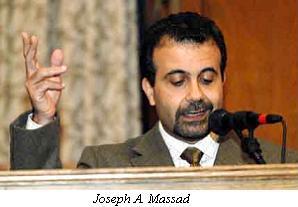
Two weekends ago, Columbia University hosted a Palestinian film festival. I have nothing against such festivals, which have been held over the past year in Seattle and Chicago. Some of the films are worthy examples of the art. But of course, Columbia’s faculty can be counted upon to give a legitimate exercise the flavor of a hate-fest. This time, it was the turn of Joseph Massad, an assistant professor in the department that sponsored the festival. According to the Columbia Daily Spectator, Massad, speaking on a festival panel, praised the films as “weapons” and “likened Israeli Prime Minister Ariel Sharon’s cultural views to those of Nazi Minister of Propaganda Joseph Goebbels.”

All this is standard procedure for Massad, who throws out Nazi analogies with reckless abandon. (When the Campus Watch website named him, presumably for doing just that sort of thing, he called it “a Gestapo file.”) This week, Massad has cropped up on the pages of Al-Ahram Weekly, and he has outdone himself. The article is a rant against the anti-Israel left in Europe (e.g., Derrida, Bourdieu), for not being anti-Israel enough. Alas, too many of the left’s culture heroes only demand an end to Israeli occupation. They fail to see that Israel itself, in any borders, is a racist entity. The Jews, not being a nation by (Massad’s) definition, cannot have nationalism. They have only racism, implemented through colonialism. In this one op-ed, Massad manages to repeat the words “racist” and “racism” twenty-two times. Talk about Goebbels.

So here are the highlights. Israel is “a racist Jewish state,” the “offspring” of “the foundational racism of Zionism.” The “European Jew is a colonizer who has used racist colonial violence for the last century against the Palestinian people.” Israel was founded “by armed colonial settlers.” “Zionist Jewish colonialism” was a “commitment to European white supremacy in Jewish guise.” “Jewish colonists were part of the British colonial death squads that murdered Palestinian revolutionaries between 1936 and 1939.” There has been an “ideological and practical collusion between Zionism and anti-Semitism since the inception of the movement.” Zionism “has always been predicated on anti-Semitism and on an alliance between Zionists and anti-Semitic imperialists.” Zionism itself had an “anti-Semitic project of destroying Jewish cultures and languages in the diaspora.”

Heard enough? Too bad. “Israeli colonialism and racism operate with the same force, albeit with different means, inside the Jewish state as they do in the territories Israel occupies.” Israel’s racism manifests itself in “the racist curricula of Israeli Jewish schools, the racist Israeli Jewish media representations of Palestinians, the racist declarations of Israeli Jewish leaders on the right and on the left, and the Jewish supremacist rights and privileges guiding Zionism and Israeli state laws and policies.” “The ultimate achievement of Israel,” concludes Massad, is “the transformation of the Jew into the anti-Semite, and the Palestinian into the Jew.”

On any blind reading, you would discount these as the blurtings of a rabid fanatic, obviously consumed by a hatred of Israel and its people so venomous and manic that it has destroyed any capacity for sober historical judgment. You would be right.

Yet Massad, in the dens he inhabits, is not considered a fanatic at all. Quite the contrary: he is the flower of Columbia University and American Middle Eastern studies. He completed his doctorate at Columbia; Columbia University Press published it; and Columbia University now employs him (to teach, inter alia, Israeli politics and society). The Middle East Studies Association (MESA) awarded him its prize for outstanding dissertation, and the resulting book has been reviewed favorably by MESA’s current president-elect. Massad also recently passed his three-year review at Columbia, and is now on leave writing what I have heard described as his “tenure book,” the opus he hopes will make Columbia his oyster. It’s entitled The Persistence of the Palestinian Question, and its core argument is—you guessed it—Israel is a racist state.

It will be fascinating to see how Rashid Khalidi, the new Edward Said Professor of Middle Eastern Studies at Columbia, and designated head of its Middle East Institute, deals with the Massad phenomenon. (Khalidi earlier endorsed Massad’s first book as “one of the best of the new crop.”) And I eagerly look forward to Massad’s “tenure book”—or, to borrow from his own stock of analogies, his Mein Kampf.

POSTSCRIPT: I noticed that Khalidi’s endorsement of Massad’s only book describes it as “well-written.” So here’s a sample, from chapter one:

Whereas the genetic moment of every national interpellation secures the subsequent claims made by popular nationalism anchoring the political and popular concept of the nation, every retelling of the story of the nation becomes in fact a moment of sublation (incorporation and transcendence), wherein the newly constituted Jordanian identity sublates its predecessor in an interminable process, and whereby the new Jordanian identity is reinscribed as the one that had always already existed as it does today.

Also don’t miss Massad’s recent exchange with Israeli “new historian” Benny Morris, in which Morris turns the tables and shows “surprise” at Massad’s racism. “I resent your accusation of racism,” Massad huffed—and immediately retaliated by calling Morris a “racist Orientalist.” Is there a pattern here?

UPDATE: One of the things I did learn from Orientalism was that the most effective way to damn someone is to quote him. Said, in his walk through the valley of orientalist texts, left no quote unturned. I recently deployed this technique in dealing with Columbia’s Joseph Massad, who wrote an anti-Israel article in the Ahram Weekly full of self-incriminating hyperbole. All I had to do was quote him.

Now Massad has replied, also in the Ahram Weekly, in an article loaded with sweeping assertions. According to Massad, I am “keen to defend Israel’s prerogative to kill and bomb anyone who stands in its way.” I seek to “extend Israeli violence to the U.S. academic arena.” I have “not yet eliminated anyone physically,” but I and my “young dupes” have the “express aim of imploding freedom.” I am guilty of “virulent anti-Arab racism.” And so on.

What disappoints me about this rambling text of 2,300 words is that Massad does not quote me even once. Of course, nowhere have I written that Israel has the “prerogative to kill and bomb anyone,” but surely I must have written something worth quoting, even out of context, which would damn me. Massad, alas, has failed to master the ingenious technique of Orientalism, despite reading and rereading it. (He’s also failed to learn from Said that you lie low until you have tenure, but that’s another matter.)

It’s just another reminder that the unique and irreplacable Edward Said will have no successors. The Beirut Daily Star once likened one of Said’s Beirut lectures to “an American rock concert for the learned and the not-so.” An apt comparison—and when Said is gone, we’ll be left with the Edward impersonators.