Bashar Watch

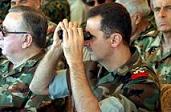
A few years ago, I heard an officer in Israeli military intelligence say that there’s nothing so comical as the sight of Bashar Asad, ophthalmologist, peering through binoculars at a military exercise. He looks so unmilitary. I didn’t know exactly what that meant, but now I do. Just look at this picture, taken on Monday at a Syrian military exercise at an “undisclosed location,” and released by the official Syrian press agency.

Bashar is decked out in a fresh uniform, sleeves rolled up a little too neatly. The effect is simply to reveal his spindly white forearms, which don’t look like they’ve ever seen the sun.

But there’s something even funnier. Where’s his watch? His wrists are bare. Now as anyone knows, you can’t last for an hour in any military, even the Syrian, without a watch.

Explanation? Here’s one. When Bashar got to the base and changed into his military costume, he realized that he would look ridiculous in his civilian watch–probably a fancy Rolex. So he took it off and stuffed it in his pocket. Not owning a military watch, he just went without.

(I know, you’re thinking that the watch might have been brushed out by a Syrian military censor, lest it reveal the time. Top secret! So here is a larger version of the photo–no obvious tampering. Anyway, if a censor wanted to obscure the time, he could have just obscured the watch face.)
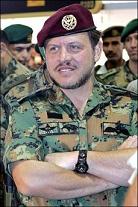
Compare the Bashar photo to this shot of Jordan’s King Abdullah, at a Special Operation Forces Exhibition held in March at a Jordanian airbase. On this basis alone, I’m betting that Abdullah outlasts Bashar.

Just in: A well-informed source tells me that Dr. Bashar, while adjusting the focus on his binoculars, was heard muttering to himself: “Better… or worse? Better… or worse?”

Ammar Abdulhamid in senile Syria

Ammar Abdbulhamid, the Syrian reformer and dissident, is the subject of a profile in this morning’s New York Times. Abdulhamid is a courageous spokesman for progressive change in the Arab world, who’s also drawn attention to the obligation of governments to protect minorities a point on which Arab regimes historically have had an appalling record. Abdulhamid appeared together with me at The Washington Institute last December, and we shared a panel on the theme of what happens “When Minorities Rule.” Here’s a summary of his forthright remarks, devoted largely to Syria. (And here’s a summary and full text of my own presentation.)

Abdulhamid returned to Damascus last month (he had done a stint at the Saban Center), and he started a blog, here. It’s got exactly one entry, in which he reports that his travel has been restricted:

It’s been 20 days since our return to the Senile Country. A cold security reception at the airport set the tone of this homecoming, more or less, and culminated in a travel ban. Still, seeing the kids at the airport was absolutely rejuvenating.

The travel ban is not total, that is, I can still travel if I want, provided that I get a security clearance before I leave and report back upon my return.

Oh, of all the stupid things they could do? Did they really think they can put me on a leash? Did they think that I’d accept, that I’d cooperate? Well, they have another thing coming. I happen to be very much fond of the idea of staying at home at this stage and cutting down on travel time. I have proposals and articles to write, a team to enlarge, conferences to plan and people to hassle. This is going to be a productive year, a very productive year for all of us here.

Sandbox will track his adventures closely.

Update: Abdulhamid has made another blog entry, his second, this Sunday morning. Today he had a meeting with the Military Security Apparatus, and he goes back tomorrow. (The brigadier general was too busy to see him…)