In Iran, survival isn’t victory

On February 27, 1991, President George H.W. Bush addressed the American people, announcing the end of offensive military operations against Saddam Hussein’s forces. Iraqi troops had been completely expelled from Kuwait, which they had invaded the previous summer. During six weeks of bombing and a 100-hour ground campaign called “Desert Storm,” the U.S. and coalition allies destroyed about two dozen Iraqi divisions, hundreds of Iraqi aircraft, thousands of tanks, and Iraq’s weapons industry. A retreating Iraqi column was utterly destroyed during its escape from Kuwait. Gruesome images from that “highway of death” vividly showed the scale of Iraq’s defeat.

The following day, February 28, Bush made this entry in his diary:

It’s now early Thursday morning on the 28th. Still no feeling of euphoria. I think I know why it is. After my speech last night, Baghdad radio started broadcasting that we’ve been forced to capitulate. I see on the television that public opinion in Jordan and in the streets of Baghdad is that they have won. It is such a canard, so little, but it’s what concerns me. It hasn’t been a clean end—there is no battleship Missouri surrender. This is what’s missing to make this akin to WWII, to separate Kuwait from Korea and Vietnam.… The headlines are great. “We Win.” The television accurately reflects the humiliation of Saddam Hussein and it drives the point home to the American people. But internationally, it’s not there yet, at least in the Arab world that has been lined up with Saddam.

The fact that the enemy refused to acknowledge defeat troubled Bush. “Obviously,” he comforted himself, “when the [Iraqi] troops straggle home with no armor, beaten up, 50,000 … and maybe more dead, the people of Iraq will know.” But if they knew, Saddam regime’s made sure they never showed it. In 2003, Saddam shared his perspective with American television journalist Dan Rather:

In 1991 Iraq was not defeated. In fact, our army withdrew from Kuwait according to a decision taken by us. Yes, it withdrew, but when we were back within our boundaries, the boundaries of Iraq, the Iraqi army was not defeated. Nor was the people of Iraq…. It was [Bush’s] decision to…. stop the fighting. And, consequently, Iraq was not defeated.

No one knows how the current Iran war will end, but two things seem certain. The Supreme Leader will not send his representative to sign an unconditional surrender on the deck of the aircraft carrier Abraham Lincoln. And whoever leads the regime will declare victory for Iran, regardless of how much damage the U.S. and Israel inflict. In that respect, the Islamic Republic is no different from Saddam’s Iraq.

Iran has not experienced a military victory against a foreign enemy since the 18th century. As a result, its leaders are skilled at presenting defeats as draws, and draws (like the Iran-Iraq war in the 1980s) as victories. This is a coping strategy that allows Iran to preserve some dignity as the inheritor of past empires, which once thrived on legendary military triumphs and territorial conquests. A self-soothing narrative hides from Iranians the simple truth that Iran isn’t a global power. It’s not even the leading power in the Middle East. It’s too poor, corrupt, mismanaged, and divided to enjoy such a high status, no matter how much the regime tries to rally Iran’s people into sacrifices.

It’s now being said that if the regime remains in power, it’s somehow a triumph. “To survive would count as victory for Iran’s regime,” announces the Economist. But that’s Saddam-think. Survival isn’t victory unless it’s accompanied by a strategic gain that outweighs military losses. Since 1978, the Islamic Republic has aimed for Iran’s dominance of the Persian Gulf and the broader Middle East through ambitious weapons programs and support for proxies across the region. Survival is a poor substitute for losing all that, and most of it is already gone.

In 1991, George H.W. Bush had people around him who reassured him that it didn’t matter what people in the streets of Amman or Baghdad thought. What mattered was the objective achievement of defined war aims. They understood then, and we know in retrospect, that the war finished off Iraq as a pretender to regional power. Mission accomplished.

Thirty-five years later, Operation Desert Storm is remembered as the last decisive victory the United States won in a regional war—even though, at the time, America’s president thought it wasn’t a “clean end.” If that war didn’t end cleanly, the Iran war won’t either. The question is whether those who launched this war have the wisdom to realize it.

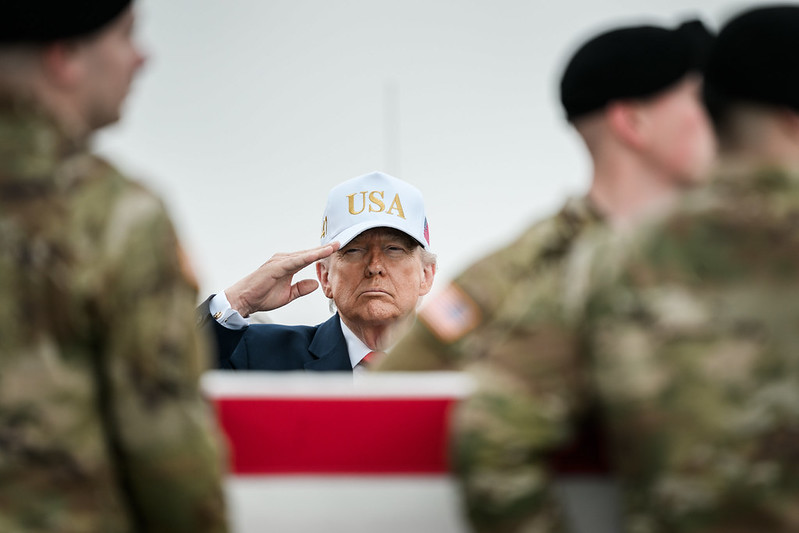
Header image: President Donald J. Trump attends transfer of remains of six US soldiers killed in an Iranian drone strike in Kuwait, March 7, 2026, at Dover Air Force Base, Delaware. Official White House photo by Daniel Torok, public domain.
How does Trump’s partition plan compare?

Left to right: Peel plan 1937, UN plan 1947, Trump plan 2020

It’s officially called the “Vision for Peace, Prosperity, and a Brighter Future.” But the scheme devised by Jared Kushner for his father-in-law President Donald Trump is basically a partition plan, replete with a map.

The President seems to think that his plan is unprecedented in its detail:

In the past, even the most well-intentioned plans were light on factual details and heavy on conceptual frameworks. By contrast, our plan is 80 pages and is the most detailed proposal ever put forward by far.

But past partition plans also were heavy on details and accompanying maps. The British partition plan of 1937, produced by a “royal commission” and popularly named after its otherwise-forgotten chairman, one Lord Peel, ran to 231 pages. Its follow up, the Palestine Partition Commission Report, had 310 pages and thirteen maps. The 1947 partition plan written by the United Nations Special Committee on Palestine had 83 pages (including “annexes, appendix and maps”). The two follow-ups of the Ad Hoc Committee for Palestine, with additional details, added more than a hundred pages.

That’s a long time ago, and one might be forgiven for categorizing Trump’s initiative among the more recent and conceptual “peace plans.” But it’s really the successor to the two preceding partition plans, both in its level of detail and, especially, in its maps.

The most striking consistency in these three partition plans is that the Zionist or Israeli side helped to fashion them so as to say “yes,” while the Palestinian Arabs refused to help prepare them, and so ended up saying “no.” Each rejected plan has been followed eventually by another, which has offered the Palestinians still less.

Comparing the 2020 map to 1947, and the 1947 map to 1937, makes that graphically clear. The Palestinians have appealed every verdict of history, and have lost every time. Odds are that this pattern will be repeated yet again, because the Palestinians remain too weak and divided, or resentful and myth-infected, to say “yes.”

Gradations of legitimacy

But while there’s consistency in the way these plans have been received, there are major differences in their authority. The most legitimate partition plan was that of 1947, because it was put together by an international commission, and it enjoyed the overt support of the two superpowers, the United States and the Soviet Union. On that basis, it garnered two-thirds support in the UN General Assembly, and became enshrined as Resolution 181.

While the resolution wasn’t more than a recommendation, it was strong enough to figure in Israel’s declaration of statehood. “By virtue of our natural and historic right,” the declaration reads, “and on the strength of the resolution of the United Nations General Assembly, [we] hereby proclaim the establishment of a Jewish state in Eretz-Israel, to be known as the State of Israel.”

The earlier 1937 partition plan didn’t get nearly as far. The royal commission’s report was no more than a recommendation to the British government, which then convened another commission, which then declared partition impractical. The League of Nations, in whose name Britain ruled Palestine, never weighed in. For all the heft of the Peel plan, few remember it, although it was the first to establish partition as a possible solution.

At this moment, the Trump partition plan is closer to 1937 than 1947. True, it’s officially and overtly promoted by the president of the world’s leading power, which works in its favor. But it’s the brainchild of a handful of Americans, and it has no wider buy-in, except by Israel. A partition plan, to make history, doesn’t need Palestinian backing, as 1947 showed. But it can’t go very far if it doesn’t have what the 1947 plan had: some degree of international endorsement.

Russia, Europe, the Arab states — all of them could advance or retard the plan. Wooing them is especially important for Israel, since it seeks “recognition” for what it’s possessed for half a century. Borders gain legitimacy by mutual agreement (Israel’s borders with Egypt and Jordan) or international certification (its border with Lebanon). It isn’t enough for Trump to wave a scepter, or Israeli prime minister Benjamin Netanyahu to evoke the Bible, however potent both instruments may be. The United States and Israel will have to canvas the world for support, just as they did in 1947.

Dancing in the streets?

Another difference is the degree of urgency: past plans emerged from crisis situations. In 1937, Palestine was in the midst of an Arab rebellion and violent turmoil. Jews fleeing Nazi persecution sought a refuge. In 1947, surviving Jewish refugees in Europe cried out for entry to Palestine. Partition was conceived as a kind of emergency surgery.

In 2020, in contrast, Israelis and Palestinians are living through the calmest decade-plus in their modern history. They have hammered out a status quo that’s far from perfect, but that still functions. The Trump partition plan emerges, instead, from the urgent political needs of Trump and Netanyahu. Since no one else is desperately awaiting such a plan, few will be keen to make sacrifices for its success.

That may be why the Trump plan is such a conservative one, grounded in realities as they are. Remember that the 1937 plan, forged in a different moral climate, proposed the involuntary “transfer” of more than 200,000 Palestinian Arabs out of the Jewish state. The 1947 plan left more than a third of the country’s Arabs within a Jewish state they opposed. (Most ended up fleeing it.) 1937 and 1947 gave rise to huge debates and fed deep passions all around.

Trump’s partition, by contrast, doesn’t imagine anyone moving, or (with few exceptions) living under a new kind of rule. That’s why its map is also so convoluted, compared to its predecessors. All partition maps have had strange anomalies, with awkward corridors and crossing points. The Trump map is full of enclaves, bypasses, and even a tunnel, precisely so that no one need relocate or submit to alien rule.

Because the plan so closely hews to the status quo, it won’t spark much jubilation among Israelis or much violence among Palestinians. But perhaps that’s its best hope. On the ground, there already exists a kind of two-state reality. Israel is a very strong polity, the Palestinian Authority a very weak one. But both have presidents, cabinets, security forces, anthems, and control of territory. Trump’s plan is focused on drawing final borders and building Palestinian state capacity. It may be a fool’s errand, but it’s not as radical as its predecessors.

History books or recycle bin?

So is it “historic,” a word regularly abused by politicians? Netanyahu: “I believe that down the decades — and perhaps down the centuries — we will remember January 28, 2020.” He even bordered on blasphemy when he compared the occasion to May 14, 1948, arguably the most significant date in Jewish history in the last two millennia.

At this point, it’s not even clear we’ll remember January 28 six months from now. A plan on paper doesn’t make history, even if it’s called “The Vision” and gets launched to strains of “Hail to the Chief.” The Trump partition plan isn’t “dead on arrival.” But for an American plan to stand even a chance of survival, the president must put his and America’s full weight behind it for years to come, perhaps even “down the decades.”

Does Trump’s America, does anyone’s America, have the attention span, grit, and finesse to see the “deal of the century” through? That’s the question of the century.

Cross-posted at the Times of Israel.

Trump’s Mideast strategy: disaster or opportunity?

Over at Mosaic Magazine, Michael Doran published a long essay on the preferred American strategy in the Middle East, a piece that’s been popular among supporters of Donald Trump’s plan for a smaller U.S. footprint in the Middle East. Elliott Abrams offered the first response, and I’ve offered the second, below. (Original title: “Is the American Withdrawal from Syria a Disaster, or an Opportunity, or Something Else?”) Be sure to return to Mosaic Magazine for additional responses, and for Doran’s “last-word” rejoinder.

I have immense respect for the judgment of Michael Doran. So it’s significant that he thoroughly opposes Donald Trump’s decision to withdraw U.S. forces from Syria.

Wait a moment, you say. Doran doesn’t write that in “The Strategy Washington Is Pursuing in the Middle East Is the Only Strategy Worth Pursuing.” If anything, in his latest essay for Mosaic, he acquiesces in Trump’s Syria decision, and indeed regards it as “inescapable.”

To which I’d answer yes—but, before Trump announced his decision, Doran was all against it. And since he was just as persuasive then as he is now, what’s a sworn Doran fan like me supposed to conclude?

Continue reading “Trump’s Mideast strategy: disaster or opportunity?”