Israel likes its U.S. presidents strong

The Wall Street Journal ran a symposium over the weekend about world reactions to Obama’s Syria turnaround. I wrote the contribution on Israel. Many aspects of the “turnaround,” especially the enhanced role of Russia in the Middle East, impact Israel. But I focused instead on Obama’s earlier “turnaround”: his decision to seek authorization for military action from Congress. Excerpt:

What Israelis found alarming was the way Mr. Obama shifted the burden of decision. Every one of Mr. Obama’s Syrian maneuvers was viewed as a dry run for his conduct in a likely future crisis over Iran’s nuclear drive. That’s where the stakes are highest for Israel, and that’s where Israelis sometimes question Obama’s resolve.

Israelis always imagined they would go to Mr. Obama with a crucial piece of highly sensitive intelligence on Iranian progress, and he would make good on his promise to block Iran with a swift presidential decision. So Mr. Obama’s punt to Congress over what John Kerry called an “unbelievably small” strike left Israelis rubbing their eyes. If this is now standard operating procedure in Washington, can Israel afford to wait if action against Iran becomes urgent?

Israel’s standing in Congress and U.S. public opinion is high, but the Syrian episode has shown how dead-set both are against U.S. military action in the Middle East. Israel won’t have videos of dying children to sway opinion, and it won’t be able to share its intelligence outside the Oval Office. Bottom line: The chance that Israel may need to act first against Iran has gone up.

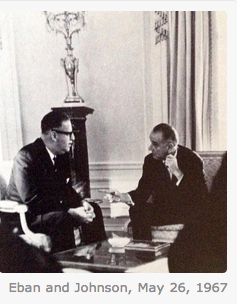
Why was Obama’s recourse to Congress so alarming? Israel has long favored strong presidential prerogatives. That’s because the crises that have faced Israel rarely ever leave it the time to work the many halls of Congress. Israel discovered the dangers of presidential weakness in May 1967, when Israel went to President Lyndon Johnson to keep a commitment—a “red line” set by a previous administration—and Johnson balked. He insisted he would have to secure congressional support first. That show of presidential paralysis left Israel’s top diplomat shaken, and set the stage for Israel’s decision to launch a preemptive war.

2013 isn’t 1967. But Israel long ago concluded that the only thing as worrisome as a diffident America is a diffident American president—and that a president’s decision to resort to Congress, far from being a constitutional imperative, is a sign of trouble at the top.

“Not worth five cents”

What did Israel want from Lyndon Johnson in May 1967? On May 22, in the midst of rising tensions across the region, Egypt’s president Gamal Abdul Nasser announced the closure of the Straits of Tiran to Israel-bound ships headed for the port of Eilat, effectively blockading it. More than a decade before that, in 1956, Israel had broken a similar Egyptian blockade by invading and occupying the Sinai. Israel withdrew in 1957, partly in return for an American assurance that the United States would be “prepared to exercise the right of free and innocent passage [through the Straits] and to join with others to secure general recognition of this right.” In 1967, when Nasser reimposed Egypt’s blockade, Israel asked the United States to make good on that 1957 commitment, by leading an international flotilla through the Straits to Eilat. Israeli foreign minister Abba Eban flew to Washington and met with Johnson in the Yellow Oval Room on May 26 to make Israel’s case.

Johnson astonished Eban by pleading that he didn’t have sufficient authority to act. The U.S. memorandum of conversation summarized it this way:

President Johnson said he is of no value to Israel if he does not have the support of his Congress, the Cabinet and the people. Going ahead without this support would not be helpful to Israel…

We did not know what our Congress would do. We are fully aware of what three past Presidents have said but this is not worth five cents if the people and the Congress did not support the President…

If he were to take a precipitous decision tonight he could not be effective in helping Israel… The President knew his Congress after 30 years of experience. He said that he would try to get Congressional support; that is what he has been doing over the past days, having called a number of Congressmen. It is going reasonably well…

The President said again the Constitutional processes are basic to actions on matters involving war and peace. We are trying to bring Congress along. He said: “What I can do, I do.”

Abba Eban later gave a more devastating version of the “five-cent” quote: “What a president says and thinks is not worth five cents unless he has the people and Congress behind him. Without the Congress I’m just a six-feet-four Texan. With the Congress I’m president of the United States in the fullest sense.” According to the Israeli record of the meeting, Johnson also acknowledged that he hadn’t made his own progress on the Hill: “I can tell you at this moment I do not have one vote and one dollar for taking action before thrashing this matter out in the UN in a reasonable time.” And Johnson ultimately put the onus on Israel to get Congress on board: “Unless you people move your anatomies up on the Hill and start getting some votes, I will not be able to carry out” American commitments.

Johnson must have understood the impression he was leaving upon Eban. In the Israeli record, there are two remarkable quotes: “I’m not a feeble mouse or a coward and we’re going to try.” And: “How to take Congress with me, I’ve got my own views. I’m not an enemy or a coward. I’m going to plan and pursue vigorously every lead I can.” That Johnson twice had to insist that he wasn’t a coward suggested that he realized just how feckless he must have seemed.

In his two memoirs, Eban recalled his astonishment at this apparent abdication:

I remember being almost stunned by the frequency with which [Johnson] used the rhetoric of impotence. This ostensibly strong leader had become a paralyzed president. The Vietnam trauma had stripped him of his executive powers….

I’ve often ask myself if there was ever a president who spoke in such defeatist terms about his own competence to act…. When it came to a possibility of military action—with a risk as trivial, in relation to U.S. power, as the dispatch of an intimidatory naval force to an international waterway—he had to throw up his hands in defeat…. On a purely logistical level, this would have been one of the least hazardous operations in American history—the inhibitions derived entirely from the domestic political context. The senators consulted by Johnson were hesitant and timorous. They thought that the possibility of Soviet intervention, however unlikely, could not be totally ignored.

The revulsion of Americans from the use of their own armed forces had virtually destroyed his presidential function. I was astonished that he was not too proud to avoid these self-deprecatory statements in the presence of so many of his senior associates. I thought that I could see [Defense] Secretary McNamara and [chairman of the Joint Chiefs] General Wheeler wilt with embarrassment every time that he said how little power of action he had.

The tactical objective, the cancellation of the Eilat blockade, was limited in scope and entirely feasible. It was everything that the Vietnam war was not. Lyndon Johnson’s perceptions were sharp enough to grasp all these implications. What he lacked was “only” the authority to put them to work. Less than three years after the greatest electoral triumph in American presidential history he was like Samson shorn of his previous strength…. With every passing day the obstacles became greater and the will for action diminished. He inhabited the White House, but the presidency was effectively out of his hands.

After the meeting, Johnson wrote a letter to Israeli prime minister Levi Eshkol, reemphasizing the primacy of the Congress: “As you will understand and as I explained to Mr. Eban, it would be unwise as well as most unproductive for me to act without the full consultation and backing of Congress. We are now in the process of urgently consulting the leaders of our Congress and counseling with its membership.” This was actually an improvement on the draft that had been prepared for him, and which included this sentence: “As you will understand, I cannot act at all without full backing of Congress.” (Emphasis added.) That accurately reflected the essence of the message conveyed to Eban, but Johnson was not prepared to admit his total emasculation in writing.

There is a debate among historians as to whether Johnson did or didn’t signal a green light to Israel to act on its own. It finally did on June 5.

“Too big for business as usual”

In light of this history, it’s not hard to see why Israel would view any handoff by a president to the Congress in the midst of a direct challenge to a presidential commitment as a sign of weakness and an indication that Israel had better start planning to act on its own. It’s not that Israel lacks friends on the Hill. But in crises where time is short and intelligence is ambivalent—and such are the crises Israel takes to the White House—Israel needs presidents who are decisive.

In seeking congressional authorization for military action in Syria, President Obama did not negate his own authority: “I believe I have the authority to carry out this military action without specific congressional authorization.” But “in the absence of any direct or imminent threat to our security,” and “because the issues are too big for business as usual,” he went to the Congress, so that “the country” and “our democracy” would be stronger, and U.S. action would be “more effective.”

Views differ differ as to whether the precedent just set will bind Obama (or his successors) in the future. But Israel understandably has no desire to become the test case, should it conclude that immediate action is needed to stop Iran from crossing Israel’s own “red lines.” Iran’s progress might not pose an imminent threat to U.S. security, and a U.S. use of force would definitely be “too big for business as usual.” So if those are now the criteria for taking decisions out of the Oval Office, Israel has reason to be concerned.

And they may well be the criteria. In 2007, then-Senator Obama was asked in an interview specifically about whether the president could bomb suspected nuclear sites in Iran without a congressional authorization. His answer:

Military action is most successful when it is authorized and supported by the Legislative branch. It is always preferable to have the informed consent of Congress prior to any military action.

As for the specific question about bombing suspected nuclear sites, I recently introduced S.J. Res. [Senate Joint Resolution] 23, which states in part that “any offensive military action taken by the United States against Iran must be explicitly authorized by Congress.”

That resolution went nowhere, but it establishes a strong presumption that Obama would insist on securing congressional authorization for the future use of force against Iran. Depending on the timing, that could put Israel in an impossible situation similar to that it faced in May 1967. Perhaps that’s why one of Israel’s most ardent supporters, Harvard Law professor Alan Dershowitz, has urged that Obama ask Congress now to authorize the use of force against Iran. Senator Lindsey Graham has proposed just that, without waiting for Obama: “I’m not asking the president to come to us; we’re putting it on the table, because if we don’t do this soon, this mess in Syria is going to lead to a conflict between Israel and Iran.”

Whether such an authorization-in-advance is feasible is an open question. In the meantime, there’s always the very real prospect that history could do something rare: repeat itself. In 1967, Israel faced a choice between an urgent need to act and waiting for a reluctant Congress to stiffen the spine of a weakened president. Israel acted, and the consequences reverberate to this day. Faced with a similar choice in the future, it is quite likely Israel would do the same.

This post first appeared on the Commentary blog on September 17. 
The NIC of time

The National Intelligence Council (NIC) has just published its fifth long-term prognostication, Global Trends 2030: Alternative Worlds. This is an officially sponsored guessing game, but much of what government does has long lead times, so long-term projections need to be made by somebody.

By their nature, these hedged predictions say as much about present politics as future probabilities. One prediction (p. 71) is particularly striking, touching as it does on the drivers of anti-Americanism in the Muslim world:

Although al-Qa’ida and others have focused on the United States [as] a clear enemy, the appeal of the United States as the “great enemy” is declining. The impending withdrawal of US forces from Iraq and decreases in US forces in Afghanistan help to reduce the extent to which terrorists can draw on the United States as a lightning rod for anger. Soon, US support for Israel could be the last remaining major focus of Muslim anger.

It’s a peculiar assessment. After all, when al-Qa’ida attacked the United States on 9/11, there were no US forces in Iraq or Afghanistan. The 9/11 attacks undoubtedly did resonate in the Muslim world, and that couldn’t have been the result of an American boots-on-the-ground presence in the region. So what drove anti-Americanism back then? Is there a suggestion here that US support for Israel was already the “major focus”? What about American support for authoritarian regimes? We are told again and again how deeply Muslims have resented such support, and they could resent it even more in 2030, should the oil-saturated monarchies of Saudi Arabia and the Persian Gulf last that long.

And what happened to the assessments in past reports, which cited “globalization” as the source of Muslim anger against the West in general, and the United States in particular? The report issued in 2000, anticipating 2015, offered this: “Popular resentment of globalization as a Western intrusion will be widespread. Political Islam in various forms will be an attractive alternative for millions of Muslims throughout the region, and some radical variants will continue to be divisive social and political forces.” Right on the mark, as evidenced by events unfolding before our eyes. Why isn’t such “intrusion” likely to continue to inflame the Muslim world?

Such resentment has a long history, and so does its neglect by Western analysts. The British historian Arnold Toynbee, in his 1922 book The Western Question in Greece and Turkey: A Study in the Contact of Civilisations, offered a striking allegory to illustrate the West’s effect upon the East:

Savages are distressed at the waning of the moon and attempt to counteract it by magical remedies. They do not realise that the shadow which creeps forward till it blots out all but a fragment of the shining disc, is cast by their world. In much the same way we civilised people of the West glance with pity or contempt at our non-Western contemporaries lying under the shadow of some stronger power, which seems to paralyse their energies by depriving them of light. Generally we are too deeply engrossed in our own business to look closer, and we pass by on the other side—conjecturing (if our curiosity is sufficiently aroused to demand an explanation) that the shadow which oppresses these sickly forms is the ghost of their own past. Yet if we paused to examine that dim gigantic overshadowing figure standing, apparently unconscious, with its back to its victims, we should be startled to find that its features are ours…

It is difficult for us to realise the profound influence on the East which we actually, though unconsciously, exercise… and the relationship described in my allegory cannot permanently continue. Either the overshadowing figure must turn its head, perceive the harm that unintentionally it has been doing, and move out of the light; or its victims, after vain attempts to arouse its attention and request it to change its posture, must stagger to their feet and stab it in the back.

The attacks of 9/11 were just such a stab in the back, and the confusion that ensued over Muslim enthusiasm for them arose precisely from America’s failure to grasp how thoroughly its revolutionary example undermines traditional orders everywhere. Where Toynbee erred, of course, was in his assumption that the West could simply “move out of the light,” thus liberating those in its shadow. No doubt there are still those who believe that if only we were to stand aside or step back, our profile would diminish, and with it the resentment against us. It was the historian and political thinker Elie Kedourie—a relentless critic of Toynbee as historian and seer—who added the necessary refinement.

In his view, the damaging effect of the West upon the East had nothing to do with what the West did. It was an inevitable effect of what the West was, and no amount of sidestepping or backtracking could mitigate the consequences. The West, Kedourie asserted, “cannot help being what it is. By the very fact of its existence, it was a destabilizing force for the Middle East.” And he employed a different allegory: “Someone who has influenza is not really responsible for the fact that someone else catches his disease.” The West could not be blamed for being what it is: the carrier of an aggressive virus that ravages all traditions.

So the suggestion in the NIC report, that Muslim anger against the United States might soon be reduced to a kernel of resentment over US support for Israel, is a species of wishful thinking. The United States will continue to infect the Muslim world, even if its willingness or ability to project hard power declines. The so-called “Arab Spring,” which is so often hailed as the product of indigenous processes, is in fact an inflammation produced by the most contagious of all viruses: the idea of freedom, now linked inseparably to American-style democracy. As long as Muslim societies remain internally divided over freedom and democracy, there will be governments and factions that will stoke hatred of America. In some places, American flags will be waved, but in others American embassies will be burned. In either case, the United States will be regarded, favorably or unfavorably, as the grinding wheel of change in the world.

There is another odd assertion in the report (p. 75):

Resolution of the Israeli-Palestinian conflict would have dramatic consequences for the region over the next two decades. For Israel, a permanent resolution to the conflict could open the door to regional relationships unthinkable today. The end of Palestinian conflict would provide a strategic setback to Iran and its resistance camp and over time undermine public support for militant groups such as Hizballah and Hamas.

This is the myth of linkage, and it echoes almost precisely a claim made by President Obama when he was still a candidate in 2008. “All these issues are connected,” Obama said.

If we can solve the Israeli-Palestinian process, then that will make it easier for Arab states and the Gulf states to support us when it comes to issues like Iraq and Afghanistan. It will also weaken Iran, which has been using Hamas and Hezbollah as a way to stir up mischief in the region.

This thesis (the theatrical NIC version reads like “New Middle East” circa 1995) seems less persuasive with each passing month, as many other “dramatic consequences” unfold, eclipsing or competing with the long-running Israel-Palestine show. The reassertion of linkage here is thoroughly political. It is not a measured assessment, but it is the sort of statement that stands a chance of being echoed by a high administration official, if not by the President himself. And it draws rebuttals from people like me—which helps to keep the NIC, a poor cousin to the agencies that deal in hard intelligence, in the limelight and on a budget line. After all, this was an agency that the Obama administration first thought to entrust to the ministrations of Chas Freeman (click here in case you’ve forgotten). That wasn’t exactly a token of high regard for the institution.

But if one really does believe in linkage, and in the “dramatic consequences” that an Israeli-Palestinian agreement would have for the region, why not reverse it? If such an agreement promises to be so transformative, shouldn’t its pursuit justify delivering hammer blows to Iran, Hezbollah, and Hamas, to keep them from obstructing it? The linkage thesis has dual uses—and abuses—which make it the favorite concept behind all sorts of reductionist approaches to the Middle East. It’s a pity to see it surface in a report that pretends to nuance and sophistication.

Haass and Hamas

Richard N. Haass is president of the Council on Foreign Relations. His last position in government was director of policy planning in the State Department, during the first couple of years of the Bush administration. The buzz in Washington is that Haass could be named special envoy for Arab-Israeli issues. The New York Times asked Haass about it for today’s edition, and he says he hasn’t been approached, but is flattered by the attention.

Read this exchange with Haass, which took place on the NewsHour:

Jim Lehrer: So what can be done about Hamas? Who can stop this?

Richard Haass: I think the key thing there that you’re probably never going to satisfy them politically, indeed, you wouldn’t want to satisfy them politically…

Lehrer: Why?

Haass: The goals of many people, in groups like Hamas, is a one-state solution, and that state isn’t Israel. It’s a Palestinian state that’s based upon probably Islamic precepts.

Lehrer: So there’s no way to negotiate with Hamas. That’s what you’re saying. Forget that?

Haass: I agree with that. That’s an important point. There are some groups out there you can negotiate with. You have to decide whether there are terms you can live with. But groups like Hamas, they have political agendas that I would suggest are beyond negotiation. And for them, and as a result there’s not a political answer—there’s got to be an intelligence, a law enforcement, and a military answer.

Exactly. Haass got it just right—back in 2003, the year of that interview, when he’d just come out of government and was presumably well-informed. But Haass subsequently had a complete change of heart. In 2006, in an article in Foreign Affairs, he wrote this:

U.S. officials ought to sit down with Hamas officials, much as they have with the leaders of Sinn Féin, some of whom also led the Irish Republican Army. Such exchanges should be viewed not as rewarding terrorist tactics but as instruments with the potential to bring behavior in line with U.S. policy.

What would make Hamas so amenable to this “behavior” modification? The United States would “articulate those principles it believes ought to constitute the elements of a final settlement, including the creation of a Palestinian state based on the 1967 lines…. The more generous and detailed the plan, the harder it would be for Hamas to reject negotiation and favor confrontation.”

To the best of my knowledge, Haass has never given any explanation for this total about-face. What has Hamas done or said since 2003, to transform it from a group “beyond negotiation,” deserving of a “military answer,” to a group that might accept negotiation and line up with U.S. policy? What sort of “details” about a Palestinian state in 1967 borders, and what degree of “generosity,” does Haass think are required to separate Hamas from what he himself once described as its implacable devotion to the elimination of Israel? I’m waiting for the evidence (and for the logic behind the analogy between Hamas and the Sinn Féin, which has been demolished many times, even by a current fellow at the Council on Foreign Relations).

Just recently, Haass cooperated with Martin Indyk of the Saban Center at Brookings, in authoring the opening chapter of a joint Council-Brookings recipe book on Middle East policy for the new administration. Indyk apparently had a restraining effect on Haass, but the idea of dialogue with Hamas survived all the same. The authors complain that “Bush’s boycott of Hamas, after it freely and fairly won the Palestinian elections, enabled America’s opponents in the Arab and Muslim worlds to raise the banner of ‘double standards.'” They go on to say that “given its [Hamas’s] control of Gaza and its support among at least one-third of Palestinians, a peace process that excludes it is bound to fail.” (In the Foreign Affairs version of this chapter, they hedge and write “could well fail.”) And they end up proposing that if Hamas keeps a ceasefire with Israel, and reconciles with the Palestinian Authority, “the next president should deal with the joint Palestinian leadership as well as authorize low-level contact with Hamas in Gaza.”

This constitutes a wholesale abandonment of every one of the Quartet’s three conditions for diplomatic engagement with Hamas: recognition of Israel, renunciation of terrorism and violence, and acceptance of previous Israeli-Palestinian agreements and obligations, including the Roadmap. What’s the justification for this? Is it that Hamas seized power in Gaza, and has made itself a spoiler by acquiring and firing thousands of rockets into Israel, each of which is intended to kill at random? If so, then say so. Instead Haass maintains that “such exchanges should be viewed not as rewarding terrorist tactics.” Well, if every single one of the Quartet’s conditions gets whittled away to nothing, why shouldn’t Hamas view it as a reward for its tactics? After all, the tactics haven’t changed.

Hamas must derive enormous encouragement from our vacillation. We set conditions; Hamas rejects them and continues to practice its “resistance”; so we drop our conditions in the name of some strategic master plan (e.g., “democracy,” the “peace process”). This happened during the Bush administration, when Hamas was allowed to run in Palestinian elections without meeting any of the conditions of an earlier Israeli-Palestinian agreement, which banned “any candidates, parties or coalitions… [that] commit or advocate racism or pursue the implementation of their aims by unlawful or nondemocratic means.” Hamas came into elections strutting guns and preaching incitement—and won. Why should they drop any of their cherished principles, when they see their adversaries seriously thinking about dropping their own? We insist that they reconcile with the PA. What if they don’t? Why shouldn’t they imagine we’ll eventually dump that condition too?

I have nothing against Richard Haass, and I’m sure that as an accomplished diplomat, he would faithfully serve administration policy. His views probably have evolved, especially over the past couple of weeks, during which he’s put in a few admirable performances in the media (for example). But his appointment at this time—as special envoy to Israel and the Arabs, of all things—might send the wrong signal, stiffening the resolve of Hamas at a time when Israel is trying to change the game. Send the right signal instead.

Update, January 13: The prospective Haass appointment, which got bounced around in the mainstream media for several days, originated in the blogosphere. Leslie Gelb explains how it got legs. He adds:

Stephen Walt called the Haass appointment “about the best us realists could expect.” Coming from the co-author with John Mearsheimer of a recent book that argued that the pro-Israeli Jewish lobby dominates U.S. policy on the Mideast to the detriment of American interests, this was a kiss of death—if Haass ever was being considered.