Special Relationships

This post first appeared on the Commentary blog on December 2.

Last week, John Kerry appeared with British foreign secretary William Hague in London, and they congratulated one another on concluding their nuclear deal with Iran. Kerry expressed American gratitude for Britain’s support. “We are determined to press forward,” he said, “and give further life to this very special relationship and to our common objectives.”
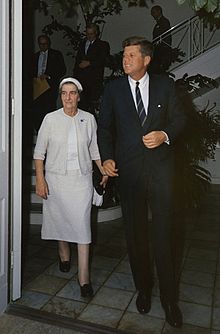
It was President John F. Kennedy who first extended the concept of a “special relationship” beyond Britain to include Israel. In December 1962, Kennedy met with Israel’s then-foreign minister, Golda Meir, in Palm Beach, Florida, and the American memorandum of conversation reported his assurance in these words: “The United States, the President said, has a special relationship with Israel in the Middle East really comparable only to that which it has with Britain over a wide range of world affairs.”

The State Department disliked this. A few months earlier, the Near East and South Asia Bureau had put together a memo on U.S.-Israel relations. “Israel’s proposals for a special relationship with the U.S. would be self-defeating if executed,” it argued. “We consider it important not to give in to Israeli and domestic pressures for a special relationship in national security matters.” But Kennedy spoke the words, and even if their definition remained foggy, they provided some reassurance to Israel every time an American president or secretary of state uttered them.

Which is why it’s worth noting that John Kerry doesn’t utter them. To the best I can determine, in his present job, he hasn’t ever described the U.S.-Israel relationship as “special.” Susan Rice, while at the UN, did so on several occasions, and Senator Kerry did it when he ran for president back in 2004 and again to AIPAC in 2009. But as best as I can tell (and I would welcome contrary evidence), he hasn’t done it as secretary of state, and that stands in striking contrast to his repeated invocation of the “special relationship” with Britain.

For example, last February he visited London and said this (Hague beaming at his side):

When you think of everything that binds the United States and Great Britain—our common values, our long shared history, our ties of family, in my case, personal and friendship—there is a reason why we call this a special relationship, or as President Obama and Prime Minister Cameron wrote, really, a partnership of the heart. It is that.

In June, Kerry (again with Hague at his side) stressed the “special relationship,” which he declared to be “grounded in so much—our history, our values, our traditions. It is, without question, an essential, if not the essential relationship.”

And in September, when Britain’s parliament voted down a motion to join the U.S. in the use of force in Syria, Kerry rushed to declare the “special relationship” intact:

The relationship between the United States and the United Kingdom has often been described as special, essential. And it has been described thusly, quite simply, because it is. It was before a vote the other day in parliament, and it will be for long afterwards after that vote. Our bond, as William [Hague] has just said, is bigger than one vote; it’s bigger than one moment in history. It’s about values. It’s about rules of the road, rules by which human beings try to organize their societies and offer people maximum freedom and opportunity, respecting rights, and finding a balance in a very complicated world. And we have no better partner in that effort than Great Britain, and we are grateful for that.

Quite early, the Obama administration earned a reputation in British public opinion for showing insufficient respect for the “special relationship,” and Kerry may see his mission as repairing that impression. But then the Obama administration stands no higher in Israeli public opinion, and Kerry sees no need to do any work of repair (and a few things he has said have heaped insult on injury).

President Obama does refer to the “special relationship” with Israel, but coming from him, the phrase means a bit less than it once did. That’s because he’s upgraded Britain to something even higher. On the eve of Obama’s visit to Britain in May 2011, he and British prime minister David Cameron published a joint op-ed in the London Times that included this sentence: “Ours is not just a special relationship, it is an essential relationship—for us and for the world.” (The headline: “Not Just Special, But An Essential Relationship.”) Suddenly, the word “essential” started cropping up in references to the relationship with Britain (see also two of the Kerry quotes above). “Essential” is now the new platinum card in relations with the United States, and Britain alone holds one. (That’s why having Britain on board the Iran deal was so important to the Obama administration, and it’s why Hague was assigned the role of setting Israel straight: “We would discourage anybody in the world, including Israel, from taking any steps that would undermine this agreement and we will make that very clear to all concerned.” How pleased he must have been to categorize Israel among the world’s “anybodies.”)

Still, while Obama may have promoted Britain, he didn’t demote Israel. And as John Kennedy made clear more than fifty years ago, the two belong in a league of their own. Just what makes a “special relationship”? It’s more than democracy—the world is full of democracies. It’s not “shared values,” since American values are widely shared around the world. What compels the United States openly to acknowledge two “special relationships” is that two foreign states embody old cultures to which the American public feels profoundly and uniquely indebted.

Given that debt, the U.S. government assumes the obligation to show a bit of respect and work a little harder to make its case, when its biggest-knows-best policies impinge on the interests of those two states. When they dissent, as Britain did over Syria and Israel now does over Iran, it’s their privilege to do so and still win American praise as “special” friends who are entitled to speak their minds freely. For an example of how it’s done, see the Kerry quote above, following the British balk on Syria. So far, there’s no equivalent for Israel over Iran.

The U.S. government’s recognition of a “special relationship” doesn’t create a fact, it acknowledges a debt felt deeply by the American people. John Kerry apparently doesn’t fully grasp that reality in regard to Israel. But then, little in his Mideast diplomacy suggests that reality constrains him anyway.

Superpower Outage

This post first appeared on the Commentary blog on November 13.

Jonathan Tobin, writing at the Commentary blog, rightly dismisses as dangerous any Israeli attempt to play China or Russia off the United States out of frustration with the Iran policy of the Obama administration. When it comes to dealing with the immediate threat posed by Iran, only Washington has superpower leverage, and if Israel wanders off the reservation, it will only damage itself.

But Jonathan makes a further claim: “Israel’s long-term safety must be seen as linked to the ability of the United States to maintain its status as the leader of the free world. Even at times of great tension with Washington, Israelis must never forget that it is not just that they have no viable alternatives to the U.S. but that American power remains the best hope of freedom for all nations.” This “linkage” is problematic, and its acceptance could blind Israelis to what they need to do to survive through the next half-century.

The problem with American power, like all power, is that it waxes and wanes. We have become used to the notion that U.S. preeminence in the world and the Middle East is a constant. But it isn’t so. Geography has rendered the United States the most self-contained superpower in history. As a result, it goes through manic bouts of interventionism and isolationism, and sometimes awakens to the responsibilities of its power too late. It did so during the Holocaust, and it did so during the first years of Israeli independence, when the fledgling Jewish state had to look to the Soviet Union and France for the arms essential to its defense. The simple truth is that Israel cannot rely on the United States to do just the right thing at just the right time. That’s at the heart of the crisis of confidence between the United States and Israel over Iran, and its sources run deeper than the particular world view of Barack Obama.

More than six years ago, before Obama even declared his candidacy, I told the Conference of Presidents that “America’s era in the Middle East will end one day,” and that “it is possible that in twenty years’ time, America will be less interested and engaged in the Middle East. What is our Plan B then?” Obama accelerated that timetable, but the long-term trend has been clear for years. And one doesn’t have to be a “declinist” to realize that the United States can lead the free world and still write off the Middle East, which isn’t part of it. That’s precisely the mood in America today.

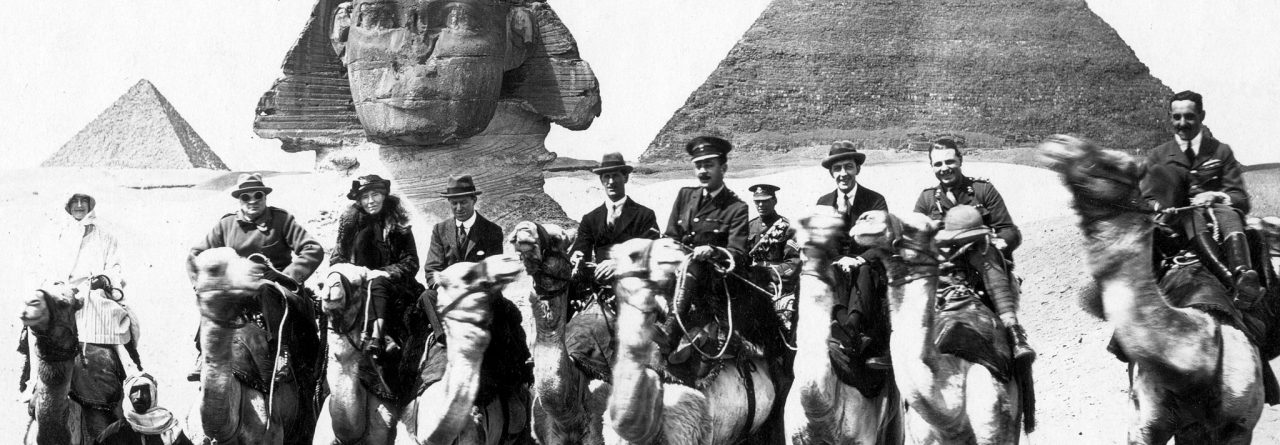
Hedging has been a fundamental principle of Zionism from its inception. That’s how it managed to outlast the fall of two empires that dominated the Middle East in the pre-state decades. When political Zionism emerged, the Ottoman Empire still held sway over the land, and Theodor Herzl went as a supplicant to the sultan’s palace in Istanbul. As late as 1912, the future first prime minister of Israel, David Ben-Gurion, and the future second president of Israel, Yitzhak Ben-Zvi, went to Istanbul to study Ottoman law, on the assumption that they would have to build the Yishuv under the same Ottoman power that had ruled the country for four centuries. (Here they are, looking like the deputies to the Ottoman parliament they planned to become.) A few years later, Ottoman power collapsed. Fortunately, Chaim Weizmann had laid the foundations for the support of the Allied victors, above all the British, whose empire now expanded to encompass the core of the Middle East.

British dominance in Palestine lasted for thirty years, during which London became the center of Zionist political activity. Britain was the mother of democracy, bastion of freedom, and home to a strong tradition of philo-Judaism and Christian Zionism. Much was made of “shared values.” But Britain, after facilitating the remarkable growth of the Yishuv, backtracked on its commitment to Zionism at the very moment of paramount Jewish need. It was Ben-Gurion who understood that the world war would bring down the British empire across Asia and Africa, Palestine included, and who sought an alliance with the ascendant United States. Still, years would pass before the United States would admit Israel to a “special relationship,” leaving Israel to fend for itself in the world’s arms market. That insecurity drove Israel to ally with Britain and France against Nasser’s Egypt—to Washington’s chagrin—and to build a nuclear capability with French assistance—in defiance of Washington.

Those days may seem distant, and Israel and the United States have had an extraordinary run. But history stands still for no people, and if our history has taught us anything about geopolitics, it is this: what is will not be. However enamored we are of the status quo, Israel needs a Plan B, and it has to consist of more than editorially flogging America for failing to maintain its forward positions in the Middle East. The State of Israel, like Zionism before it, must be agile enough to survive a power outage of any ally, and to plug in elsewhere. If Israel’s long-term safety really did depend on America’s will to govern the world, then it would be a poor substitute for Judaism’s own survival mechanism, by which the Jewish people outlasted the fall of countless host empires. But Israel’s future depends upon something within its own grasp: its ability to read the changing map of the world, to register the ebb and flow of global power, and to adapt as necessary.

Let us pray for the perpetuation of America’s power to do good in the world. Let us prepare for something less.

• Jonathan Tobin replies to this post.

Israel likes its U.S. presidents strong

The Wall Street Journal ran a symposium over the weekend about world reactions to Obama’s Syria turnaround. I wrote the contribution on Israel. Many aspects of the “turnaround,” especially the enhanced role of Russia in the Middle East, impact Israel. But I focused instead on Obama’s earlier “turnaround”: his decision to seek authorization for military action from Congress. Excerpt:

What Israelis found alarming was the way Mr. Obama shifted the burden of decision. Every one of Mr. Obama’s Syrian maneuvers was viewed as a dry run for his conduct in a likely future crisis over Iran’s nuclear drive. That’s where the stakes are highest for Israel, and that’s where Israelis sometimes question Obama’s resolve.

Israelis always imagined they would go to Mr. Obama with a crucial piece of highly sensitive intelligence on Iranian progress, and he would make good on his promise to block Iran with a swift presidential decision. So Mr. Obama’s punt to Congress over what John Kerry called an “unbelievably small” strike left Israelis rubbing their eyes. If this is now standard operating procedure in Washington, can Israel afford to wait if action against Iran becomes urgent?

Israel’s standing in Congress and U.S. public opinion is high, but the Syrian episode has shown how dead-set both are against U.S. military action in the Middle East. Israel won’t have videos of dying children to sway opinion, and it won’t be able to share its intelligence outside the Oval Office. Bottom line: The chance that Israel may need to act first against Iran has gone up.

Why was Obama’s recourse to Congress so alarming? Israel has long favored strong presidential prerogatives. That’s because the crises that have faced Israel rarely ever leave it the time to work the many halls of Congress. Israel discovered the dangers of presidential weakness in May 1967, when Israel went to President Lyndon Johnson to keep a commitment—a “red line” set by a previous administration—and Johnson balked. He insisted he would have to secure congressional support first. That show of presidential paralysis left Israel’s top diplomat shaken, and set the stage for Israel’s decision to launch a preemptive war.

2013 isn’t 1967. But Israel long ago concluded that the only thing as worrisome as a diffident America is a diffident American president—and that a president’s decision to resort to Congress, far from being a constitutional imperative, is a sign of trouble at the top.

“Not worth five cents”

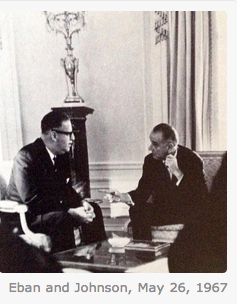
What did Israel want from Lyndon Johnson in May 1967? On May 22, in the midst of rising tensions across the region, Egypt’s president Gamal Abdul Nasser announced the closure of the Straits of Tiran to Israel-bound ships headed for the port of Eilat, effectively blockading it. More than a decade before that, in 1956, Israel had broken a similar Egyptian blockade by invading and occupying the Sinai. Israel withdrew in 1957, partly in return for an American assurance that the United States would be “prepared to exercise the right of free and innocent passage [through the Straits] and to join with others to secure general recognition of this right.” In 1967, when Nasser reimposed Egypt’s blockade, Israel asked the United States to make good on that 1957 commitment, by leading an international flotilla through the Straits to Eilat. Israeli foreign minister Abba Eban flew to Washington and met with Johnson in the Yellow Oval Room on May 26 to make Israel’s case.

Johnson astonished Eban by pleading that he didn’t have sufficient authority to act. The U.S. memorandum of conversation summarized it this way:

President Johnson said he is of no value to Israel if he does not have the support of his Congress, the Cabinet and the people. Going ahead without this support would not be helpful to Israel…

We did not know what our Congress would do. We are fully aware of what three past Presidents have said but this is not worth five cents if the people and the Congress did not support the President…

If he were to take a precipitous decision tonight he could not be effective in helping Israel… The President knew his Congress after 30 years of experience. He said that he would try to get Congressional support; that is what he has been doing over the past days, having called a number of Congressmen. It is going reasonably well…

The President said again the Constitutional processes are basic to actions on matters involving war and peace. We are trying to bring Congress along. He said: “What I can do, I do.”

Abba Eban later gave a more devastating version of the “five-cent” quote: “What a president says and thinks is not worth five cents unless he has the people and Congress behind him. Without the Congress I’m just a six-feet-four Texan. With the Congress I’m president of the United States in the fullest sense.” According to the Israeli record of the meeting, Johnson also acknowledged that he hadn’t made his own progress on the Hill: “I can tell you at this moment I do not have one vote and one dollar for taking action before thrashing this matter out in the UN in a reasonable time.” And Johnson ultimately put the onus on Israel to get Congress on board: “Unless you people move your anatomies up on the Hill and start getting some votes, I will not be able to carry out” American commitments.

Johnson must have understood the impression he was leaving upon Eban. In the Israeli record, there are two remarkable quotes: “I’m not a feeble mouse or a coward and we’re going to try.” And: “How to take Congress with me, I’ve got my own views. I’m not an enemy or a coward. I’m going to plan and pursue vigorously every lead I can.” That Johnson twice had to insist that he wasn’t a coward suggested that he realized just how feckless he must have seemed.

In his two memoirs, Eban recalled his astonishment at this apparent abdication:

I remember being almost stunned by the frequency with which [Johnson] used the rhetoric of impotence. This ostensibly strong leader had become a paralyzed president. The Vietnam trauma had stripped him of his executive powers….

I’ve often ask myself if there was ever a president who spoke in such defeatist terms about his own competence to act…. When it came to a possibility of military action—with a risk as trivial, in relation to U.S. power, as the dispatch of an intimidatory naval force to an international waterway—he had to throw up his hands in defeat…. On a purely logistical level, this would have been one of the least hazardous operations in American history—the inhibitions derived entirely from the domestic political context. The senators consulted by Johnson were hesitant and timorous. They thought that the possibility of Soviet intervention, however unlikely, could not be totally ignored.

The revulsion of Americans from the use of their own armed forces had virtually destroyed his presidential function. I was astonished that he was not too proud to avoid these self-deprecatory statements in the presence of so many of his senior associates. I thought that I could see [Defense] Secretary McNamara and [chairman of the Joint Chiefs] General Wheeler wilt with embarrassment every time that he said how little power of action he had.

The tactical objective, the cancellation of the Eilat blockade, was limited in scope and entirely feasible. It was everything that the Vietnam war was not. Lyndon Johnson’s perceptions were sharp enough to grasp all these implications. What he lacked was “only” the authority to put them to work. Less than three years after the greatest electoral triumph in American presidential history he was like Samson shorn of his previous strength…. With every passing day the obstacles became greater and the will for action diminished. He inhabited the White House, but the presidency was effectively out of his hands.

After the meeting, Johnson wrote a letter to Israeli prime minister Levi Eshkol, reemphasizing the primacy of the Congress: “As you will understand and as I explained to Mr. Eban, it would be unwise as well as most unproductive for me to act without the full consultation and backing of Congress. We are now in the process of urgently consulting the leaders of our Congress and counseling with its membership.” This was actually an improvement on the draft that had been prepared for him, and which included this sentence: “As you will understand, I cannot act at all without full backing of Congress.” (Emphasis added.) That accurately reflected the essence of the message conveyed to Eban, but Johnson was not prepared to admit his total emasculation in writing.

There is a debate among historians as to whether Johnson did or didn’t signal a green light to Israel to act on its own. It finally did on June 5.

“Too big for business as usual”

In light of this history, it’s not hard to see why Israel would view any handoff by a president to the Congress in the midst of a direct challenge to a presidential commitment as a sign of weakness and an indication that Israel had better start planning to act on its own. It’s not that Israel lacks friends on the Hill. But in crises where time is short and intelligence is ambivalent—and such are the crises Israel takes to the White House—Israel needs presidents who are decisive.

In seeking congressional authorization for military action in Syria, President Obama did not negate his own authority: “I believe I have the authority to carry out this military action without specific congressional authorization.” But “in the absence of any direct or imminent threat to our security,” and “because the issues are too big for business as usual,” he went to the Congress, so that “the country” and “our democracy” would be stronger, and U.S. action would be “more effective.”

Views differ differ as to whether the precedent just set will bind Obama (or his successors) in the future. But Israel understandably has no desire to become the test case, should it conclude that immediate action is needed to stop Iran from crossing Israel’s own “red lines.” Iran’s progress might not pose an imminent threat to U.S. security, and a U.S. use of force would definitely be “too big for business as usual.” So if those are now the criteria for taking decisions out of the Oval Office, Israel has reason to be concerned.

And they may well be the criteria. In 2007, then-Senator Obama was asked in an interview specifically about whether the president could bomb suspected nuclear sites in Iran without a congressional authorization. His answer:

Military action is most successful when it is authorized and supported by the Legislative branch. It is always preferable to have the informed consent of Congress prior to any military action.

As for the specific question about bombing suspected nuclear sites, I recently introduced S.J. Res. [Senate Joint Resolution] 23, which states in part that “any offensive military action taken by the United States against Iran must be explicitly authorized by Congress.”

That resolution went nowhere, but it establishes a strong presumption that Obama would insist on securing congressional authorization for the future use of force against Iran. Depending on the timing, that could put Israel in an impossible situation similar to that it faced in May 1967. Perhaps that’s why one of Israel’s most ardent supporters, Harvard Law professor Alan Dershowitz, has urged that Obama ask Congress now to authorize the use of force against Iran. Senator Lindsey Graham has proposed just that, without waiting for Obama: “I’m not asking the president to come to us; we’re putting it on the table, because if we don’t do this soon, this mess in Syria is going to lead to a conflict between Israel and Iran.”

Whether such an authorization-in-advance is feasible is an open question. In the meantime, there’s always the very real prospect that history could do something rare: repeat itself. In 1967, Israel faced a choice between an urgent need to act and waiting for a reluctant Congress to stiffen the spine of a weakened president. Israel acted, and the consequences reverberate to this day. Faced with a similar choice in the future, it is quite likely Israel would do the same.

This post first appeared on the Commentary blog on September 17.