by Martin Kramer
The Journal of the Middle East and Africa 16, no. 1 (2025): 1–14, https://doi.org/10.1080/21520844.2025.2449738
Abstract: This article revisits Yasir Arafat’s 1974 address to the United Nations General Assembly, a pivotal moment in Palestinian diplomacy. After an analysis of its preparation, translation, delivery, and reception, the article reassesses the speech’s impact on the Palestinian cause in America.
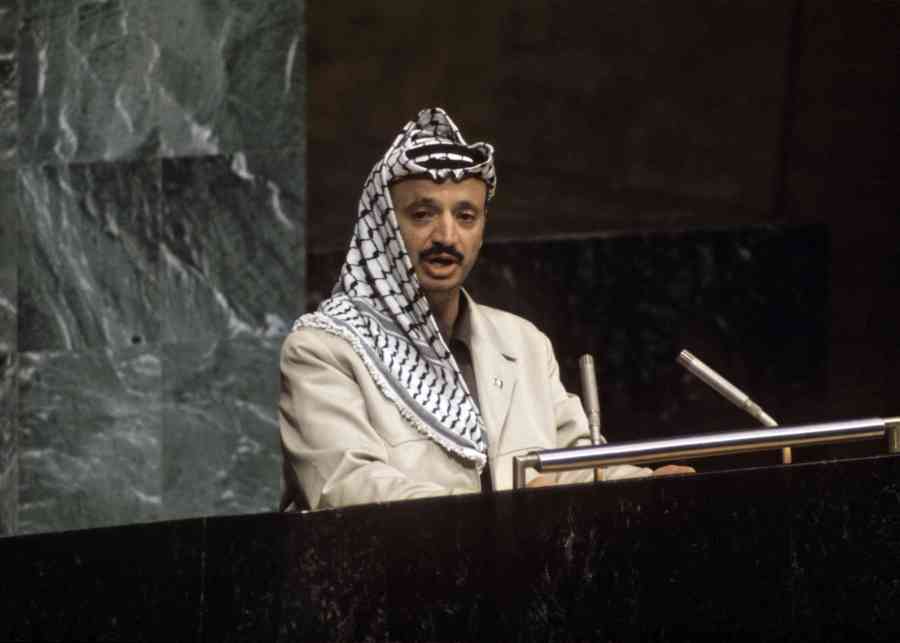
It is now fifty years since PLO Chairman Yasir Arafat’s November 13, 1974 address to the UN General Assembly. The entire Arab world thrilled to the sight of Arafat, clad in his trademark keffiyeh, khaki uniform, and holster, speaking from a podium typically reserved for heads of state. “Today, I have come bearing an olive branch and a freedom fighter’s gun,” Arafat famously proclaimed to the chamber and the world. “Do not let the olive branch fall from my hand.” He repeated that line three times, his finger raised in warning. The speech received a standing ovation.
That speech was a political triumph – “the greatest diplomatic success in Palestinian history,” according to Palestinian-American historian Rashid Khalidi.1 One Palestinian biographer of Arafat, despite being a harsh critic, called his UN appearance “one of the greatest successes in the history of a national movement fighting for independence. It is remembered by Palestinians the way Americans remember the landing on the moon.”2
Arafat’s efforts culminated in the UN’s decision, days later, to grant the Palestine Liberation Organization (PLO) observer status – a symbolic acknowledgment of Palestinian claims and a step toward political legitimacy. Israel found itself on the defensive, in a UN increasingly dominated by newly independent Asian and African states. In 1947, Zionists had celebrated the General Assembly’s recommendation for a Jewish state. In 1974, Israelis decried what they saw as a betrayal by that same body. (Resentment deepened further in 1975, when the General Assembly passed a resolution declaring that “Zionism is a form of racism and racial discrimination.”)
Yet Arafat’s UN speech was as much theater as it was politics, filled with frantic pacing, comic misunderstandings, and the tumult of doors popping open and slamming shut. “The whole thing had a slight Marx Brothers element to it,” recalled Brian Urquhart, a renowned British UN official and trouble-shooter. “I say this with great kindness, but it was sort of like everything that Arafat does, with a certain element of farce and a great deal of rushing about.”3
To mark the anniversary, I have chosen to focus on how the speech was drafted and translated, framed by some telling anecdotes and followed by an overall assessment.
“Sole legitimate representative”
By 1974, Arafat was already on his way to fame. He first appeared on the cover of Time magazine in 1968, wearing his signature sunglasses and keffiyeh. At the time, he operated against Israel from within Jordan, but in 1970, Jordan’s King Hussein expelled him and the PLO from the country. The PLO quickly regrouped in Palestinian refugee camps in Lebanon, where Arafat established control over a rogue state-within-a-state based in Beirut.
Then came the October 1973 Arab-Israeli War and the subsequent oil embargo. The emboldened and enriched Arab regimes leveraged their new-found clout to elevate the Palestinian cause, partly in an effort to contain Arafat.
Henry Kissinger, the U.S. Secretary of State, urged the Israeli government to negotiate with Jordan over the West Bank. “Israel hasn’t realized their choice is between dealing with Jordan and dealing with Arafat,” he said in private. “They can’t deal with neither.”4 But Israel resisted, and in October 1974, the Arab League, meeting in Rabat, sidelined Jordan and recognized the PLO as the “sole legitimate representative of the Palestinian people.” The Arab states had effectively become patrons of the Palestinian “revolution.”
In September 1974, Algerian Foreign Minister Abdelaziz Bouteflika was elected President of the UN General Assembly. This paved the way for an Arab initiative to secure a General Assembly vote inviting Arafat to speak, as the opening act of a comprehensive discussion on “the question of Palestine.”
The vote passed, and the maneuvering began. How would Arafat travel to New York, and which PLO members would accompany him? Who would handle his security? Most importantly, what tone would he adopt? Would he appear as the fiery revolutionary, spewing rhetoric, or as a statesman, signaling flexibility? Behind the scenes, a struggle unfolded as governments and individuals vied to influence the direction of Arafat’s speech.
“Get a shave”
One of the most intriguing interventions came from the leader of Lebanon’s Shi‘ites, Imam Musa Sadr. The Imam, whose followers largely resided in southern Lebanon, maintained an open line to Arafat, whose fedayeen operated near Shi‘ite villages. Sadr also had a notable admirer in the American ambassador to Lebanon, McMurtrie “Mac” Godley.
On November 11, two days before the speech, Sadr told Godley he had a “lengthy discussion” with Arafat. Sadr assured Godley that Arafat would deliver “a statesmanlike speech” and described him as “a responsible government leader and no longer a revolutionary military chieftain.” The Imam had urged Arafat to “discard his dark glasses, keffiyeh, and get a shave” to make his transformation evident.
Sadr then conveyed Arafat’s primary concern: would any U.S. official greet him in New York? Godley replied that no one would, as doing so would “complicate the U.S. peace-seeking role.”
The Imam then inquired if it would not be possible for some distinguished non-governmental American, such as a college professor, etc., to be on hand to welcome Arafat to the United States. While he accepted our argumentation regarding U.S. officials, these nuances were not—repeat, not—understood by Arafat, who is a total neophyte to sophisticated, protocolaire nuances and who is accustomed to the Arab reception style of being welcomed in one’s home, etc.5
In fact, Arafat was no neophyte and had savvy advisors like Nabil Sha‘ath and Shafiq al-Hout to guide him. They would have scoffed at Sadr’s suggestion that a mere college professor greet Arafat. Ultimately, there was no official greeting, as the U.S. government preferred to deal with the PLO through a CIA backchannel.6
Events on the day before the speech kept the media busy. A Jewish Defense League militant threatened Arafat’s life, declaring, “He won’t leave this country alive.” The FBI swiftly arrested him. Pro-Israel demonstrations and an anti-Arafat sit-in took place at the UN. Meanwhile, a thousand police officers patrolled the East Side and Kennedy Airport. Police snipers were stationed on the roof of the Waldorf Astoria, where the PLO delegation occupied three floors. Bomb disposal trucks were on standby nearby, helicopters hovered overhead, and patrol boats monitored the East River. Ultimately, the U.S. government picked up the $700,000 tab for security, reimbursing the City of New York.
Arafat arrived at five in the morning on the day of his speech, transported by a U.S. military helicopter to the UN building in Manhattan. At the last minute, he agreed to shave. However, he still took the podium wearing his dark glasses, keffiyeh, and holster – left empty out of respect for the venue.
Behind the scenes, another controversy arose over a symbolic protocol. When state leaders ascended the dais to address the General Assembly, they were traditionally seated in a high-backed chair during their introduction. The Americans were alarmed to see the chair on the dais. “This was a clear signal that Bouteflika intended to treat Arafat as a chief of state,” observed the U.S. ambassador, who urgently pressed his Saudi counterpart to intervene. The Saudi ambassador, after professing ignorance of the chair, went to the offices of the UN Secretary-General and the President. He later returned, claiming credit for devising a “compromise.” Ultimately, Arafat strode directly from the anteroom to the rostrum, bypassing the chair entirely. After his speech, however, he slyly draped his arm over the back of the chair while accepting applause.7
Drafting the speech
The most detailed account of how the speech was written comes from Nabil Sha‘ath, as outlined in his (Arabic) memoirs and a BBC interview.8 Arafat asked Sha‘ath, a Wharton-educated consultant who headed the PLO’s “Palestine Planning Center,” to draft the speech. Sha‘ath made a counter-proposal: “I suggest that you appoint me as the secretary to a drafting committee for the speech.”
I volunteered to draft the key points for discussion with the committee, then write the first draft for the committee to review, discuss, and modify as needed. After each revision, I would incorporate the changes and return to the committee until we arrived at a final version.9
Sha‘ath understood that his draft would require not only the approval of Abu Ammar (Arafat) but also the buy-in of other prominent PLO leaders. As a result, the drafting committee in Beirut grew large, including Abu Iyad (Salah Khalaf), Abu Jihad (Khalil al-Wazir), Shafiq al-Hout, and the poet Mahmoud Darwish. Sha‘ath explained:
I worked with the committee for three full weeks, during which we met twice a week. The meetings sometimes lasted for hours. I would read the text aloud, distribute printed copies, and record their comments, suggestions, and corrections that we agreed on in each session. I would then revise the draft to maintain coherence and consistency in tone.10
According to Sha‘ath, “I wrote the first draft and rewrote that draft about five or six times to include suggestions from those who were members of that committee.”11 Shafiq al-Hout, however, offered a different version, claiming that he finalized the text. Sha‘ath had produced only “a generic document… Abu Ammar had sent it on to me and asked me to review and amend it as necessary… It took us three whole days to accomplish this task.”12 While Sha‘ath is still with us, the passing of the other participants makes it impossible to reconcile the contradictions in their accounts.
The point of departure for the speech generated no internal dissent. Sha‘ath explained:
The strategic goal was to convince the world that we are victims of racist settler colonialism, and that our struggle is part of the broader global fight against colonialism and racism, aiming for a better world defined by freedom, justice, and equality.13
Given the UN setting, Sha‘ath aimed to frame the Palestinian cause as less specifically Arab and Muslim, and more universal and progressive: not against the Jews, but against Zionism; not against the West, but against colonialism and imperialism; and less about revolution than about freedom. Every theme in the Palestinian litany of historical grievances is present in the text, which oscillates between victimhood and resistance.14
While the starting point was clear-cut, the proposed solution was far less so. The PLO’s original position, outlined in its 1968 charter, stated that all of Palestine, once liberated, would be cleansed of Jews who had arrived “after the beginning of the Zionist invasion,” to make way for a Palestinian Arab state. This concept of coerced removal mirrored the fate of European settlers in Algeria a decade earlier, which served as a model for the early PLO.
Sha‘ath, however, championed a different approach: the creation of a unified “democratic, non-racist, secular state” for Arabs and Jews alike, which he described as “the progressive, humane alternative.”15
As an interim step, potentially leading to either outcome, the PLO had recently declared its willingness to establish a national authority (sulta) on any “liberated” area of the West Bank or Gaza wrested from Israel. This position drew criticism from Palestinian detractors, who feared the PLO might settle for partition, thereby betraying the demand for the “return” of refugees to their former homes in Israel.
According to Sha‘ath, the final version of the speech represented a compromise:
I convinced the committee and its leader, Abu Ammar, that this historic speech should speak of all of Palestine as a future path…. The discussions ultimately led to an agreement on this strategic approach, mentioning the concept of an “independent Palestinian state” once, and our right to establish a national authority over any liberated area once more, alongside the future vision for a unified, democratic, non-racist Palestinian state.16
While this formula maintained unity within Palestinian ranks, it left many observers baffled and confused.
The poet Mahmoud Darwish contributed the most famous line of the speech: “Today, I have come bearing an olive branch and a freedom fighter’s gun. Do not let the olive branch fall from my hand.” Some non-Arab sources have erroneously attributed this line to Edward Said (more on his role below).17 But as Sha‘ath explained, “The final phrasing of this well-known line was actually crafted by our great poet Mahmoud Darwish, who added it to the speech I had drafted.”18 Sha‘ath admitted that his own draft included “a longer line… [that] did not end that neatly and sharply. It was Mahmoud Darwish who recoined it to become such a memorable quote.”19
“Arafat’s delivery was superb,” Sha‘ath recalled many years later.20 Shafiq al-Hout, however, remembered it differently. In Arabic, vowel marks – diacritical symbols that guide pronunciation and grammatical meaning – are crucial to eloquent and formal speech. Arafat asked al-Hout and Darwish to add all the vowel marks in bright red ink to ensure clarity. “We did so,” al-Hout recounted, “but despite our best efforts, he still managed to ride roughshod over the complexities of Arabic grammar as he read out the speech.”21
This was not a new issue. Darwish once quipped that Arafat deserved a spot in the Guinness Book of World Records for committing three linguistic errors in a single word.22 Edward Said was even more scathing, lamenting Arafat’s “mispronunciations, hesitations, and awkward circumlocutions, seeming to an educated ear to be the equivalent of an elephant tramping aimlessly through a flower patch.”23
Despite these flaws, Arafat still conveyed an overall impression of confidence. Arabic-speakers forgave him, while others judged the speech based on its translation.
“I am a rebel”
The translation was key to how the speech would be received in the West. Sha‘ath understood this perfectly and was determined not to leave anything to chance. The goal was “to manage the translations ourselves rather than relying on live translation by the General Assembly Secretariat.” According to Sha‘ath, “I arranged for Dr. Edward Said to handle the English translation.”24
In 1974, Edward Said was largely unknown to Arab and Palestinian audiences. Even in his own field of literary studies, he was regarded as a promising yet still obscure academic. The previous year, he had spent time in Beirut on leave, reconnecting with his Arab roots, but he had not met Arafat. Said was recruited to translate the speech at the last minute – not due to any fame, but because he had been flagged as a sympathizer by Ibrahim Abu-Lughod, a trusted and veteran Palestinian-American activist and professor.
Said apparently didn’t work alone. According to Shafiq al-Hout, another individual contributed to the translation: Randa Khalidi (El Fattal), a Palestinian-Lebanese activist and Oxford graduate in English literature, who had directed the Arab League’s information office in New York.25 Once described as an “Arab propagandist,” she openly embraced the label, replying, “I do not fear the use of the word.”26
Khalidi was an English-language editor and translator by profession, later becoming a novelist and playwright in Arabic. She represented the Fatah wing of the PLO and, unlike Said, had a superior command of literary Arabic and a long history of radical activism. She appeared publicly as part of Arafat’s team in New York.
As Said and Khalidi have long since passed, the exact responsibility for the translation cannot be accurately apportioned. Among Said’s papers at Columbia University is a file related to the speech. It includes a barely marked typescript of the Arabic text and a mimeographed translation signed by Arafat himself.27 Alas, these materials provide no clear insight into the translation process. While both Sha‘ath and al-Hout credit Said, it is entirely possible that important contributions were made by Randa Khalidi.
The English translation contains numerous anomalies. One Arab analyst has suggested that it conveys “significantly fewer negative connotations than intended in the original text, which means that the translator was aware of these negative connotations and tried to mitigate them by using less problematic English elements.”28 Establishing this would require a line-by-line analysis, yet certain choices made by the translator seem to support this interpretation.
For example, Arafat twice referred to himself as a “revolutionary” (tha’ir), but neither instance was translated accurately. “I am a revolutionary for freedom” was rendered as “I am a rebel, and freedom is my cause.” (This may have been intended to evoke the famous title of the 1955 film Rebel Without a Cause, whose hero stands up to bullying.) Similarly, “I have come bearing an olive branch and a revolutionary’s gun” was translated as “I have come bearing an olive branch and a freedom fighter’s gun.” This phrasing reframed Arafat as a fighter for freedom against oppression, rather than as a threat to the established order.
An intriguing mistranslation introduced a now-ubiquitous concept. In Arabic, Arafat referred to Zionism as a project “to settle invaders from the West in Palestine.” The English translation radically alters this: Zionism’s purpose was described as “the establishment of western-style settler colonialism.” This concept reappears elsewhere in the translation: “European Jews were transformed into the instruments of aggression; they became the elements of settler colonialism intimately allied to racial discrimination.”
Today, an academic industry produces theories about settler colonialism, often aimed at negating the Jewish claim to what Jews have called the Land of Israel for millennia. That is a separate topic, but Arafat’s speech demonstrates that the concept had already gained traction among PLO intellectuals and propagandists half a century ago.29 How the phrase settler colonialism made its way into the English translation – and who was responsible – will likely never be known.
The PLO provided its translation to the UN Secretariat in advance, and the tactic proved successful. Sha‘ath explained: “The United Nations interpreters used the Edward Said translation, except when Arafat made a little change here and there.” Arafat did, in fact, go “a little bit beyond his [prepared] speech, but basically to repeat certain sentences.”30
At the PLO’s press conference following the speech, according to al-Hout, “we distributed an English copy of the speech, which had been translated by Edward Said and Randa Khalidi.”31 This translation, labeled “an unofficial United Nations translation,” filled ten columns in the New York Times the next day.
Given the high profile of this translation, it is notable that Said never publicly acknowledged his role in its production. I stand to be corrected if I’m mistaken, but I have not found a single reference in Said’s writings to his work as translator.
As the American on the team, Said was tasked with softening Arafat’s message for an American audience, but the translation only partially achieved this. In fact, the New York Times reported that “French Arabic-language experts” gave the translation a failing grade. Having “studied the original text, as delivered in Arabic by Mr. Arafat, [they] say it was ‘replete with subtleties’ that got lost in the English translation that the Palestine Liberation Organization itself supplied.”32 It is certain that Said read this critique, and it may explain why he never took credit for a translation that failed to meet the standards of clearly sympathetic “experts.”
In later years, Said acknowledged that his command of literary Arabic was far from expert. Educated in English-speaking colonial schools as a young man, he had never properly learned classical Arabic. It was only during his year in Beirut in 1972–73 that he began to “re-educate myself in Arabic language and literature,” with the assistance of a tutor.33 In his 1999 memoirs, he admitted, “Only now can I overcome my alienation from Arabic caused by education and exile and take pleasure in it.”34 Even so, he described himself as “still loitering on the fringes of the language rather than standing confidently at its center.”35
Said, a master of English, was thus an incongruous choice as a translator from Arabic and may have preferred not to be identified as one.
The ultimate goal
So much for the speech and its translation. An analysis of its reception could fill a volume. The New York Times noted that diplomats were scrutinizing the speech “as if it had come straight out of the Dead Sea scrolls.”36 Interpreting it became a pastime for both experts and commentators alike.
A good example of expert parsing came from Godley, the U.S. ambassador to Lebanon. He described the speech as “relatively restrained when set beside familiar PLO jargon and past extremist Palestinian slogans.” Godley also observed that Arafat’s “final plea for the establishment of Palestinian ‘national independent sovereignty’ was neither textually nor conceptually linked with his ‘hope’ for the eventual creation of a democratic secular state in all of Palestine.”37 If true (and who could really tell?), this was presumably progress in the right direction.
Or was this just wishful thinking? An example of high-level commentary came from Washington Post columnist George Will, who dismissed exegetes like Godley:
If Arafat is trying to hide his aim – the destruction of Israel – he is doing so in accordance with Sherlock Holmes’ axiom that the best way to hide a letter is to put it on the mantel in front of the clock. But, of course, Arafat sees no reason to hide his aim. Arafat’s message is clear. But platoons of civil servants, assuming that all politicians are like democratic politicians and thus do not take their own words seriously, will produce reams of memoranda analyzing what Arafat “really” means.38
Will went on to describe Arafat as a “hate-inspired racialist” and drew analogies between him and Hitler – no fewer than five times.
The Anti-Defamation League conducted a survey of American press reactions, finding that forty-one of the top fifty newspapers commented on Arafat’s speech. Of these, thirty-nine (95.1 percent) were critical, while only two (4.9 percent) offered a more neutral or favorable assessment.39 Israeli diplomats found some consolation in this. “From our point of view,” wrote Avi Pazner, an adviser at the Israeli embassy in Washington,
it is now easier to present the issue as a stark choice between the existence of Israel and its destruction by the PLO, relying on Arafat’s own words that received extensive media attention…. We can now point to his own words as proof that he has not shifted at all from the objectives stated in the 1968 charter. Even if the terminology has changed, the ultimate goal remains the same.40
This strategy worked, and Arafat soon came to acknowledge it. Six months later in Beirut, he complained to a visiting U.S. senator that his speech “had been greatly distorted by the press and by others. The American press saw in it only the intent to destroy Israel, not the ‘positive steps we have taken.’”41 But if emphasizing those “positive steps” was his intent, his speechwriters buried the lede. As Time magazine noted: “Although PLO moderates may eventually be resigned to some kind of territorial compromise with Israel, Arafat obviously considered last week an inappropriate time to mention it.”42
Still, the ADL press survey included this caveat:
Many papers did not categorically reject the PLO as a participant or as a factor in future negotiations for peace in the Middle East. While Arafat’s stated position before the UN was found totally unacceptable by nearly all the papers that commented, his future acceptability as a party to, or participant in, efforts at a settlement was left very much open. The prevailing view was, that everything now depends on what Arafat does, and says, in the days ahead.43
Henceforth, Arafat-watching became a global industry, with foreign analysts scrutinizing every hint of possible moderation. Even Pazner had to acknowledge that Arafat had become a new source of media fascination:
Arafat’s mere appearance sparked a wave of articles in all the newspapers on the Palestinian issue. Most of these articles focused on Arafat’s personality and the Palestinian cause, and the descriptions of Arafat did emphasize his responsibility for acts of terror. But they also conveyed a hint of admiration for his political achievements, considering that just a decade ago, he was almost unknown.44
Israel seemingly faced a dual challenge: the growing perception that the PLO might be undergoing a transformation, and the belief that a savvy Arafat had the acumen to make it happen. In the end, that concern was overblown. In 1975, civil war broke out in Lebanon, reducing the PLO to one more warring militia, until its expulsion by Israel from Beirut in 1982.
Missed opportunity?
The speech undeniably placed the Palestinian cause on the international agenda. In its wake, Arafat appeared once again on the cover of Time magazine, but with a notable difference. In 1968, the banner on the cover read “The Arab Commandos.” In 1974, it proclaimed “The Palestinians,” reflecting their transformation from a “refugee problem” to a political issue. “For the first time in their history,” wrote Edward Said five years later, “the Palestinians entered more or less consciously the international political arena where the Zionists had preceded them for almost a century.”45
The difficulty for the Palestinians was that they failed to enter the American political arena. In his speech, Arafat prioritized his home audience: the Palestinians in general and refugees in particular. “Palestinian emotions erupted later during the night in Beirut camps,” noted Godley, “where heavy and unrestrained automatic-weapons firing was heard continuously for several hours and caused considerable panic.”46
Arafat’s next priorities were the Arab, African, and Asian states at the UN, whose support had placed him on the rostrum. Shafiq al-Hout described it as “exhilarating” that Arafat “could talk like this and receive equally positive responses at the United Nations, in the refugee camps, and among Palestinian audiences all over the globe.”47
America came last. Arafat made a clumsy attempt in the speech to strike an American note, drawing a comparison between the Palestinians and “the American people in their struggle for liberation from the British colonialists.” He urged Americans “to recall George Washington to mind, heroic Washington whose purpose was his nation’s freedom and independence, Abraham Lincoln, champion of the destitute and the wretched, and also Woodrow Wilson whose doctrine of Fourteen Points remains subscribed to and venerated by our people.”
Whoever included this in the speech overlooked the implication of Arafat comparing himself to America’s founders and saviors. The Philadelphia Inquirer, published in “the birthplace of America,” pushed back:
To equate the mass murders of airline passengers, Olympic athletes, and school children with American democracy and idealism is an effrontery that reveals either a profound ignorance of American history or an insufferable infatuation with delusions of glory. Let Mr. Arafat be assured he is no Washington, Lincoln, or Wilson. His utterance of their names was a travesty.48
In America, Arafat seemed more akin to Che Guevara or Fidel Castro, both of whom had addressed the UN in the 1960s. This impression was reinforced when Arafat flew directly from his New York speech to Havana, where Castro awarded him the Order of Playa Girón: the Bay of Pigs Medal.
In 1974, it might have seemed that America’s postwar supremacy was over. The war in Vietnam had drained its confidence, the president had resigned in disgrace, the economy had contracted, and the stock market had crashed. At the same time, the Arab moment appeared to have arrived, marked by the quadrupling of oil prices. The Soviet Union, a patron of revolutionary causes, was riding high. Who could blame Arafat for attempting an end-run around the United States?
But in retrospect, America’s low point was just that – a low point – and it would soon experience a spectacular rebound. Had Arafat made a greater effort to break through in America in 1974, he might have had more to show for his UN gambit. If he had recognized that time was working against him and his allies, not for them, he might have made different choices in his speech.
At the time, the obstacles were not as formidable as they would later become. Yitzhak Rabin was leading a Labor government. There were only 10,000 Israeli settlers in the West Bank. Hamas did not yet exist. A “peace process” in the 1970s might have looked very different from the one that emerged in the 1990s.
Not until 1988 did Arafat again appear solo on the cover of Time, this time without his sunglasses, and under the headline “About Face.” “Why Arafat Said the Magic Words” read the subhead. It referred to his renouncing terrorism and recognizing Israel, opening the door to a formal U.S.-PLO dialogue. It was the nod of the United States, not the applause at the UN, that finally advanced Arafat toward his goal. By that time, however, that goal had receded from reach.
Shafiq al-Hout, thirty years after the speech, claimed that it was the United States that missed the opportunity, because “any intelligent person would have understood that Arafat’s ‘gun and the olive branch’ speech… was an implicit recognition of the State of Israel.”49 But an intelligent person, at the same distance in time, might think otherwise. “Arafat appeared as a belligerent revolutionary,” wrote Arab-American commentator Hussein Ibish,
speaking about holding a gun in one hand and an olive branch in the other. His comments were well-received among many Arabs and others in the Third World, but they played right into the hands of those who sought to depict him as a violent terrorist.50
That is precisely how Arafat was perceived in America for years to come. Framed this way, it is debatable whether his UN appearance advanced the Palestinian cause or had the opposite effect and set it back. “We had waited a quarter of a century for this moment,” recalled Shafiq al-Hout, “and we had paid very dearly for it.”51 Yet, if Ibish is correct, the Palestinians who thrilled to Arafat’s finger-wagging ultimatum may have continued to pay for it, many times over.
Notes
- Rashid Khalidi, The Hundred Years’ War on Palestine: A History of Settler Colonialism and Resistance, 1917–2017 (New York: Metropolitan Books, 2020), 117. Back to text
- Saïd K. Aburish, Arafat: From Defender to Dictator (New York: Bloomsbury Publishing, 1998), 142. Back to text
- Quoted by Andrew Gowers and Tony Walker, Behind the Myth: Yasser Arafat and the Palestinian Revolution (London: W.H. Allen, 1990), 129. Back to text
- Memorandum of conversation, Washington, March 8, 1974, in Foreign Relations of the United States, 1969–1976, vol. 26, Arab-Israeli Dispute, 1974–1976, ed. Adam M. Howard (Washington: U.S. Government Printing Office, 2011), document 31. Back to text
- G. McMurtrie Godley, “Reception of Yassir ‘Arafat,” cable no. 13491, Beirut, November 11, 1974. U.S. Department of State, https://web.archive.org/web/20241219193647/https://wikileaks.org/plusd/cables/1974BEIRUT13491_b.html. State Department cables lack prepositions, and all letters are capitalized. For ease of reading, I have corrected both, in this and subsequent quotes. Back to text
- This was the channel between CIA officer Robert Ames and Ali Hassan Salameh, chief of operations for Fatah. Salameh accompanied Arafat to New York and met Ames there. For the channel, see Kai Bird, The Good Spy: The Life and Death of Robert Ames (New York: Crown, 2014). Back to text
- John A. Scali, “PLO Leader Arafat’s Appearance in GA,” cable no. 1974USUNN05048_b, New York, November 13, 1974, U.S. Department of State, https://web.archive.org/web/20240623072241/https://wikileaks.org/plusd/cables/1974USUNN05048_b.html. Back to text
- Nabil Sha‘ath, Hayati min al-Nakba ila al-Thawra: Sira Dhatiyya (Cairo: Dar al-Shuruq, 2016), chap. 12, hereafter cited as Sha‘ath, Hayati; and “Arafat Goes to the United Nations,” Witness History, BBC World Service, first broadcast September 30, 2012, https://www.bbc.co.uk/programmes/b01n0vh2, hereafter cited as Sha‘ath, interview. Back to text
- Sha‘ath, Hayati. Back to text
- Sha‘ath, Hayati. Back to text
- Sha‘ath, interview. Back to text
- Shafiq al-Hout, My Life in the PLO: The Inside Story of the Palestinian Struggle, trans. Hader Al-Hout and Laila Othman (London: Pluto Press, 2010), 121. Back to text
- Sha‘ath, Hayati. Back to text
- The most authoritative in English: “Palestine at the United Nations,” Journal of Palestine Studies 4, no. 2 (Winter 1975): 181–92, https://www.jstor.org/stable/2535860; and Yasir Arafat, Palestine Lives (Washington, D.C.: Free Palestine, 1974), https://archive.org/details/Arafat_201310 (a facsimile reproduction of the translation circulated by the PLO at the UN). The most authoritative in Arabic: “Al-khitab al-ta’rikhi li-l-akh Abu ‘Ammar fi dawrat Filastin: al-harb tandali’ min Filastin wa al-silm yabda’ min Filastin,” Shu’un Filastiniya 40 (December 1974): 5–19. Back to text
- Sha‘ath, Hayati. Back to text
- Sha‘ath, Hayati. Back to text
- For example, Adam Shatz, “Palestinianism,” London Review of Books 43, no. 9 (May 6, 2021), https://www.lrb.co.uk/the-paper/v43/n09/adam-shatz/palestinianism (“Said helped draft the speech and added the closing line: ‘Don’t let the olive branch fall from my hand.’”) Back to text
- Sha‘ath, Hayati. Back to text
- Sha‘ath, interview. Back to text
- Sha‘ath, Hayati. Back to text
- Al-Hout, My Life in the PLO, 121. In al-Hout’s Arabic memoirs, on which this translation is based, the wording is stronger: Arafat “made every conceivable error.” Back to text
- According to Wadi‘ ‘Awawdah, “Abu ‘Ammar al-insan…. Hikayat yarwiha rufaqa’ wa-asdiqa’,” Al-Quds al-Arabi, November 10, 2024. Back to text
- Edward W. Said, “Living in Arabic,” Raritan 21, no. 4 (Spring 2002): 229. Back to text
- Sha‘ath, Hayati. Back to text
- Al-Hout, My Life in the PLO, 125. Back to text
- Letter from Randa Khalidi Fattal, New York Magazine, March 22, 1971, 5. Back to text
- Edward W. Said Papers, MS #1524, box 124, folder 2, Rare Book & Manuscript Library, Columbia University, New York, NY. Back to text
- Alaa M. I. Abudaher, Transfer of Ideology in the Translation of Political Speeches: Yasser Arafat’s Speech at the UN in 1974 (Master’s thesis, University of Gothenburg, 2024), https://gupea.ub.gu.se/handle/2077/82318. Back to text
- The landmarks here: Fayez A. Sayegh, Zionist Colonialism in Palestine (Beirut: Research Center, Palestine Liberation Organization, 1965); and Maxime Rodinson, Israel: A Colonial-Settler State?, trans. David Thorstad (New York: Monad Press, 1973), which was reviewed in the PLO’s journal Shu’un Filastiniya. Back to text
- Sha‘ath, interview. Back to text
- Al-Hout, My Life in the PLO, 125. Back to text
- Paul Hofmann, “Arafat’s Message,” New York Times, November 15, 1974. Back to text
- Edward Said, “Reflections on the Fall of Beirut,” London Review of Books 7, no. 12 (July 4, 1985), https://www.lrb.co.uk/the-paper/v07/n12/edward-said/edward-said-reflects-on-the-fall-of-beirut. Back to text
- Edward Said, Out of Place (New York: Knopf, 1999), 198. Back to text
- Said, “Living in Arabic,” 234. Back to text
- Hofmann, “Arafat’s Message.” Back to text
- G. McMurtrie Godley, “Yasser Arafat and the UNGA,” cable no. 13681, Beirut, November 14, 1974, U.S. Department of State, https://search.wikileaks.org/plusd/cables/1974BEIRUT13681_b.html. Back to text
- George F. Will, “Knowing One When You See One,” Washington Post, November 16, 1974. Back to text
- Jerome Bakst, “U.S. Press Reaction to Arafat’s U.N. Speech,” Anti-Defamation League of B’nai Brith, December 1974, copy in Israel State Archives, “Palestinians, Arafat, vol. 5 (January 4, 1974 – December 27, 1974),” file no. 8158/3, citation ID: 000psxf. Back to text
- Avi Pazner, “Arafat at the UN,” despatch no. 258, Washington, November 14, 1974, Israel State Archives, “Directors General [Prime Minister’s Office] M. Gazit, O. Eran: Palestinians, vol. 3 (November 1974 – June 1975),” file no. A-278/13, citation ID: 000wi8k. Back to text
- Howard H. Baker Jr., Peace and Stability in the Middle East: A Report to the Committee on Foreign Relations, United States Senate, 94th Congress, 1st sess., Committee Print (Washington, DC: U.S. Government Printing Office, 1975), 10. Back to text
- “Guns and Olive Branches,” Time, November 25, 1974. Back to text
- Bakst, “U.S. Press Reaction to Arafat’s U.N. Speech.” Back to text
- Avi Pazner, “Arafat at the UN.” Back to text
- Edward W. Said, The Question of Palestine (New York: Vintage Books, 1980), 224. Back to text
- Godley, “Yasser Arafat and the UNGA.” Back to text
- Al-Hout, My Life in the PLO, 130. Back to text
- “Arafat is No Hero, Despite the U.N. Cheers,” Philadelphia Inquirer, November 15, 1974. Back to text
- “Arafat and the Journey of the Palestinian Revolution: An Interview with Shafiq Al-Hout,” Journal of Palestine Studies 39, no. 1 (2009): 52. Back to text
- Hussein Ibish, “The Speech Yasser Arafat Never Gave,” NOW Lebanon, September 27, 2011, https://web.archive.org/web/20120130110040/https://nowlebanon.com/NewsArchiveDetails.aspx?ID=315757. Back to text
- Al-Hout, My Life in the PLO, 123. Back to text
Notes on Contributor
Martin Kramer is a historian of the Middle East at Tel Aviv University, and the Walter P. Stern fellow at The Washington Institute for Near East Policy.
ORCID
Martin Kramer
http://orcid.org/0000-0002-2560-2679

