365 Days of Campus Watch

A year ago, and one week after the launch of Sandstorm, Daniel Pipes launched another website: Campus Watch. How well I remember. My endorsement of Campus Watch appeared in its first press release, and since Pipes happened to be traveling in Canada, I was the one who got inundated with calls from journalists asking just what Campus Watch intended to do. I dodged the question: I had endorsed Campus Watch on trust, without knowing the direction Pipes would take. I knew only that he had invoked my book, Ivory Towers on Sand, as inspiration for the project.

It wasn’t long before cries of McCarthyism rolled across the land, as a result of the website’s opening gambit: listing a number of professors with especially egregious records. It was a wild start. But a year later, and looking back on it, I can say with certainty (and relief) that my trust in Campus Watch was vindicated. After the initial wave of publicity and protest, it dropped the list of professors, and began to provide two invaluable services to the public.

First, the website has scoured the press, posting everything related to the Middle East politics of American academe. Until Campus Watch, such material accumulated only in the files of organizations and universities. Since Campus Watch, it has been available to anyone. This has made the site immensely popular, to judge from its ratings. And since the Campus Watch site refers traffic to Sandstorm (instead of posting), I know from my own tracker that many of its readers come from universities (dot-edu domains). I wouldn’t be surprised to learn that most people in Middle Eastern studies rely on the site to follow debates about their own field and Middle Eastern matters on campus.

Second, Campus Watch has conducted and published its own research. Many academics feared that Campus Watch would be engaged in espionage in the classroom, because it invited students to send it information. But while students may have helped to alert Campus Watch to problems, the published research of Campus Watch over the last year has been based upon the on-the-record speaking and writing of the professors themselves. The research has been solid and well-documented—the same sort of rigor I try to practice in this column.

In sum, Campus Watch has provided a real service and met a genuine need. And regular visitors to the site cannot but reach the conclusions that animated its launch: first, that the American campus has become an arena in which some professors openly propagandize on Middle Eastern issues; and second, that Middle Eastern studies—the supposed bastion of objectivity—are no exception. Indeed, on some campuses, they are the heart of the problem.

Over the year, I was often amazed by the way some academics and students played up the “menace” of Campus Watch. This reached a disgraceful culmination at York University in Toronto, where a university research center disinvited Daniel Pipes on the spurious grounds that Campus Watch somehow threatened academic freedom. It reached a comic apogee in the completely bogus claim by a UCLA professor that he had been listed by Campus Watch—a crass bid for the sympathy of his fellows. Those criticized by Campus Watch suffered, at worst, bouts of email spamming (quelle horreur!), but charges of McCarthyism and cries of “Down with Campus Watch!” became the convenient rallying cry for a wide range of campus opportunists and poseurs.

The fact is that Campus Watch plays within the rules of legitimate give-and-take. Its gloves are off, but it doesn’t slug beneath the belt. And it more than proved its worth in its first year. That’s because in the build-up to the Iraq war, many professors said and wrote things that perfectly exemplified their complete detachment from the realities of the Middle East and American politics. The statements that caught the headlines—such as the hope expressed by a Columbia professor that “a thousand Mogadishus” befall U.S. forces in Iraq—were not isolated blurtings by way-out extremists. They were extrapolations of ideas and arguments generated by professors in Middle Eastern studies. Thanks to the reporting of Campus Watch, it was possible to see patterns in this patter.

The next step for Campus Watch is to move beyond criticism to foster new alternatives within Middle Eastern studies. Students often write to me, asking where they should study to escape the rigid conformism of the field. The question has no easy answer, but I intend to formulate one, and Sandstorm will be making some endorsements this year. Daniel Pipes, who has taken a seat on the board of the United States Institute of Peace, is now positioned to legitimize and support alternatives in scholarly research. Campus Watch has set its ultimate goal as “the improvement of Middle Eastern studies.” Achieving that will take more than watching for bias. It means watching for promise too.

Concealment Continues at Columbia

“An outrageous Israeli, Martin Kramer, uses his website to attack everybody who says anything he doesn’t like.” That’s Edward Said speaking, in an interview in a new collection entitled (predictably) Culture and Resistance. I would take it as a compliment, if I didn’t already know how easily Professor Said is outraged. But it’s a valuable testimonial nonetheless, and one worth quoting as Sandstorm marks its first anniversary.

Said offers this sample of my outrageous conduct:

For example, [Kramer] has described Columbia as “the Bir Zeit (university) on the Hudson,” because there are two Palestinians teaching here. Two Palestinians teaching in a faculty of 8,000 people! If you have two Palestinians, it makes you a kind of terrorist hideout. This is part of the atmosphere of intimidation that is McCarthyite.

I’m delighted to learn from this passage (and other sources) that my “Bir Zeit-on-Hudson” label has stuck to Columbia. Columbia warrants it not because Palestinians dominate the teaching of the modern Middle East there (they do), but because of the total absence of other perspectives, and Columbia’s apparent lack of interest in promoting a diversity of approaches. I never called Columbia a terrorist hideout, nor have I described any of its faculty as apologists for terrorism. I do accuse them of creating, on their campus and especially in the Middle East department, an atmosphere of intimidation that really is McCarthyite.

Said’s interview also jogged my memory: his reference to me includes a footnote harking back to a Sandstorm entry from last November. It was then that newspapers first reported that Rashid Khalidi, a University of Chicago historian, had been invited to Columbia to occupy the newly-established Edward Said Chair of Arab Studies. It was also reported that Columbia would protect the anonymity of the chair’s donor(s). In my entry, I insisted that the university had an obligation to reveal the identity of the donor(s).

Here we are, ten months later, and there has been no disclosure. A couple of donors, approached by a journalist, have acknowledged making contributions. But the vast majority of donors—and there are apparently almost twenty—have remained anonymous, and Columbia has not published any names.

As it happens, I have seen what purports to be a list of the donors. I’m not at liberty to publish it, and in any case I see no reason to relieve Columbia of its responsibility. But I don’t think it would violate a trust if I were to characterize the list. It includes individuals and foundations, Arab and non-Arab, known as supporters of the Palestinian cause—no surprise there. There is a corporate presence, which is a bit of a surprise. And on the list that I have seen, there is a foreign government, which I find positively alarming.

Why alarming? Rashid Khalidi, the new incumbent of the Said Chair, has also been named the director of Columbia’s Middle East Institute, which will receive about $1 million in federal subsidies over the next three years. Under any circumstances, a university’s concealment of a gift from a foreign source strikes me as unethical. Under these circumstances, Columbia’s failure to disclose is unconscionable. It’s also worth noting that if a foreign gift is large enough ($250,000), it must be disclosed to the U.S. Department of Education in a timely manner, according to Section 1011f. of the Higher Education Act (“Disclosure of Foreign Gifts”). In New York State, there is a similar disclosure law that kicks in at $100,000, although according to a recent account, “there is little, if any, compliance with existing law.” Ah, universities.

All of which leads me back to my original demand. Now that the incumbent of the Said Chair is administering a federally-funded National Resource Center, with control over taxpayers’ funds, his own funding is a matter of the public interest. Columbia must make known the donors, or at the very least identify any foreign government, entity or person that contributed to the endowment of the Edward Said Chair. If Columbia continues to refuse to make such information public, the Department of Education should initiate action to secure it, and then make it available to the rest of us.

I also urge the Middle East Studies Association (MESA), at its annual conference in November, to pass a general resolution calling upon all universities to reveal the sources of endowments in our field. The remaining credibility of Middle Eastern studies is at stake. If Columbia’s practices spread throughout the field, it is only a matter of time before a major scandal erupts, linking scholars to tainted money. MESA should stand unequivocally on the side of public disclosure—even if Khalidi is a former MESA president, and even if the current MESA president is a Columbia dean.


Updates from Sandbox

The updates below originally appeared in Sandbox, this website’s quick news log. Sandbox is a supplement to the established weblog Sandstorm.

Dirhams at Columbia. On Friday, Columbia University finally disclosed the list of donors to the Edward Said Chair, held by Rashid Khalidi. Six months ago, I’d reported the presence on the donor list of a foreign government, but I didn’t name it. Now it’s confirmed: the United Arab Emirates. At this moment, a gift chair from the UAE to Harvard’s Divinity School is frozen, because of questions about the propriety of accepting it. Columbia apparently doesn’t have the same scruples, and saved itself a controversy by keeping the gift secret. Concealing gifts from foreign governments in this field is never acceptable, period. What I find disgraceful is that the leaders and institutions of Middle Eastern studies didn’t join my demand for transparency. Shame, shame, shame.
Wed, Mar 17 2004 7:06 pm
Share a chair. Several readers have asked for the full list of donors to the Edward Said Chair, which Columbia released Friday. For some reason, it’s not on Columbia’s website. Here is the list:


Yusef Abu Khadra
Abdel Muhsen Al-Qattan
Ramzi A. Dalloul
Richard and Barbara Debs
Richard B. Fisher
Gordon Gray, Jr.
Daoud Hanania
Rita E. Hauser
Walid H. Kattan
Said T. Khory
Munib R. Masri
Morgan Capital & Energy
Olayan Charitable Trust
Hasib Sabbagh
Kamal A. Shair
Abdul Shakashir
Abdul Majeed Shoman
Jean Stein
United Arab Emirates

Thu, Mar 18 2004 7:24 pm


Columbia owns up. The Columbia Spectator now tells the full story of Columbia’s ethical and legal dereliction in concealing the donors of the Edward Said Professorship (incumbent: Rashid Khalidi). The names were finally disclosed on March 12. Reporter Chris Beam writes: “Kramer, who led the call for disclosure of the names, wrote in an e-mail that although individual donors might justifiably request anonymity, gifts from foundations and corporations should be revealed. ‘But above all’, he wrote, ‘there are no circumstances—and I repeat that—no circumstances whatsoever, that justify the anonymity of a foreign government that has given to a university’.” The government in question: United Arab Emirates, good for $200,000.
Fri, Mar 26 2004 10:17 am
Palestinian millionaires. Sixteen of the donors to the Edward Said Professorship are individuals. Eight of these are trustees of the Geneva-registered Welfare Association, which gives to Palestinian welfare and development projects. The association, a wealthy club, has about a hundred active members, most of them prominent Palestinian businessmen. Edward Said was also a trustee. The Columbia Spectator article, cited immediately below, reports that Rita Hauser, a well-connected New York lawyer and philanthropist who happens to be Jewish, originally proposed the chair. Maybe, but these Palestinian millionaires look to me like the core of the initiative.
Sun, Mar 28 2004 8:48 am
And Columbia too. One of the donors of the Edward Said Professorship at Columbia is Ramzi Atta Dalloul. Once upon a time, he brokered arms deals between France and Iraq. When Saddam found out how much Dalloul was skimming off the top, he summoned him to Baghdad to demand his money back. Ken Timmerman’s Death Lobby (p. 66): “The terrified Palestinian is said to have forked up $8 million in cash and may have made other ‘contributions’ to a secret Baath party fund held in a Swiss bank.” (Here’s more on Dalloul’s Iraq deal from Said K. Aburish, who was in on it.) Dalloul was a generous fellow, according to Timmerman: “Besides making contributions to Arafat’s Fatah Movement, Dalloul sought additional protection by making substantial payments to one of Arafat’s rivals, the radical Palestinian leader George Habash.”
Sun, Mar 28 2004 5:57 pm
What about Columbia? Harvard University’s Divinity School has decided to return that $2.5 million gift for an Islamic studies chair to the donor: the United Arab Emirates. Bottom line: the UAE is just too toxic to warrant the kind of legitimation Harvard confers. Remember: the UAE also contributed $200,000 toward the Edward Said Chair at Columbia, a fact concealed by Columbia until last spring. Maybe now’s the time for Columbia to consider returning that UAE gift. Or are Columbia’s standards not quite up to Harvard’s?
Wed, Jul 28 2004 2:43 pm
Why Columbia should. Harvard is returning $2.5 million to the United Arab Emirates, donated earlier to establish an Islamic studies chair. The UAE also gave $200,000 toward the new Edward Said Chair at Columbia. So will Columbia return its gift? “Why would we?” a Columbia spokesperson says. “Our gift differs in both the source and the purpose from the Harvard gift.” Nonsense. If anything, Columbia has a greater obligation to return UAE money. (1) Columbia initially concealed the gift. (2) The chair it helped to create has adequate funding from other sources. (3) It’s disgraceful that a chair named after a University Professor (Columbia’s elect) be funded even partly by the ruler of a country defined as “not free.”
Mon, Aug 9 2004 3:10 a

Lawrence of Academia?

Last month, academics who run a discussion log on Middle Eastern studies exchanged ideas on how to justify their Title VI federal subsidy. One of them posted this:

The anecdote/argument that I find works best with gov’t officals concerning the importance of Title VI funding is to note that Lawrence of Arabia was only in a position to help the British war effort because he had a grant to study crusader castles as part of his academic studies before the war. Without that “soft,” non-policy oriented academic work, he would not have had the linguistic skills, cultural knowledge and geographic familiarity with the region to help the war effort….[this] does tend to open the eyes of more narrow-minded gov’t folks looking for a direct payoff between gov’t funding of area studies and potential national security benefit.

Another academic responded with this:

Not in the same league as the T.E. Lawrence anecdote, but a bit closer to home. It turns out that General Abizaid, who is taking Tommy Frank’s position, has an MA in area studies from Harvard.

These anecdotes seem to be the best Middle Eastern studies can muster to support the notion that they do contribute to national security. In fact, they actually demonstrate the opposite of what the academics claim.

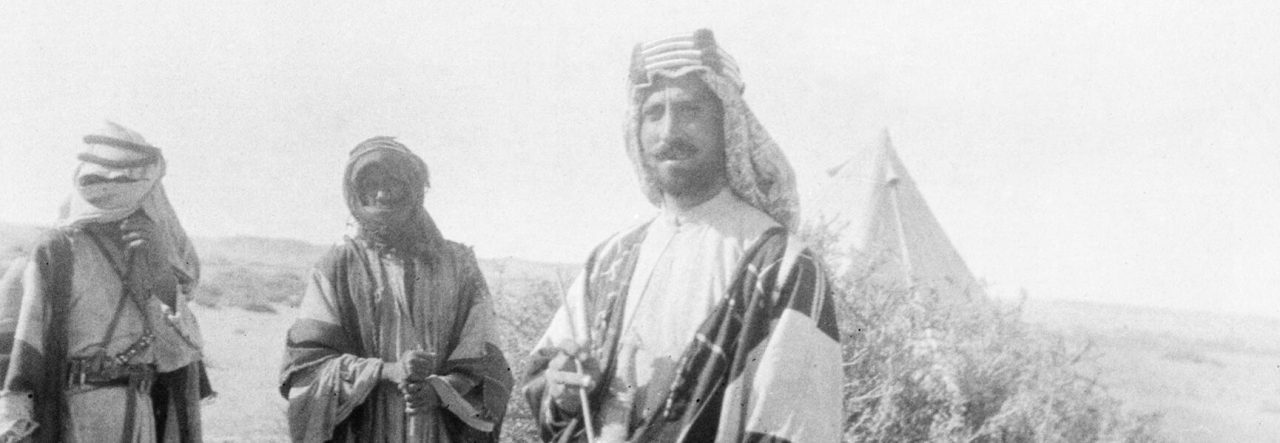
T.E. Lawrence, Oxford student, did go out to Syria before the First World War, to study medieval castles and do some archeology. And he did acquire a knowledge of Arabic, a familiarity with the Arabs, and a lot of geographic knowledge. But how did he get out to Syria, and who put him “in a position to help the British war effort”? Answer: D.G. Hogarth his professor.

It was Hogarth, Keeper of the Ashmolean Museum and an Oxford don, who saw the potential of young Lawrence. It was Hogarth who arranged his travelling scholarship. It was Hogarth who employed him before the war, at his archeological dig in northern Syria. And it was Hogarth who directed the wartime intelligence branch known as the “Arab Bureau” in Cairo from 1916. Lawrence acted on its behalf in Arabia.

Lawrence always acknowledged his debt to his professor. “D.G.H. had been a god-father to me,” he later wrote, “and he remained the best friend I ever had.” “I owe to [Hogarth] every good job I’ve had,” he told two of his biographers. “He is the man to whom I owe everything I have had since I was seventeen.” And this, in his Seven Pillars of Wisdom: “Mentor to us all was Hogarth, our father confessor, and advisor, who brought us the parallels and lessons of history, and moderation and courage.” No Hogarth, no Lawrence—this has been the considered opinion of more than one Lawrence biographer.

So the Lawrence anecdote really poses this question: where are America’s Hogarths? Where are the professors with a strong sense of the national interest, lots of knowledge acquired in the field, good intelligence connections, a willingness to recruit their students, and an eagerness to serve in times of war? No such person exists in Middle Eastern studies. Indeed, Hogarth-like activities would be enough to get even the most established professor drummed out of the field.

And this leads to the second example: the new commander of CENTCOM, General John Abizaid. It is true that Abizaid, a West Pointer, spent a mid-career year at Harvard, where he earned a master’s degree in Middle Eastern area studies. But before you give Middle Eastern studies any credit for Abizaid, consider this: Abizaid’s mentor at Harvard was later drummed out of the field, for his very low-key links to U.S.intelligence.

Abizaid spent the academic year 1980-81 at Harvard, where he studied under Nadav Safran, a noted professor of Middle Eastern studies. At the time, Safran was working on a RAND paper on Saudi defense budgets and concepts. Abizaid’s main product as a student was a 100-page seminar paper on Saudi defense policy, written for Safran. ”It was absolutely the best seminar paper I ever got in my 30-plus years at Harvard,” Safran told a reporter.

If Abizaid benefited from Harvard, it is because he found in Safran a professor open to mentoring a career military officer. Such professors stir the visceral antagonism of their “colleagues,” and when Safran went a bit too far, they crushed him. The story is well known: Safran landed CIA funding for his Saudi project and a conference on Islamism. When his rivals exposed the fact, it unleashed a frenzy of academic witch-hunting. The 1985 Middle East Studies Association conference issued a resolution that “deplored” Safran’s conduct, and the next year he resigned his directorship of Harvard’s Middle East Center. That killed him academically: Safran wasn’t even sixty, but he never published another book or significant article.

Safran committed the one unpardonable sin in his field. You can kowtow to Middle Eastern despots, take money from oil-sodden emirs, apologize for suicide bombers, and mislead the American public on a grand scale. Hundreds of professors in Middle Eastern studies have done all these things, and have gotten promotions. But get too intimate with the CIA, and you’re done. Safran passed away on July 5. The Harvard Crimson ended its obituary on this note: “He taught for a few more years after his resignation as director of the center and was disappointed that the controversy followed him. Later in life, he was interested in painting.” A young professor reading these lines can’t miss the message.

But without professors like Hogarth and Safran—faculty willing to mentor and tutor officers, statesmen, and spies—the United States is not going to get any Lawrences or Abizaids out of academe. That’s why it’s time for the United States to use its resources to promote diversity in Middle Eastern studies. Reform Title VI.