
This post first appeared in the English-language opinion section of Israel Hayom on November 29. It is a précis of a more in-depth essay published in Mosaic Magazine on November 27.
Earlier this month, the governments of Britain and Israel marked the centennial of the Balfour Declaration with great fanfare. In London and Jerusalem, prime ministers, parliamentarians and protesters weighed in.
In comparison, notice of this week’s 70th anniversary of the 1947 U.N. partition resolution, the first international legitimation of a Jewish state, has been relatively subdued. Why?
A centennial is certainly a rare thing, and the Balfour Declaration makes for dramatic telling. But the vote over the partition resolution had plenty of drama, too. Many people alive today recall it vividly, and the excitement of it is easily retrievable on YouTube.
So why, one asks again, did the Balfour Declaration’s 100th anniversary resonate, while the partition-vote anniversary does not?
First, the subsequent 70 years have been marked by repeated assaults on Israel’s legitimacy, launched from within that very same United Nations. This reached an obscene climax in 1975, when the General Assembly passed a resolution defining Zionism “as a form of racism and racial discrimination.” And while the General Assembly revoked that resolution in 1991, U.N. bodies continue to defame Israel through hateful resolutions.
The second cause for reticence is the notion that the resolution wasn’t all that important anyway, so why bother? By 1947, the Jews in Palestine were 600,000-strong and unstoppable. For those who wish to emphasize Israel’s birth as the result only of battlefield grit and sacrifice, there is a logical prejudice against celebrating the U.N. vote as a watershed.
Third, the other half of the U.N. resolution poses a problem for some Israelis and supporters of Israel: It recommended the establishment of an Arab state as well as a Jewish one. Israeli leader Menachem Begin called it a “dismemberment contract,” and promised that it would “never be recognized.” Not surprisingly, for Zionist opponents of partition today, it is nothing to celebrate.
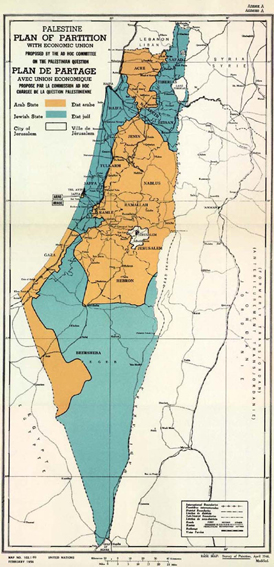
But even Israelis who favored partition might not be in a mood to celebrate. This is because the partition plan came with a map, a division that would have left all of Jerusalem under international control, surrounded on all sides by the proposed Arab state. It also would have cut the Jewish state into three chunks, linked at two points. Zionist centrists accepted partition but bristled at the proposed borders.
When, in the spring of 1948, the Arabs went to war to throttle Israel, Israel countered by seizing part of the territory allotted to the Arab state and pushed through a corridor to the besieged Jews in western Jerusalem. Israel then insisted that the Arabs, by going to war, had nullified the partition plan and its map. In 1949, Prime Minister David Ben-Gurion declared the resolution “null and void,” bereft of all “moral force.”
In this view, Israel did not arise from the U.N. resolution but emerged upon its death. Why then celebrate a dead letter, strangled at birth by the Arabs, and then buried by Israel?
All these reasons explain why relatively little attention is being paid to the 70th anniversary of the U.N. vote.
But this is a missed opportunity.
Most obviously, the Balfour Declaration spoke only of a “national home” for the Jews, which the British later interpreted to be less than a state. The 1947 U.N. resolution, by contrast, explicitly recommended a Jewish state.
But there is another compelling reason to emphasize the 1947 resolution: The Arabs rejected it. And because they did, preferring war, they cannot escape their share of responsibility for the war’s consequences: their “Nakba” (“Catastrophe”).
Prior to the vote, the General Assembly empowered a “special committee,” comprising representatives of 11 member states, to investigate the situation and make recommendations to the General Assembly. The Zionists wooed the committee, but the Palestinian Arab leaders boycotted it. Then not only did Arab leaders reject the committee’s majority report, which recommended partition, they even rejected the minority report, which proposed a federated, binational state. In the Arab view, the Jews had no right to anything – not a single immigrant, not a shred of self-government.
Their second mistake compounded the first. The Arabs misread the significance of the partition vote. The two rising superpowers, the United States and the Soviet Union, drove the “aye” vote forward. This, despite the fact that the Soviets had been hostile to Zionism and supportive of the Arabs all through the 1920s and 1930s. The sudden Soviet turnabout showed how strongly the wind was blowing against the Arabs.
Why did the Arabs reject the resolution? Because they thought that once the British left, they would defeat the Jews. An example is the testimony of the late Palestinian academic Ibrahim Abu-Lughod, a native of Jaffa, who left an account of the mood there on the eve of the war. The Arabs thought that “as the country belonged to them, they were the ones who would defend their homeland with zeal and patriotism. … There was a belief that the Jews were generally cowards.”
This is why the Arabs refused to accept partition, or a federated state, or any plan that recognized any Jewish rights at all. Why concede anything to the cowardly Jews? The people of Jaffa, Abu-Lughod said, believed that “if they made ready a bit … then they were sure to emerge victorious.”
Instead, the Palestinians went down to an ignominious defeat, dragging the Arab states with them. Indeed, their conduct in the war conformed almost precisely to the conduct they had expected of the Jews, making them contemptible in their own eyes and in the eyes of other Arabs.
It took more than 60 years for a Palestinian leader, Palestinian Authority President Mahmoud Abbas, to describe Palestinian and Arab rejection of partition as a “mistake,” which he did in an interview in 2011. But this is far from a full accounting.
That is why it remains important to mark this 70th anniversary, and every anniversary to come. It isn’t just a reminder of Israel’s legitimacy; it’s a reminder of Arab responsibility.

 Martin Kramer on the Middle East
You must be logged in to post a comment.