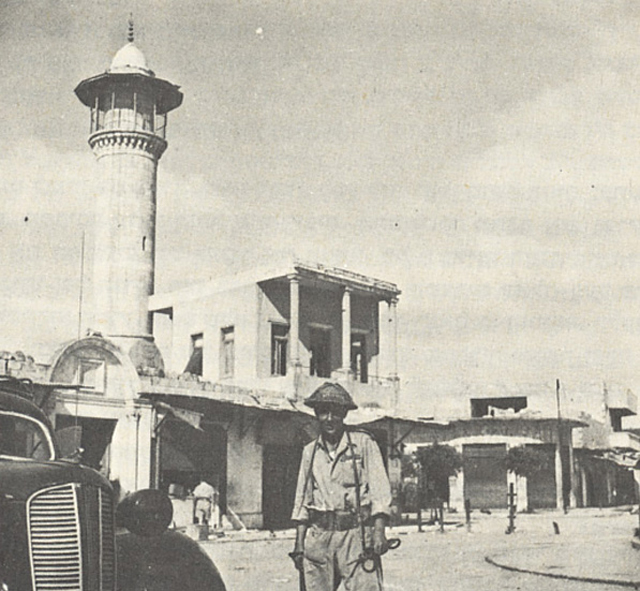
Departure from Lydda

The first response to my essay on Ari Shavit’s Lydda “massacre” claim has appeared over at Mosaic Magazine. It’s by Efraim Karsh, who not only seconds my doubts about the “massacre,” but questions Shavit’s claim that the expulsion of Lydda’s population was planned in advance. Karsh:

No exodus was foreseen in Israeli military plans for the city’s capture or was reflected in the initial phase of its occupation. Quite the contrary: the Israeli commander assured local dignitaries that the city’s inhabitants would be allowed to stay if they so wished. In line with that promise, the occupying Israeli force also requested a competent administrator and other personnel to run the affairs of the civilian population.

Only when some of the townspeople refused to surrender and opened fire on Israeli forces did the calculation change, leading Israel to “encourage” the departure of the population.

I found oblique confirmation of this in the 1988 film interview with the military governor, Shmarya Gutman, now in the archives of the Palmah Museum. According to him, the original plan was to remove the fighting-age Arab men and take them prisoner. Had this been accomplished, the remaining population could not have organized itself for departure. Gutman:

There was actually a decision to take the young men held in the [Great] Mosque and convey them onward as prisoners. But I knew that if that happened, the whole departure operation wouldn’t be implemented. The place would remain a pressure cooker. We would be stuck with thousands of old people, just so that a few young men could be taken prisoner. I sent them off before the buses arrived [to transport them to detention]. When the buses came, they asked: “Where are they?” I said: “They all left.” “How’s that? We wanted to take them.” I said: “I didn’t receive an order.”

The interviewer asked Gutman whether he took that decision on his own accord. His answer: “I did everything on my own accord. I didn’t get an order to detain them.”

Read Karsh’s full response here. There are more responses to come.

Massacre at Lydda?

“In thirty minutes, at high noon, more than 200 civilians are killed. Zionism carries out a massacre in the city of Lydda.” That lapel-grabber, from Ari Shavit’s bestselling My Promised Land: The Triumph and Tragedy of Israel, is the departure point for my essay at Mosaic Magazine, “What Happened at Lydda.”

I won’t summarize the piece, which will run at the top of the magazine site for the month of July. When I first read Shavit’s account, I thought it sounded forced, and so I searched for other interviews with the same people he spoke to twenty years ago, when he collected his material. (Most of the subjects are dead.) A fairly quick search yielded results: I found a trove of additional interviews in public archives. On their foundation it’s possible to construct an entirely different story: not of a vengeful massacre by “Zionism,” but of collateral damage in a city turned into a battlefield.

Sound familiar from the recent history of Israel? It should. This is a story that repeats itself every few years. I don’t know exactly what happened in Lydda on July 12, 1948, because the testimony is contradictory. But Shavit has vouched for the accuracy of his work down to the last fact and detail. Read the essay and see whether I’ve planted a seed of doubt.

Some will say that Shavit’s book, on balance, is good for Israel, and so should be entitled to an exemption from this sort of criticism. The confession of sin married to expressions of love for Israel may be what many American Jews need just now, and I make no judgment about the book as a whole. But the same argument for silence was made when American Jews needed to believe that Israel could do no wrong. And while confession is good for the soul, confessing the supposed sins of others—in this case, the Palmah officers and soldiers of the Yiftah brigade who conquered Lydda—must be done judiciously. After all, most of them can no longer speak.

My motive hasn’t been to protect Israel’s honor against the charge of massacre. There are some well-documented instances from 1948. It’s just that Lydda isn’t one of them. From a narrative point of view, it’s appealing to combine the stories of the largest expulsion and the largest massacre. But that’s a little too tidy, and when the past appears tidy, it deserves another look.

As a historian, I know something about the rules, but as I admit in the article, I’m not a historian of 1948 (or even of Israel). My expertise is the rest of the Middle East. That’s why I placed the essay at Mosaic Magazine, which solicits responses by experts. I’m eager to ignite a debate among people who have made this era their lives’ work (and, of course, Shavit too). There’s also a comments feature, for anyone who might have an interesting insight. I urge you to read my opening move, and I’ll be posting more pointers as appropriate.

And as a bonus for getting this far in this post, here are links to some remarkable photographs of Lydda at the time of its capture, taken by Boris Karmi (1914-2002).

  • Mula Cohen (1923-2002), commander of the Yiftah brigade. Shavit portrays him a sad figure, but he looks like he’s on top of the world here.
  • A portrait of a smiling Israeli soldier against the backdrop of the “small mosque,” epicenter of the alleged massacre.
  • Yiftah brigade soldiers take a break in Lydda.

Patrick Seale in Israel

This post first appeared on the Commentary blog on April 14.

Patrick Seale, journalist and author, best known for his reportage on Syria and his mediation between Hafez Asad and the West, has passed away at the age of 83, after a battle with brain cancer. Here are a few impressions of my few encounters with him, from an Israeli point of view.

In the world of Israeli Middle East expertise, Seale’s 1965 book The Struggle for Syria had an almost iconic status. When it first appeared, there weren’t a lot of books on contemporary Syria, and Israeli analysts parsed every word. Seale didn’t just rely on published sources, he interviewed all the actors, and he became renowned for his access to otherwise taciturn Arab politicians. Ma’arachot, the publishing house of the Israel Defense Forces, published a Hebrew translation of the book in 1968, and it quickly found its way to every relevant shelf.

In 1988, he published a biography of Syria’s ruler, under the title Asad: The Struggle for the Middle East. There was that word “struggle” again, although this time his book had the flavor of a semi-official enterprise. Indeed, Seale ended it with this sentence: “When asked how he would wish this chronicle to be concluded, Asad replied: ‘Say simply that the struggle continues.'” Footnoted: “Interview with President Asad, Damascus, 18 March 1988.” Of course, this only enhanced the aura surrounding Seale in Israeli eyes, and the biography immediately appeared in Hebrew translation. (In contrast, the book’s distribution was banned in Syria. Seale’s account was fine for Westerners, but some passages weren’t sufficiently obsequious for consumption in Damascus.)

But when I first met Seale, it wasn’t in connection with his Syria work. The date was February 5, 1992, and the place, the Chicago studio of Milt Rosenberg’s highly regarded talk show, “Extension 720.” I was a visiting professor at the University of Chicago, and Seale was passing through town to promote a new book, Abu Nidal: A Gun for Hire. It was a wretched piece of conspiracy mongering (the Economist called it “ludicrous”), claiming that the Mossad was behind the Palestinian terrorist Sabri al-Banna (Abu Nidal). Seale didn’t bring a single shred of evidence. I read and annotated the book, and came to the studio loaded for bear. In the waiting room, where we met, Seale seemed almost apologetic: “I’ve written something of a potboiler.” In the on-air exchange, I quoted his claims line by line, pressing him to produce even a scintilla of evidence, of which there was none. At one point, I told Seale that I respected his Struggle for Syria, but each of his subsequent efforts was less rigorous than its predecessor, and with Abu Nidal he’d scraped bottom. Maybe one day I’ll put the exchange online (I have the tape). I remember thinking it was a nice evening’s work; it certainly wasn’t the beginning of a friendship.

I didn’t expect to encounter Seale again, but later events in the 1990s set in motion Israel-Syria feelers and intermittent peace talks, and when the Labor party prevailed in the May 1999 elections, prime minister-elect Ehud Barak indicated that he wanted to relaunch negotiations. It was Barak who asked my colleague Itamar Rabinovich, Israel’s preeminent Syria hand, to invite Seale to Israel to speak publicly. (Seale knew and respected Rabinovich, although the tie had been severed for a few years, after Rabinovich disparaged Seale’s Asad biography in a review.) I headed the Moshe Dayan Center at Tel Aviv University at that time, and that’s how I came to co-sponsor and co-chair Patrick Seale’s first and only public address in Israel. The date: June 9, 1999.

I’ll not forget the Seale-fest that ensued in the lead-up and sequel to his appearance. Everyone wanted to know Asad’s real redlines, and everyone assumed Seale was on a quasi-official mission to relay a message from Damascus. The media besieged us with requests to interview him. When he came to the university to speak, more than five hundred people packed the hall. He had audiences with Barak (a “red-carpet reception,” said one source), President Ezer Weizman (who gave Seale a Golan-must-go interview), and former prime ministers Yitzhak Shamir and Shimon Peres. Uri Saguy, a former head of military intelligence and Barak’s expected point man on Syria, took Seale to the Golan, where Saguy told Israeli settlers, with tears in his eyes, that “hard decisions may be coming.”

Rabinovich was the go-to for these meetings, but I also found myself consumed with the management of Patrick Seale, media star, for the better part of a week. He was charming, diplomatic, and precise in his formulations, and he clearly enjoyed the limelight. Seale genuinely yearned to facilitate a breakthrough—on Asad’s terms, of course. Later that month, Seale published side-by-side interviews with Barak and Asad, in which they signaled hope for this and that. Seale denied being a go-between, but that’s exactly how Israelis regarded him.

It turned out to be a bridge too far, for reasons that will keep historians busy for years to come. When Asad died a year later and his son Bashar took over, Israelis concluded that Seale didn’t have the same access in Damascus that he’d had under the old man. Failure at Camp David, Intifada II, Barak’s departure, Ariel Sharon and George W. Bush, 9/11, and the Iraq war all pushed Syrian-Israel peace off the agenda, and put Syria on the defensive. Seale slipped into Israel-bashing on a scale unprecedented even for him. Read the columns yourself.

And that’s where my Seale story ends, but there’s a footnote. Whenever Seale came up in Israeli discussions, there usually would be a fair bit of winking and nodding about his ancestry. His father, a Russian Jew born (I think) in Jerusalem under the name of Ephraim Sigel, converted to Christianity, changed his name to Morris Seale, studied theology in Belfast (where Patrick was born), and became an ordained minister of the Irish Presbyterian Church. Sigel-Seale then went out as a missionary to Damascus, where Patrick spent his childhood. Nothing more excites speculation among Israelis than the discovery that a foreign friend or foe is a blood member of the tribe. (Albright, Kerry… it happens all the time.) Did Hafez Asad and his cronies know that their Patrick wasn’t purely Irish? Did it matter? How could it not? Etcetera—for what it’s worth. (Not much, I think.)

Seale has left a world in which even the idea of Syria is in peril, as nearly every achievement of Hafez Asad unravels. In the preface to a 1986 reedition of The Struggle for Syria, Seale wrote that Hafez Asad

seeks to discipline Lebanon, Jordan, and the Palestinians, preventing them from entering into any relationship with Israel without his consent, trying to turn the Arab Levant into a bastion against Israeli expansion… But just as Asad needs to unite the Levant in order to recover the occupied territories, Israel needs to divide it in order to keep them… “Greater Syria” is a sort of mirror-image of “Greater Israel” and its inevitable opponent. Both cannot win.

It might not be as black-and-white as all that, but if Seale was right, there can be no doubt today who the winner is. Syria is prostrate, an arena for the meddling of others, while the Arab Levant continues to divide and subdivide into its smallest parts. As the old man told Seale back in 1988, “the struggle continues,” but it’s not the one he or Seale envisioned. Theirs will be a sad reunion.