Here is a quick aside about a passage in Christopher Hitchens’s overwrought and over-written defense of Rashid Khalidi. Hitchens announces that the Khalidi family “hold[s] a celebrated house and position in the city [of Jerusalem] since approximately the time of the Crusades. I have had the honor of being invited to this very house. If Rashid chooses to state that he doesn’t care to be evicted from his ancestral home in order to make way for some settler from Brooklyn who claims to have God on his side, I think he has a perfect right to say so.”
Let us leave aside the typically English schoolboy enchantment with assumed Arab aristocracy (please, don’t get me started). Rashid Khalidi was himself born and raised in… Brooklyn. Here is testimony from a witness: “I lived in Brooklyn and watched young Rashid and his brothers grow, even held him as an infant while listening to his father, Ismail, talk about Palestine and the diplomatic issues he dealt with.” On the maternal side, Rashid’s roots in Brooklyn go back a good ways: “His grandmother,” he is reported to have told an audience, “who immigrated to America from Lebanon was a member of First Unitarian Church in Brooklyn.” His mother and father married in that church, and he attended Sunday school there.
So were Khalidi to forgo the familiar pleasures and privileges of Columbia University for the rigors of Jerusalem, wouldn’t he also be a settler from Brooklyn?
This short post is to alert rss and email subscribers (via Feedburner) that there are several important updates to my earlier post, “Khalidi of the PLO.” One brings a passage from a 1978 New York Times report from Beirut, noting that Rashid Khalidi “works for the P.L.O.” Another uncovers a passage from a 1976 Los Angeles Times report, also from Beirut, describing Khalidi as “a PLO spokesman.”
The last update, the most compelling, unearths a 1979 radio documentary on the PLO featuring Khalidi, in which he is repeatedly identified as an official PLO spokesperson in the Palestinian news service, Wafa. The interview with him was conducted in PLO headquarters in Beirut. The documentary may be heard in its entirety.
Did you notice this sentence in a recent story about the Khalidi-Obama video controversy in the Los Angeles Times? It mentioned “[Rashid] Khalidi, a renowned scholar on the Palestinians who in the 1970s had acted as a spokesman for Yasser Arafat’s Palestine Liberation Organization.”
Wait a minute—isn’t that “spokesman” claim supposed to be dubious, false, contested? “They’ve falsely called him a spokesman for the PLO,” huffed Jake Tapper, ABC News’ Senior National Correspondent. The bloggers say so too. “Khalidi was not, as the schlock rightwing press charges, a spokesman for the Palestine Liberation Organization” (Juan Cole). “The fact that [McCain] repeats the charge that Khalidi was a spokesman for the PLO, a claim that Khalidi denies, and that there is independent reason to think is false—suggests either that he doesn’t know, or that he doesn’t care what the truth is” (Hilary Bok at Obsidian Wings). “Rashid Khalidi, by the way, is not and never was a ‘PLO spokesperson'” (Richard Silverstein). And not all the protest comes from the left. “He never was a spokesman for the PLO” (R. Bruce McColm, who was the president of the International Republican Institute when it dumped hundreds of thousands of dollars on a Khalidi-backed project in the 1990s).
So what gives at the Los Angeles Times? Simple. It was the Times, back in 1976, which first tagged Khalidi as “a PLO spokesman.” And it wasn’t just any correspondent who did it. It was Joe Alex Morris Jr., who at the time headed the newspaper’s Beirut bureau (which he had opened in 1965).
Morris was a legendary Middle East correspondent. Upon his death in Iran in 1979—he was killed while covering the Iranian revolution—the Washington Post wrote that he “was regarded by his colleagues as the dean of American correspondents in the Middle East. For more than a quarter century he chronicled them all, Arabs and Israelis, Farouk and Nasser and Saddam Hussein and the Palestinians, the shah and Khomeini, always insisting on reporting from up front.” In 1968, he won the Overseas Press Club Award for his coverage of the June 1967 war. In 1981, the Nieman Foundation posthumously conferred upon him its award for conscience and integrity in journalism. Since that time, the Foundation has sponsored an annual memorial lecture in his name, delivered at Harvard by an outstanding journalist. (Lecturers have included a who’s who of prominent Middle East correspondents: Tom Friedman, Jonathan Randal, Anthony Shadid, John Burns, George Packer…)
If Morris reported it, then the Los Angeles Times regards it as a fact. In the face of all the self-interested denials of a heated election year, it’s clearly sticking by the 32-year-old reportage of a long-dead correspondent. I find that noble, and if you admire the newspaper for holding back the video, then you should admire it for this as well. Morris was not an interested party when he identified Khalidi as “a PLO spokesman,” he was contemporary with events, and there is every reason to presume that he reported this accurately. The Los Angeles Times hasn’t allowed politically motivated howls to erode its total confidence in Morris and his professionalism.
Plaudits to the Los Angeles Times.
(Footnote: In 1978, the Beirut bureau chief of the New York Times, James M. Markham, likewise wrote that Khalidi “works for the P.L.O.” Let’s see if the New York Times stands by that highly esteemed correspondent—also long dead. For all the evidence of Khalidi’s role as spokesman, now including a 1979 radio documentary, visit my post “Khalidi of the PLO.”)
 This short post is to alert rss and email subscribers (via Feedburner) that there are several important updates to my earlier post, “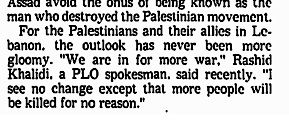


You must be logged in to post a comment.