The Washington Institute awards prizes

The 2010 Washington Institute Book Prize, which I’ve promoted here before, has been awarded. More details and the jurors’ commendations here. This is from the Institute’s prize announcement:

From Empathy to Denial: Arab Responses to the Holocaust, Meir Litvak and Esther Webman’s impressively researched chronicle of Arab attitudes toward the Holocaust, has won the prestigious Gold Prize—including a cash award of $30,000—in The Washington Institute’s 2010 Book Prize competition. This sweeping account, based largely on Arab public commentary and other Arabic-language sources, covers six decades of postwar history and documents how, after the establishment of the State of Israel, Arab attitudes toward the Holocaust influenced—and were shaped by—broader anti-Zionist sentiment.

The Washington Institute Book Prize, now in its third year, was established to highlight new nonfiction books on the Middle East and is among the world’s most lucrative literary awards.

The Institute awarded the 2010 Silver Prize ($15,000) to Lebanese journalist and public intellectual Michael Young, opinion editor of the Beirut-based Daily Star, for his compelling personal narrative The Ghosts of Martyrs Square: An Eyewitness Account of Lebanon’s Life Struggle. The Bronze Prize ($5,000) recipient is historian Jeffrey Herf for Nazi Propaganda for the Arab World, a vivid examination of the Nazi propaganda campaign aimed at Arabs and Muslims of the Middle East during World War II.

“This year’s award winners include two outstanding examples of rising public interest in the long-overlooked history of the Holocaust’s impact in the Middle East, including the complex relationship between the Holocaust and Arab-Israeli relations,” noted Institute executive director Dr. Robert Satloff. “And we are particularly delighted to recognize the contribution made by Michael Young, whose powerful memoir brings to light the sordid politics that undermine the very idea that Lebanon represents.”

Winners were chosen by a three-person jury: Washington Post editorial board member Jackson Diehl, Weekly Standard editor William Kristol, and distinguished historian Walter Laqueur.
Ayatollah Fadlallah dies

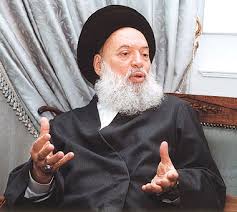
Ayatollah Sayyid Muhammad Husayn Fadlallah has passed away in Beirut at the age of 74. He had been in poor health for some years, suffering from diabetes and heart problems. Fadlallah became famous (and, to his enemies, notorious) in the 1980s, for his role in channeling the message of Hezbollah to thinking young Shi’ites and to the world. He played a complex game, and it long fascinated me. I published a first short piece on him in 1985, and I explored him further in a 100-page study, finished in 1992 and accessible here.

In the years since I followed him, Fadlallah’s presence diminished. First, Hezbollah acquired a political leader, Sayyid Hasan Nasrallah, with a powerful presence of his own. Hezbollah became less reliant on Fadlallah, at least as a mobilizer within Lebanon. Second, Fadlallah drifted even further into the stratosphere of grand ayatollah-hood, well above party politics, including those of Hezbollah. Third, some rival Shi’ite clerics, especially in Iran, thought he was getting too big for his breeches, and worked to cut him down through nasty accusations of theological deviation. Fourth, the removal of Saddam Hussein from power breathed new life into the religious academies in Najaf in Iraq, and its clerics, such as Ayatollah Ali Sistani, again began to loom large among Arabic-speaking Shi’ites. Fifth, Fadlallah’s poor health began to drag him down. His forte had always been the pulpit sermon, delivered in a controlled but fiery style, but in recent years, there wasn’t much flicker in his performances.

He was a permanent stop on the circuit for foreign dignitaries, some of them pursuers of Islamist “moderation.” They would see him (after stringent security checks), get their photo taken with the wise man, and come away pondering his elliptical comments. Last year Jimmy Carter turned up (photo), much to the chagrin of the State Department, and Noam Chomsky paid his respects last May (photo). Within Lebanon, he built a substantial empire of charitable institutions such as schools and clinics, many of them funded by wealthy Shi’ites outside the country. The institutions will long outlive him.

When I first published on Fadlallah in 1985, I wouldn’t have put a nickel on his dying a natural death. That same year, he was the target of a car bombing that missed him and killed over eighty persons. But Fadlallah was an expert in planting seeds of doubt, and over the years he dropped off the hit lists of Hezbollah’s enemies. Still, without him, Hezbollah would have had a much tougher row to hoe in the early years. He wasn’t responsible, as far as I know, for any one act of violence, but he justified quite a few of them after the fact. Up until today, he was on the U.S. Treasury Department’s list of “specially designated nationals.”

Needless to say, when it came to Israel, he was uncompromising. I do think I treated him fairly and respectfully in my long study, and I made sure he received it—especially the subsequent Hebrew edition, which appeared as a monograph with his portrait on the cover. At the peak of his powers, he was truly formidable. It’s unlikely that Lebanon will be home to another figure quite like him again.

A Zero-Sum Game

This is Martin Kramer’s contribution to a roundtable on “Obama in the Mideast” organized by Lee Smith for Tablet Magazine. Other contributers: Elliott Abrams, Ramin Ahmadi, Andrew Exum, Dore Gold, Robert Malley, Lokman Slim, and Jacob Weisberg. Read in full here and here.

“Power is no longer a zero-sum game. No one nation can or should try to dominate another nation. No world order that elevates one nation or group of people over another will succeed. No balance of power among nations will hold.” Thus spoke Barack Obama to the U.N. General Assembly last September. This must rank with George W. Bush’s “bring ’em on” as an invitation to America’s adversaries to defy it. Bush later expressed regret that he said his words, noting that “in certain parts of the world they were misinterpreted.” Obama likewise may rue having spoken his.

In the Middle East, power is a zero-sum game, domination by a benevolent hegemon creates order, and the regional balance of power is the foundation of peace. It’s the pax Americana, and while it may be stressful to uphold it, the alternative is more stressful still. And as the impression of American power wanes, we are getting a foretaste of “post-American” disorder. A struggle has begun among the middle powers—Iran, Turkey, and Israel—to fill the vacuum. Iran floods Lebanon with rockets, Turkey sends a flotilla to Gaza, Israel sends an assassination squad to Dubai—these are all the signs of an accelerating regional cold war. Each middle power seeks to demonstrate its reach, around, above, and behind the fading superpower.

The response in Washington is to huff and puff, imposing settlement “freezes” and “crippling” sanctions. This is the illusion of power, not its substance. The Obama Administration is bringing the United States out of the Middle East, to a position from which it believes it can “contain” threats with diplomacy, deterrence, and drones. As the United States decamps, its allies will feel insecure, its enemies emboldened. The Middle East’s stress test has begun.