Chronologically-challenged Professor Walt

In the past, I’ve demolished Stephen Walt and John Mearsheimer’s claim that Israel and its friends drove the United States to war with Iraq. I did it when they published their article, and did it again when they published their book, The Israel Lobby. It’s a conspiracy theory, pure and simple. And because Walt is a conspiracy theorist, he does what they all do: he rips evidence out of context. Here’s his latest grasp at a straw: his claim that Tony Blair has “revealed” that “Israel officials were involved in those discussions” on Iraq held between Blair and George Bush in Crawford, Texas in April 2002. Walt brings as evidence this quote from Blair’s testimony to the U.K. (Chilcot) inquiry investigating the Iraq war:

As I recall that discussion, it was less to do with specifics about what we were going to do on Iraq or, indeed, the Middle East, because the Israel issue was a big, big issue at the time. I think, in fact, I remember, actually, there may have been conversations that we had even with Israelis, the two of us, whilst we were there. So that was a major part of all this.

Walt’s conclusion: “Blair is acknowledging that concerns about Israel were part of the equation, and that the Israeli government was being actively consulted in the planning for the war.” Walt goes on to declare that “more evidence of their influence [of Israel and the Israel lobby] on the decision for war will leak out,” and that “Blair’s testimony is evidence of that process at work.”

When people who don’t know much about the Middle East, like Stephen Walt, pose as experts, they make basic mistakes of chronology. So let me remind him of exactly what coincided with the Crawford meeting of April 6-7, 2002.

Israel launched Operation Defensive Shield in the West Bank on March 29. Israeli prime minister Ariel Sharon ordered the operation in response to a wave of Palestinian suicide bombings. Its objective was the reoccupation of West Bank cities, dismantling the infrastructure of terror, and laying siege to Yasser Arafat in his Ramallah HQ. On April 2, Israeli forces battled their way into Bethlehem and secured Jenin city, and on April 3, they began to clear out the Jenin refugee camp. When Bush and Blair sat down in Crawford, Israel was laying siege to terrorists holed up in the Church of the Nativity, and the Battle of Jenin was in full swing. The Arab propaganda mills exploited the fog of war to make the operation seem like Sabra and Shatila redux, replete with massacres and mass graves. Arab leaders bombarded Bush and Blair with demands for action to stop Israel.
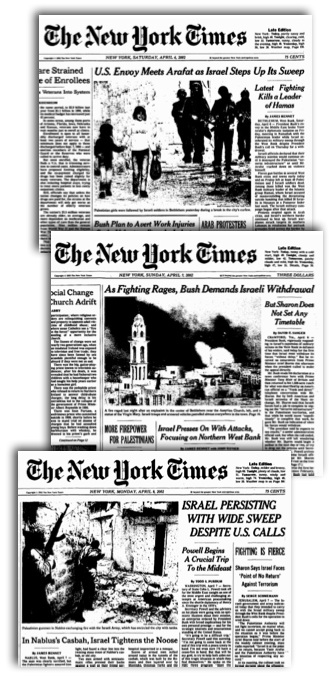
Bush succumbed to the mounting pressure, and on April 4 told Sharon to pull Israeli forces out of West Bank cities. On April 6, the first day of the Crawford meeting, Bush sharpened that message in a press conference with Blair, calling on Israel to withdraw “without delay.” He said the same in a 20-minute phone call to Sharon that very day. It was the lowest point in Israeli-American relations during the Bush years, and a crisis of massive proportions. Here is the chronology.

So Blair was right to recall that at Crawford, “the Israel issue was a big, big issue,” and that there were conversations with the Israelis. But these weren’t “active consulting” over plans for the Iraq war (and nothing in Blair’s testimony suggests they were). They were urgent negotiations about an ongoing war in the West Bank, and consisted of full-court pressure on Israel to end it. That Walt doesn’t say so—that “April 2002” doesn’t immediately trigger a mention of the historical context—is evidence either of ignorance or deception. Take your pick. (Illustration: New York Times front pages from April 6-8, 2002, the Crawford weekend.)

And while we’re on straws, Walt grasped at another one which left me smiling. Walt:

Consider that former President Bill Clinton told an audience at an Aspen Institute meeting in 2006 that “every Israeli politician I knew” (and he knows a lot of them) believed that Saddam Hussein was so great a threat that he should be removed even if he did not have WMD.

I never trust Walt to represent a source accurately (see past example), so I checked it. The quote was reported by James Bennet, who puts it in context:

[Clinton] segued into a discussion of Democratic Senator Joe Lieberman’s position in favor of going to war, noting how it squared with the view of Dick Cheney, Donald Rumsfeld and others that Saddam Hussein was such a menace he should be removed regardless of whether he had WMD. Then, out of the blue, came this: “That was also the position of every Israeli politician I knew, by the way.”

So Clinton attributed the idea that Saddam should be removed regardless of WMD to Cheney, Rumsfeld, Lieberman, and “others”—all of the usual suspects—and only then to Israeli leaders, “by the way.” As far as Walt’s thesis, this proves… well, what does it prove, Professor Walt? The amusing sequel comes when Bennet notes that even “I knew some Israeli politicians with doubts about the war,” and then relays this explanation:

One longtime and acute observer of Clinton, whom I won’t name here, suggested to me that, as is his tendency, Clinton was looking to please people he spotted in the crowd before him—in this case, seated in the front rows, several representatives of Arab nations, including Queen Noor of Jordan.

So Clinton wasn’t just speaking to “an audience” in Aspen. He had Queen Noor in the front row! Could Bill Clinton have been pandering? Naw, couldn’t be.

Superfluous young men

You get six minutes at the Herzliya Conference to say something memorable (and there is a clock ticking away at your feet, facing the audience). So I made a memorable argument for the role of population growth in radicalization, a clip of which is embedded below. It’s memorable—but not at all original. I first encountered the idea (and the phrase “superfluous young men”) in the stimulating work of Gunnar Heinsohn (here is one example of many). My discussion of the Palestinian angle isn’t original either. See Heinsohn’s “Ending the West’s Proxy War Against Israel: Stop funding a Palestinian youth bulge, and the fighting will stop too” (here).

There is also one error in my popularized recycling of his thesis. Heinsohn’s rule of thumb is that when 30 percent or more of the total male population is between 15-29 (fighting age), violence ensues. In my talk, I added that I would put it higher, at 40 percent. But that 40 percent should be of the total adult male population (15-64). I doubt that in any of the countries of the region, the 15-29 range accounts for 40 percent of total male population. Heinsohn is right.

An excellent compendium of demographic data on age structure in the Middle East, and a valuable discussion of it, may be found in the Stanford Center for Longevity’s “Critical Demographics of the Greater Middle East: A New Lens for Understanding Regional Issues” (here).

Update, February 22: See my rejoinder to critics of this presentation. It’s entitled “Smear Intifada.”

Update, February 23: The directors of the Weatherhead Center at Harvard: “Accusations have been made that Martin Kramer’s statements are genocidal. These accusations are baseless.” Full text here.

Update, 2018: Read “A Controversy at Harvard,” my retrospective on this affair.

Text of speech as delivered: I’m going to try to pull the focus back a bit. Our panel title implies that indoctrination is the key to radicalism. If we could shut down the jihadi websites and silence the radical preachers, if we could get the Saudis to stop funding extremists and fix the textbooks, the radical fever would subside.

But there are other views. There are those who say that the heart of the problem is despotic governments. If there were more democracy, and less Western backing for kings, emirs, and presidents for life, the radical fever would subside.

Others say that the heart of the problem is America’s unconditional support for Israel, and U.S. military campaigns in Iraq and Afghanistan. If the U.S. were to take its armies out of these lands, if the U.S. were to force Israel to end its occupation of Palestinian territory, the radical fever would subside.

Now as between these three explanations, you might prefer one to another. I myself have had a running debate with people who think that anger at Israel drives Al Qaeda or recruitment to Al Qaeda. Typical is this view, expressed last week, by a noted, prominent analyst: “We can separate Al Qaeda from the vast majority of Muslims by advancing a just and lasting peace that Palestinians accept.” I don’t know what the Palestinians would accept, and I think the vast majority of Muslims are already separated from Al Qaeda. But in places like Yemen and Afghanistan and Somalia, where Al Qaeda is most deeply entrenched, a “just and lasting” peace for the Palestinians wouldn’t make a shred of difference.

But the indoctrination explanation and the lack-of-democracy explanation also underestimate the problem, by suggesting that our policies can go far to change the dynamic. They can’t, and let me explain why.

The societies in which radicalism thrives differ from ours in many ways, but one way is crucial. The median age in Germany is 44, in the United Kingdom it is 40. In the United States, it is 37. In Israel, it is 29, in Turkey it is 28. That’s for perspective. In Iraq, it is 19. In Afghanistan, Somalia, Yemen, and Gaza, the median age is 17. Where the median age drops below 20, Islamist radicalization takes place on a massive scale. The biggest radicalizer is fertility that hovers at 6 or 7, and masses of economically superfluous young men of fighting age, between 15 and 29.

A German demographer, Gunnar Heinsohn, has a rule of thumb, that when 15- to 29-year-olds make up more than 30 per cent of the population, violence ensues. I would put it higher, at 40 percent—which is exactly where it stands in Iraq, Afghanistan, Somalia, Yemen and Gaza. If the state can’t control these young men, someone else will; if society can’t offer dignified pursuits for the fourth and fifth and sixth sons, someone else will. And it isn’t just the frustration of poverty; it is just as much the shortage of status. Osama bin Laden lacked for nothing, but his father, Saudi Arabia’s biggest contractor, married 22 times and had about 55 children. Osama was number 17. Radical Islam is a way for the superfluous sons to enter history.

So radical Islam answers a demand among frustrated young men, it doesn’t create it. How should that affect the West’s approach to the problem? First, let us not delude ourselves about the prospects of counterradicalization techniques. Afghanistan and Yemen will almost double their populations between now and 2030. What will 28 million more Afghans and 20 million more Yemenis do? What about the nearly 80 million more Pakistanis who will be added by 2030? This explosive growth will drive radicalization through another generation at least, and push it into Europe and America through emigration.

Second, there is hope. By 2030, these societies will have passed through the youth bulge. Fertility is already falling, in some places steeply. And when it falls, the radicals will lose their pool of recruits. A present example is Iran, where a revolt is brewing against the agenda of Ahmadinejad and the hardliners. It is also a place where fertility has dropped from 7 to below replacement, below 2—as steep a drop as China’s. Aging populations reject radical agendas, and the Middle East is no different.

Now eventually, this will happen among the Palestinians too, but it will happen faster if the West stops providing pro-natal subsidies for Palestinians with refugee status. Those subsidies are one reason why, in the ten years from 1997 to 2007, Gaza’s population grew by an astonishing 40 percent. At that rate, Gaza’s population will double by 2030, to three million. Israel’s present sanctions on Gaza have a political aim—undermine the Hamas regime—but if they also break Gaza’s runaway population growth—and there is some evidence that they have—that might begin to crack the culture of martyrdom which demands a constant supply of superfluous young men. That is rising to the real challenge of radical indoctrination, and treating it at its root.

Between Goldstone and Gaza, what’s one more zero?

I’ve been reading through the part of the Goldstone Report treating the economic impact of Operation Cast Lead—a part that hasn’t gotten much attention. It’s largely a crib of a March 2009 report compiled by the Palestinian Federation of Industries, whose deputy general-secretary, Amr Hamad, was interviewed three separate times by the mission. The mission deemed both the report and Hamad’s testimony to be “reliable and credible.”

The most important sentence in this section of the Goldstone Report is this one: “Mr. Amr Hamad indicated that 324 factories had been destroyed during the Israeli military operations at a cost of 40,000 jobs” (paragraph 1005). I did a double-take when I read that: 40,000 would be astonishing in an economy like Gaza’s. This is what Hamad said in his testimony (June 28, Goldstone in the chair):

The industrial sector that was destroyed, for example, the 324 factories that were destroyed, that we[re] destroyed used to employ four-hundred thous-, uh, 40,000 workers. And these have lost their uh, jobs, uh, forever.

So that’s the source of the number. But if you return to the report of the Palestinian Federation of Industries, it puts the job losses at these 324 factories not at 40,000, but at 4,000. That’s an order-of-magnitude misrepresentation by Hamad of his own organization’s findings. The Goldstone Mission should have wondered at the figure, checked Hamad’s testimony against the Palestinian Federation of Industries report, detected the discrepancy, and gotten it right. But it didn’t. Perhaps the mission members, hearing the word “factories,” thought that 40,000 jobs sounded credible. In fact, more than a quarter (88) of these 324 “factories” employed five people or less, and over half (189) employed from five to twenty people (Federation report, p. 12). The vast majority of these “factories” should really be described as “workshops.” Only three employed a hundred or more people.

Of course, that 40,000-lost-jobs figure has made its way to numerous websites, and might eventually surface in an op-ed in a major newspaper. (That sort of thing has happened before.) So it would behoove the mission to issue a correction, and post a corrected version of its report. After all, this isn’t a matter of interpretation.

And as you ponder all those figures in the Goldstone Report, just keep in mind that it contains at least one order-of-magnitude error regarding a very basic statistic. The report isn’t just biased. It’s shoddy.