Europe defeats Islam

I summarize four more sessions from my fall course on the introduction to the modern Middle East (Turkey and the Arab lands) at Shalem College in Jerusalem. Below are entries for sessions five through eight. For earlier sessions, go here. As before, I spice up each entry with an insight from the late Bernard Lewis.

Class Five: Islam (reformed) Then Joined Europe. The Tanzimat, the Ottoman reforms of the mid-19th century, are the centerpiece of session five of my intro to the Middle East at Shalem College. Then as now, many in the West complained of misgovernment, corruption, and repression in the East. The Ottoman empire, on the doorstep of Europe, seemed like an affront to enlightened European values. Arbitrary government, a bureaucracy for sale, discrimination against non-Muslim subjects—the list was long. Sound familiar?

Was it that bad? Debatable. But one Ottoman sultan set out both to satisfy Europe and strengthen his own position by pushing through far-reaching reforms. This was Abdülmecid I, the first sultan to speak a European language fluently (French). He reorganized imperial finances, established a civil code and courts outside the Islamic framework, opened a university, formed an education ministry, and more. Abdülmecid announced his plans in two imperial edicts, in 1839 and 1856—promissory notes to European opinion—and he bought the empire time by aligning with the British, who came to his defense, first against an Egyptian invading force, later (in alliance with France) against the Russians in the Crimean War. When it was over, the concert of Europe admitted the Ottomans and recognized the empire’s territorial integrity—until it didn’t.

But the big reform the Europeans demanded was to equalize the status of non-Muslims with that of Muslims in the empire. As Bernard Lewis wrote, in his magisterial Emergence of Modern Turkey, most Muslims viewed this as an “insult and outrage,” and as “a triumph over Islam of the millennial Christian enemy in the West.” The resulting resistance would slow the pace of reforms, but there could be no going back.

It’s hard to interest students in old treaties, but the Treaty of Paris (1856), following the Crimean War, can’t be avoided, since it recognized the Ottoman empire as part of the European system, subject to and guaranteed by its laws (which we now call “international law”).

If you visit the palace at Versailles, you can view this huge painting (three by five meters) that captures the moment. The artist, the Frenchman Édouard-Louis Dubufe, depicts the negotiators of the treaty. The two Ottoman negotiators are here: Mehmed Cemil Bey (the smallish figure by the door in the back), and Ali Pasha (seated on the far right). Contemporary reports say they came well-prepared.

Congress of Paris

Class Six: Britain’s Veiled Protectorate in Egypt. Exactly one class session: in my course on the modern history of the Middle East, that’s all the time we have to cover Egypt from the British occupation in 1882 to the First World War. Talk about compression. So what’s a must-have for this (sixth) session of the class?

Looming large is Sir Evelyn Baring, later Lord Cromer, who basically ran Egypt as British “agent” and “consul-general” from 1883 to 1907. To this day, he remains enveloped in controversy. He took a dim view of the Egyptian capacity for self-rule: “We have to go back to the doubtful and obscure precedents of Pharaonic times to find an epoch when, possibly, Egypt was ruled by Egyptians. Neither, for the present, do they appear to possess the qualities which would render it desirable… to raise them at a bound to the category of autonomous rulers.” And so he ran the country himself. He stabilized the economy, but couldn’t stop the tide of nationalism.

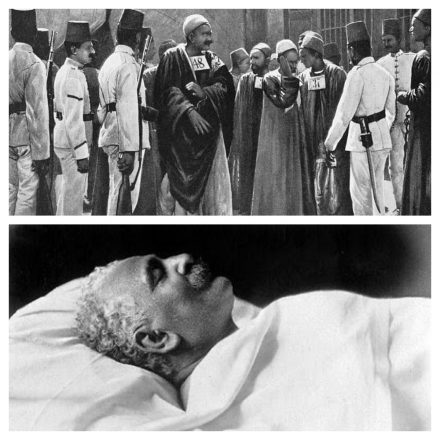
The pigeons came home to roost, so to speak, in 1906, when a party of British officers on a pigeon hunt clashed with villagers in a Nile delta village called Denshawai. An officer died in the altercation, apparently of heatstroke, but several villagers were tried and hanged, others were flogged and sentenced to penal servitude.

The perceived injustice caused a huge uproar. In class, we read the condemnation of Cromer by George Bernard Shaw, and the poem on the executions by Constantine Cavafy. And we read a manifesto by Egyptian nationalist leader Mustafa Kamel, as well as the warden’s report on Ibraham Wardani, the nationalist who in 1910 assassinated Boutros Ghali, by then Egypt’s prime minister, who’d been one of the judges in the Denshawai trial. The stage is set for the later eruption of nationalist revolt against all things British, good or bad.

(My Israeli students also need to hear that in 1903, Theodor Herzl tried to persuade Cromer to open up northern Sinai to Jewish settlement. Cromer feigned interest but eventually nixed the plan. Herzl called him “the most disagreeable Englishman I have ever faced.”)

We end by discussing a passage in Isaiah Berlin’s famous essay, “Two Concepts of Liberty” (1958). True, he writes, Egyptians

need medical help or education before they can understand, or make use of, an increase in their freedom…. First things come first: there are situations in which—to use a saying satirically attributed to the nihilists by Dostoevsky—boots are superior to Pushkin… The Egyptian peasant needs clothes or medicine before, and more than, personal liberty, but the minimum freedom that he needs today, and the greater degree of freedom that he may need tomorrow, is not some species of freedom peculiar to him, but identical with that of professors, artists and millionaires.

But when is “tomorrow” today? It’s a question that much preoccupied Bernard Lewis. But more on that on another occasion.

Images: Above, the accused at the Denshawai trial; below, the assassinated Boutros Ghali in death. (Both, Wikimedia.)
Egypt 1900s

Class Seven: The Last Ottoman Sultan Standing. By the last quarter of the 19th century, the Ottoman Empire was in salvage mode. It was bankrupt, its armies couldn’t stave off defeat, and its politics stagnated. But the once-glorious empire refused to give up the ghost. This was due, at least in part, to the resolve of its last effective sultan, Abdülhamid II, who reigned for almost 33 years, from 1876 to 1909. Session seven of my intro class on the Mideast at Shalem College revolves around this enigmatic man, who was controversial while he lived, and who remains so.

The last few years have seen something of an Abdülhamid revival in Turkey. He’s been the hero of a hugely popular television drama series, Payitaht Abdülhamid. High production values combine with a sharp disregard for the record of events (plus a dash of antisemitism), to paint Abdülhamid as a devout paragon of Muslim virtue. This perfectly suits the neo-Ottoman agenda of Turkey’s present ruler, who’s more of an Abdülhamid than an Atatürk. (That’s perhaps why it was persistently rumored that the new mega-airport just opened on the edge of Istanbul would be named after Abdülhamid. For now, it’s just Istanbul Airport.)

So who was the real Abdülhamid? You know the trope of the reform-minded prince who comes to power amid great expectations in the West, only to dash them by sliding into the authoritarian mode, or worse. (Sound familiar, Syria- and Saudi-watchers?) Abdülhamid’s first move as sultan was to promulgate a constitution and convene an elected parliament. Perhaps he thought this would prevent the amputation of Christian-populated provinces in the Balkans.

It didn’t, and a year later, Abdülhamid suspended the constitution and disbanded the parliament. It was his own show after that, and as “Turkey-in-Europe” dwindled, he fell back on the Muslim masses of Asia, to whom he promoted himself as savior-caliph. Massacres of Armenians and Assyrians eventually followed, and Abdülhamid became known as the “Red Sultan” in the European press. The later architects of secular Turkey similarly took a dim view of him.

It was Bernard Lewis, in his landmark Emergence of Modern Turkey, who first took a more favorable tack. “Abdülhamid was far from being the blind, uncompromising, complete reactionary of the historical legend,” he wrote (back in 1960). “On the contrary, he was a willing and active modernizer.” Railroads, telegraphs, schools, libraries, museums—he promoted just about any innovation that wouldn’t weaken his grip on power. No doubt, Abdülhamid deserved a rethink, and some historians have done it meticulously and fairly. But the present fad for him is over the top.

As I remind my Israeli students, Herzl met Abdülhamid in a futile attempt to extract some kind of charter for Zionism. It’s the stuff for another course, but we read Herzl’s verdict from his diary: “My impression of the Sultan was that he is a weak, cowardly, but thoroughly good-natured man. I regard him as neither crafty nor cruel, but as a profoundly unhappy prisoner in whose name a rapacious, infamous, seedy camarilla perpetrates the vilest abominations. If I didn’t have the Zionist movement to look after, I would now go and write an article that would give the poor prisoner his freedom.” It’s ironic, given the Elder-of-Zion treatment of Herzl in the current Turkish telenovela on Abdülhamid.

The Ottoman Empire outlasted Abdülhamid (he was thrown out in a revolution in 1909), but not by long. That it lasted as long as it did, may well have been to his credit.

(Image: Abdülhamid on his way to, or back from, Friday prayer. Herzl gives a vivid account of this spectacle in his diary. “Within less than an hour the most magnificent images rushed past us…”)

Abdulhamid at Selamlik

Class Eight: The War that Made the Middle East. It’s no small challenge to pack the entire First World War into one session (the eighth) of my intro to the Mideast at Shalem College. So I always fail, and end up running over into the next session. In large measure, the Middle East today is the product of that war, so it’s not remote history at all.

There’s the pre-war calculation that put the Ottomans into the war on the side of Germany. There’s the war itself, on multiple fronts, from Gallipoli to Mesopotamia, from Allenby in Palestine to the Arab Revolt (advised by Peter O’Toole… oops, Lawrence of Arabia). There’s the Ottoman-Russian struggle and the internal war on the Armenians.

In parallel, there’s the (double?) dealing: the British promises (such as they were) to the Arabs, the Sykes-Picot partition accord, the Balfour Declaration. Lots of maps to decipher, lots of texts to parse, and it can overwhelm the undergrad student. On top of that, part of the session gets eaten up explaining what the wider war was all about. That involves explaining why 20 million died, just as an aside.

In the end, I try to impress upon the students one major takeaway: the war tore up the old map, and the new one, based on a mix of great power interests and “national self-determination,” produced an endemic instability. But as I also remind my Israeli students, for the foresighted (such as the Zionists), the war provided a one-and-only opportunity to realize fantastic plans. The upset was total; no one in 1914 could have imagined what the Middle East would look like only 20 years later.

One aspect of the war was a source of grief for Bernard Lewis. He took the view that the Ottoman regime didn’t have a plan to destroy the Armenians, whose wholesale expulsion and massacre in 1915 didn’t constitute genocide. He said as much in an interview to France’s leading newspaper in 1993, and Armenian groups took him to court over it. It’s a complicated story; you’ll find Lewis’s side of it in chapter 11 (“Judgment in Paris”) of his memoirs.

His own final verdict is interesting: “If the word ‘genocide’ is to be used in its original and legal meaning… then the appropriateness of this term to the Armenian massacres of 1915 remains unproven. However, language changes, and looking at this again twenty years later it is clear that the word ‘genocide’ has developed a broader and less precise meaning today.” I suppose that meant Lewis came to acquiesce in the historicity of the Armenian genocide, in line with current-day usage. The question is, at what point does the term “genocide” become so elastic and ubiquitous in common usage that it ceases to move us? We may be past that point already.

Image: General Allenby, fresh from his conquest of Jerusalem, reads his proclamation to the city’s inhabitants, December 11, 1917 (Wikimedia).

Allenby in Jerusalem

Emulating the West

This term, I’m teaching the introduction to the modern Middle East (Turkey and the Arab lands) at Shalem College in Jerusalem. I’ll try to post something from each class, with an insight from the late Bernard Lewis, who passed away in May. Below are entries for the first four classes of the semester.

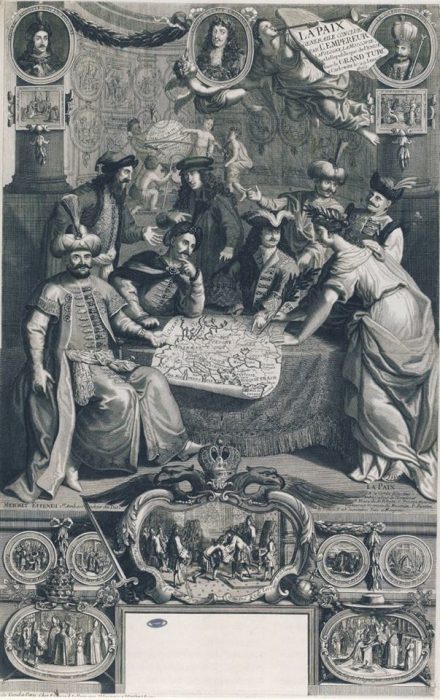
Class One: The Retreat of Islam. Before Napoleon’s invasion of Egypt, the Ottomans suffered unprecedented defeats at the hands of the Habsburgs and the Russians. In my opening, I dwell on the Treaty of Carlowitz, 1699, in which the Ottomans signed off on the loss of Hungary, Transylvania, Dalmatia, Morea, and more.

Lewis placed great importance on Carlowitz: “The disastrous retreat that followed the second Ottoman failure at Vienna, in 1683, was the first clear and unmistakable defeat. At Carlowitz the Ottoman Sultan, for the first time since the foundation of the Empire, was compelled to accept terms dictated by a victorious infidel enemy.” “The defeat… sealed at Carlowitz inaugurated a long period of almost unrelieved Muslim retreat before Christian power.” It’s hindsight, and “Turkey in Europe” lasted another 200 years. But it’s a good point to begin the saga of Ottoman retreat.

This engraving, from 1700, shows the victorious Christian allies with a map of Europe spread before them. The Turkish negotiator, on the left, looks detached; in fact, he salvaged quite a bit. And as I tell my students, at least the Ottomans were in the room. Two centuries later, the maps would be drawn without them. (Image reproduced in Hans-Martin Kaulbach’s Friedensbilder in Europa 1450-1815.)

Treaty of Carlowitz

Class Two: Bonaparte in Egypt. In the second session of my introductory course, I analyze the French invasion of Egypt, 1798. Because it was led by Bonaparte (later, Napoleon) it’s the subject of much myth and iconography. The future emperor repackaged this military disaster as a moral triumph of the Enlightenment. It’s a lesson in spin.

Still, it’s often viewed as the starting line of the modern history of the Middle East, or at least the Arab part of it. And it’s not just historians. Edward Said took 1798 as the departure point of his book Orientalism: “With Napoleon’s occupation of Egypt processes were set in motion between East and West that still dominate our contemporary cultural and political perspectives.”

So it’s interesting that Bernard Lewis, who had a much stronger sense of history, thought otherwise. “The French occupation proved to be of brief duration,” he noted (three years, to be precise), “and Egypt was subsequently restored to Muslim rule.” “In 1798, the process of defeat and withdrawal had already been going on for some time,” he emphasized—in fact, “the debate among Muslims about what had gone wrong and how to put it right began immediately after the retreat from Vienna” in 1683. But that debate “was limited to the Turks who had borne the main brunt.” Yes, the French invasion of Egypt shook up the Arabs, who’d been “sheltered from reality behind the barrier of the Ottoman Empire, still, even in its decline, a formidable military power.” But the Arabs were still a sideshow.

Lewis would always point out that the French invasion must have been particularly alarming to Muslims: Bonaparte’s small sea-borne force conquered and occupied a huge country, and it took a British force to drive the French out. But Lewis put 1798 on a timeline that’s longer and wider. Unlike the Ottoman retreats in Europe, Egypt was only a setback. So I warn my students not to be overly impressed by Napoleonic glitter. It would take much more, and many more decades, to awaken the Arabs to their predicament.

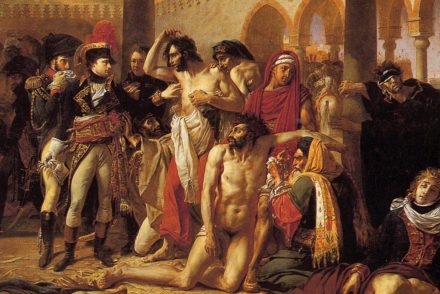
A prime piece of Napoleonic propaganda is this heroic portrayal among his plague-infected soldiery at Jaffa, by Antoine-Jean Gros, 1804 (here, detail). As the Louvre website notes, “Gros has given Bonaparte the luminous aura and gestures of Christ healing the lepers.”

Bonaparte in the Pesthouse, Jaffa

Class Three: Ottoman Modernity. In the third session of my modern Mideast course at Shalem College, I present the major reformers of the first half of the 19th century: Muhammad (Mehmet) Ali Pasha in Egypt, and Sultan Mahmud II in the Ottoman Empire.

Murdering opponents has an old history, and both of these reformers did a thorough job of it—Muhammad Ali, to the remnants of the Mamluks (1811), and Mahmud II, to the Janissary corps (1826). Then as today, there were plenty of Westerners who made excuses. “If judged wholly by our notions,” wrote one former British consul in Egypt, “the massacre of the [Mamluk] Beys was, indeed, an act of inhuman treachery. But it cannot be looked upon with the same feelings of horror that we attach to similar crimes which have been perpetrated by Christian princes.” Why? Over there, “they are accustomed from infancy to bloodshed, and punishments such as make civilised natures shudder.” Make of this what you will, it certainly evokes the shrug of the shoulders that’s greeted Bashar Asad’s liquidation of his opponents in our time.

The purpose of reform was to aggrandize the power of the ruler. I have the students ponder these words by Adolphus Slade, a British naval officer who became an Ottoman admiral:

When a nation, comparatively barbarous, copies the finished experience of a highly civilized state, without going through the intermediate stages of advancement, the few are strengthened agains the many, the powerful armed against the weak…. The sovereign’s subjects, who before had a thousand modes of avoiding his tyranny, have not now a loop-hole to escape by.

Slade would have mocked the idea that modernization advances freedom.

But the reformers won some battles, dug canals, expanded cities, opened schools and hospitals, sent missions to Europe, and (inadvertently) set the wheels of nationalism in motion. Bernard Lewis tilted a bit against the usual European celebration of these achievements. “We may question the assumption,” he wrote, that the effect of the reforms “represented an improvement on what had gone before.” But could it have been done differently? It’s a question that dogs the Middle East even today.

Below: Mahmud II at first robed himself like his traditional Ottoman forebears (left, around 1809). He later exchanged the elaborate turban for a modern-style fez, and the robes for Western jacket and trousers (right, 1830s?).

Mahmud II

Class Four: Opera, Canal, and Debts. The fourth session brings us through Egypt’s Westernizing push under the Khedive Ismail, which some see as a belle époque, and others regard as the pride before the fall. It was something of both. The Paris-educated Ismail opened the country to European experts, enterprise, capital, and (in the end) intervention. “Egypt is part of Europe,” he announced.

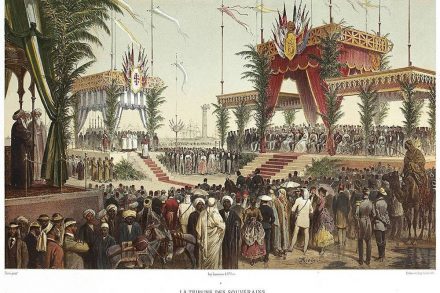
It certainly might have seemed that way, in the new quarters of Cairo modeled after Paris, and in the grand celebrations marking the opening of the Suez Canal in 1869, attended by a large swath of European royalty. But in the end, Ismail took on so much debt from English and French lenders that the country sank beneath its weight. A foreign debt commission took over the country’s finances, Ismail was pushed out, the Egyptian military revolted, and the British occupied the country (1882) to protect foreign interests. This temporary measure turned into more than half a century of tight British control.

One of the episodes that always fascinates students is Ismail’s building of an opera house in Cairo. If Paris had one, Cairo had to have one too, and to get it going, Ismail commissioned the famed Giuseppe Verdi to produce an opera suited to Egypt. The result: Aida, which had its first performance in Cairo in 1871. Set in the reign of the pharaohs, the idea for the plot was inspired by the renowned French Egyptologist, Auguste Mariette (Pasha). Opera performances found a small but devoted audience in Egypt, and after the opera house burned down in 1971, Egypt built another one, a gift of Japan.

In an easy-to-miss footnote to his bestseller What Went Wrong?, Lewis made the kind of astute observation about the opera that was his trademark:

One of the central problems of the story is the dilemma of the victorious Egyptian general Radamès, torn between the loves of two women—Amneris, the daughter of Pharaoh, and Aida the Ethiopian slave, the daughter of the Ethiopian king with whom Egypt is at war. Caught between these two women, Radamès is driven to treason and finally to death. For a 19th century European Christian, this was indeed an agonizing dilemma. It would have been meaningless in Egypt, either in the time of the pharaohs or in Verdi’s own day, and the hero could have had both ladies; the princess by marriage as a wife, the slave by gift or purchase as a concubine and perhaps later, as a secondary wife. Were Verdi and his librettist trying to send a subtle message to their Egyptian patrons; or, more probably, were they simply uninformed or unconcerned about the situation of women in Egypt?

Lewis, irreplaceable as usual.

Below we see the spectacle of the opening of the Suez Canal, in the presence of the A-list. Ismail deployed tens of thousands of forced (corvée) laborers to build the Canal, but they weren’t invited to the party. It’s a point Nasser stressed when he nationalized the canal company in 1956.

Inauguration of the Suez Canal

35 years after the Egyptian-Israeli peace treaty

This post first appeared as an article for the Commentary website on March 26.

Today, March 26, marks the 35th anniversary of the signing of the Israeli-Egyptian peace treaty, most famously evoked by the three-way handshake on the White House lawn that changed the Middle East. Israeli prime minister Menachem Begin and Egyptian president Anwar Sadat put war behind Israel and Egypt, and in so doing, ended the Israeli-Arab conflict. The Israeli-Palestinian conflict continues, and so too does the Israeli-Iranian struggle. But Israeli-Egyptian peace put an end to the destructive battlefield wars between Israel and Arab states, of the kind that erupted in 1948, 1956, 1967, and 1973. Since the famous handshake among Begin, Sadat, and Jimmy Carter, there has been no destructive battlefield war between Israel and a conventional Arab army. And Egypt and Israel now have been at peace longer than they were at war.

It has often been said of Begin and Sadat that the two men were like oil and water. “The two men were totally incompatible,” recalled Jimmy Carter, describing the Camp David negotiations that produced the treaty. “There was intense perturbation between them, shouting, banging on the tables, stalking out of the rooms. So for the next seven days, they never saw each other. And so we negotiated with them isolated from one another.”

Yet in a briefing paper prepared for the U.S. team prior to the Camp David, these sentences appear: “Both Begin and Sadat have evidenced similar personal and national objectives throughout their familiar transformation from underground fighter to political leader. Despite their often vituperative comments, each should be able to recognize the other as a politician basically capable of change, compromise, and commitment.” The idea that the similarities between Begin and Sadat made peace possible has been scanted in that interpretation of the negotiations that features Jimmy Carter as hero.

This is no surprise. No two leaders could have seemed more different, and it is almost too easy to enumerate the contrasts. For starters, Anwar Sadat came from a poor village in the Nile Delta, a place of almost immemorial permanence. Begin came from the crumbling world of East European Jewry, later erased from the earth. Sadat was an Axis sympathizer during the Second World War. Begin’s parents and brother were murdered by the Nazis. Sadat made a career of the military, and even died in a military uniform. Begin was a civilian through and through. Americans found Sadat to be alluring and easy-going, a gregarious man in a leisure suit. They regarded Begin as rigid and ideological; one American official remarked that, even at Camp David, Begin was always dressed “as though he were about to go to a funeral.” Sadat was an authoritarian dictator who sent his opponents to prison. Begin was a classic liberal with a firm commitment to democracy and the law. Etcetera.

But the similarities between the two are just as striking—perhaps even more so—and it may be precisely the personal parallels that brought them together at the crucial moment, and made the achievement of peace possible.

Marginal Men

One obvious similarity is the one to which the U.S. briefing paper alluded, in describing both as “underground fighters.” In fact, both entered politics through the back door, as conspirators who planned political violence and who were steeled by long stints in political prison.

Sadat, as a young revolutionary, immersed himself in conspiratorial plots, both against the British (who then controlled Egypt), as well as against Egyptian leaders he regarded as collaborators. As a result, he found himself in and out of prison. In 1945, the 27-year-old Sadat and his friends decided to assassinate the on-and-off prime minister of Egypt, Nahhas Pasha. Here is Sadat describing the decision to kill him:

When we were schoolboys we had gone out twice a day to have a look at Nahhas, cheering and applauding as he rode down to work and back. He had been a mythical hero—a peerless symbol of patriotism, self-sacrifice, and devotion. But then he lost everything and we came to regard him as a traitor. His disloyalty to Egypt and her people made his removal a national duty. We therefore decided to get rid of him.

The group staked out Nahhas’s motorcade; one of the members threw a grenade, but luckily for Nahhas, it missed his car. The group was quite disappointed; eager to assassinate someone, they decided to kill the former finance minister, Amin Osman Pasha. This succeeded, and while Sadat was not the triggerman, he was tried as part of the conspiracy and was acquitted only after a lengthy trial.

During eighteen months in the isolation of Cell 54, Sadat experienced his political epiphany. But what did he say about the deed that put him there? “The assassination of Amin Osman achieved its objective,” he wrote. “We had managed to mar the image of effective colonialism, with unprecedented decisiveness, in the eyes of the people.”

Menachem Begin had the more famous “underground” career. He was first sent off to prison during the Second World War by the Soviet secret police, the NKVD—an eight-month travail he recounted in his memoir White Nights. By then, he too had been initiated into a life of clandestine conspiracy—methods of operation he would bring with him to Palestine in the last days of the British mandate. There, at the age of 31, he would rise to leadership of an underground organization, the Irgun, which would be responsible for the 1946 bombing of the King David Hotel in Jerusalem, which killed 91 persons. (Begin would always claim that a telephone call had been placed to warn that the bombs had been planted.) In 1947, Begin ordered the retaliatory hanging of two kidnapped British sergeants. It was, he said, “the most difficult decision of my life,” and an act of “cruel revenge.” Begin managed to stay underground throughout this campaign, pursued by the British who never caught up with him.

Clandestine nationalist “underground” activity, involving violence against the British Empire and its collaborators, represented a clear parallel in the careers of Sadat and Begin. So, too, was their eclipse during their middle years, as the British Empire retreated from the Middle East and Egypt and Israel gained full independence. Both men spent many years on the political margins, overshadowed by charismatic leaders who had a stronger grip on the imaginations of their peoples.

Sadat was a member of the Free Officers conspiracy in 1952, and was part of the cabal of young officers who overthrew the monarchy. But after Nasser emerged decisively as the leader, Sadat came to be regarded as the most colorless man in the ruling clique. He was socially conservative, rather more religious than his colleagues, and seemingly a bit less sophisticated because of his rural origins. He spent eighteen years in the looming shadow of Nasser, and became his number two only in the year before Nasser’s death. No one could have guessed, during Nasser’s long-running high-wire act, that Sadat would succeed him. (Sadat’s deferential posture may have spared him being purged by Nasser, who never considered him a threat.) When Sadat became president, he was 52 years old—the same age as Nasser on his death.

Begin languished even longer on the margins. The Zionist revolution was credited to David Ben-Gurion, the man associated most directly with Israel’s war of independence and institution-building. The Revisionists led by Begin would always claim to have played a crucial role in Israel’s struggle for independence, by their acts of resistance—some would call them terror—against the British and the Arabs. But this was a disputed narrative—one put forward by Begin in his book The Revolt—and one that left the great majority of Israelis unmoved. The evidence for this was the performance of Begin’s political party in Israeli elections. Begin was a perpetual denizen of the opposition benches in the Israeli parliament. In a political landscape dominated by the Labor Party, he spent decade after decade delivering speeches and doing little else.

His opening only came after the 1973 war, launched by Sadat, which finally precipitated a crisis of confidence in the Labor Party leadership, and opened the door for Begin. (Here was a paradox: it was an decision of Sadat that cleared the way for Begin.) When Begin became prime minister in 1977, after leading his own party to defeat in eight election cycles, the world was astonished. He was 64 years old when he assumed the premiership.

Sadat and Begin thus spent decades in the shadow of men who effectively issued the declarations of independence of their countries. (Ben-Gurion actually declared Israel’s independence in 1948, and Nasser effectively declared Egypt’s independence by nationalizing the Suez Canal in 1956.) But neither of these giants had managed to bring peace to their peoples. Nasser drove Egypt to defeat in 1967, while Ben-Gurion, despite leading Israel to victories in 1948 and 1956, had been unable to translate military prowess into peace, and this was true of his Labor Party successors as well. They left unfinished legacies, which provided the openings for Sadat and Begin.

Who Dwell Alone

Begin and Sadat also shared a strongly pro-Western, anti-Soviet orientation. Begin had been thrown in prison by the Soviets, and although it was the struggle against the Nazis that formed him, his animosity toward the Soviet Union, while less in degree, was similar in kind. A champion of Jewish peoplehood first and foremost, he saw the Soviet Union as an oppressive regime of antisemitic evil—in contrast to many on the Israeli left at the time, who remembered the Soviet Union as the great ally of the Second World War, and who persisted in admiring its (supposedly) socialist values.

This aversion to the Soviets also held true of Sadat. During Nasser’s years, Egypt aligned itself squarely with the Soviet Union, which became Egypt’s major arms supplier, financier of the Aswan dam, and principal source of diplomatic backing. But Sadat never trusted the Soviets. He was certain they represented another form of colonialism, and that their policies were meant to keep Egypt subservient. He came to power as president in 1970, and already by 1972 he had expelled thousands of Soviet advisers, whom he regarded as agents of a foreign empire, no different than the British of an earlier era. It would be his desire to align Egypt with the West—and particularly the United States—which would set the stage for his decision to visit Jerusalem.

Both men also relied heavily on the technique of the strategic surprise. Sadat had attempted, through his first few years in power, to achieve the return of the Sinai Peninsula to Egypt through back-channel diplomacy. He ultimately concluded that what had been taken by force could only be restored by force. That led him to the bold decision to launch war against Israel in October 1973, in cooperation with Syria. His war goals were limited: to compel Israel to come to the table and force the United States to take Egypt seriously as its potential Arab partner. The war produced just enough military success to be portrayed to the Egyptian people as a victory, so that Sadat could claim to have achieved the battlefield triumph that had eluded Nasser. But to translate his (limited) military achievement into something more, there had to be a political move of comparable audacity. This would come in the form of his surprise decision to violate all the norms of Arab political conduct, and pay a visit to Israel where he appeared in the Knesset, Israel’s parliament, and made a famous speech of reconciliation.

Begin also was given to the audacious act. Three of them marked his premiership. First, there was the decision to withdraw from all of Sinai, involving the demolition of Yamit, a large Jewish settlement there. It was the first time Israel had ever dismantled a settlement, and it came as a shock, especially to his admirers. Second, there was his decision in 1981 to bomb Iraq’s nuclear reactor—a complete surprise to the world, driven by an inner conviction that he was acting to save Israel. This was followed by his decision to invade Lebanon—a move intended by Begin to complement the peace with Egypt, in remaking Israel’s strategic environment. (If it did so, it was for the worse.) Begin, like Sadat, could also surprise both friends and adversaries with bold moves.

Both men were also driven by an almost isolationist nationalism. Nasser had placed Egypt squarely in the Arab circle: Egypt was to lead the Arab world, and the Egyptians were first and foremost Arabs. In 1958, he even briefly subsumed Egypt in something called the United Arab Republic, which joined Egypt and Syria in a single polity. Sadat, in contrast, extricated Egypt from its Arab commitments. He regarded it as a civilization unto itself, so weighty that it could stand aloof and alone. Yes, it would engage in alliances and relationships with other Arab states, but Sadat was determined to put Egypt first, even if that meant that other Arabs might shun it.

Begin proceeded from a similar set of assumptions. The Jews were alone in the world, they were a people unto themselves, and they had been repudiated by East and West, even in those lands where they had been first emancipated. Begin did not regard this as tragedy, but as destiny. The Jews were destined to dwell alone, and he accepted the fact with equanimity. Here too there would be alliances and relationships, but Israel did not belong to any larger club, and ultimately it could rely only upon itself. This set the stage for the bilateral agreement between two leaders seeking to isolate their peoples from the threats around them. (It also meant that the peace itself, as much as it was intended to reconcile Egypt and Israel, was also bound to isolate them from one another.)

The two men also had a shared concept of the territorial limits of peoplehood. For Sadat, Egyptian territory was sacred, and the Sinai Peninsula was part of Egyptian territory. The commitment to the Palestinians, in contrast, was vague—diminished, in no small measure, by Egypt’s overall withdrawal from the Arab world. For Begin, the West Bank was sacred—not occupied territory, but Judea and Samaria, Israel’s patrimony. Yet the Sinai was foreign land. Had Begin been driven only by security considerations, he might have resisted withdrawal from the valuable strategic buffer represented by the Sinai. (Some of his advisers thought he should.) But his precise sense of where the Jewish homeland began and ended made possible an agreement based on a total Israeli withdrawal from Sinai.

Triumph and Tragedy

The saga of Camp David and the Israeli-Egyptian peace has been told many times (and, currently, in a play running at Arena Stage in Washington). That Jimmy Carter faced a formidable challenge in bringing Sadat and Begin to an agreement is indisputable. Begin himself, in remarks that immediately followed negotiations, said that the Camp David conference “should be renamed the Jimmy Carter conference.”

But the parallels in the lives of Sadat and Begin may have worked, in ways subtle but strong, in favor of an agreement. Here were two men forged by prison and violence into believers in their own destiny, but who had been written off politically for decades. By the time they came to power, they were in a hurry to achieve something that would transcend the legacies of their celebrated predecessors. Here were two men who believed that their peoples were fated to struggle alone, but who were prepared to go to extraordinary lengths to cement relations with the United States, in the interests of their peoples but also in order to shut the Soviet Union out of the Middle East. Here were two men who did not shy from the bold gamble, and who actually saw a greater risk in inaction. And above all, here were two men possessed not only by a strong sense of peoplehood, but of its geography, which they conceived in ways that left no overlapping territorial claims.

There is one more parallel. Both men finished their lives tragically. Sadat was assassinated in 1981 on the reviewing stand during the annual celebration of Egypt’s October 6, 1973 military offensive. While world leaders attended his funeral, the Egyptian crowds stayed home and so too did Arab leaders. He died in splendid (personal) isolation, mirroring that which he brought upon Egypt. Begin also died in isolation—one he had imposed on himself after he resigned the premiership in 1983, in the wake of the Lebanon war. In the decade between his resignation and his death, in 1992, he went into seclusion. He was buried, as he wished to be, not among Israel’s leaders on Mount Herzl, but on the Mount of Olives, and not in a state funeral, but in a simple Jewish ceremony.

For many Egyptians, Sadat’s achievement in war was tainted by an ill-conceived peace. For many Israelis, Begin’s achievement in peace was tainted by an ill-conceived war. The two men who, with Jimmy Carter, shared the world’s stage on March 26, 1979, to thundering accolades, departed this earth to mixed reviews.

But the peace treaty signed 35 years ago today has turned out to be the most durable feature of the Middle Eastern landscape, and the bedrock on which the stability of the region rests. Two “incompatible” men forged it—perhaps because, ultimately, they were so much alike.