Islam: 1,400 years embattled

In September 1973, Egypt’s leaders were looking for a name for their plan to launch a surprise attack against Israeli forces across the Suez Canal. According to the Egyptian chief of staff, Saad El Shazly, they wanted “something more inspirational than our planning title, The High Minarets.” Once the assault was set for October 6, falling in Ramadan, “Operation Badr named itself.”

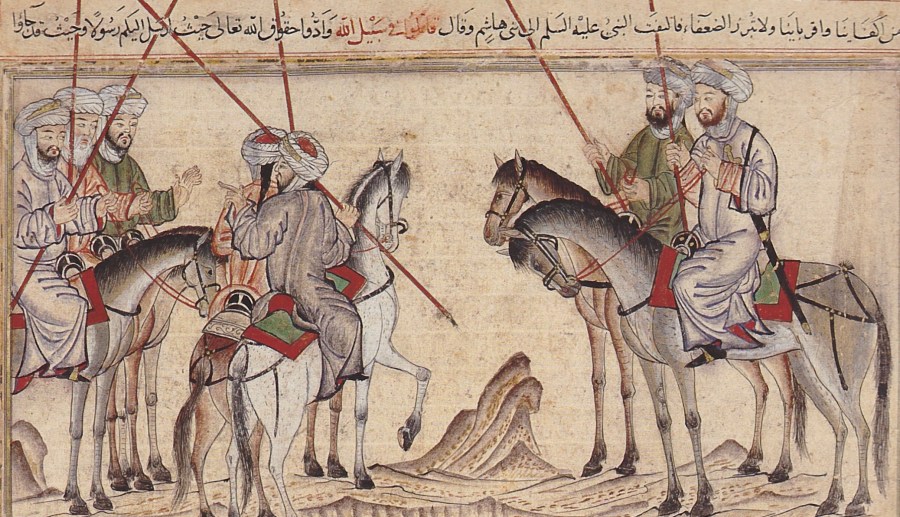
This 17th of Ramadan marks 1,400 years since the battle of Badr (624), the first military confrontation between the Muslims and their opponents—in this case, the grandees of the Prophet Muhammad’s own tribe of Quraysh. He had fled their persecution in Mecca less than two years earlier (the hijra, 622), along with his followers, in order to regroup and recruit in Medina, to the north.

At Badr, southwest of Medina, Muhammad led a contingent of 313 Muslims, outnumbered three to one, to a decisive victory over the polytheists of Mecca. The Muslims killed many, took others prisoner for ransom, and secured much booty. Angels supposedly helped out. It’s considered a turning point in the fortunes of nascent Islam, demonstrating Muhammad’s skills as a commander as well as the divine favor enjoyed by the believers.

Badr received its most memorable cinematic treatment in the 1976 epic The Message, starring Anthony Quinn and bankrolled in good part by the then-dictator of Libya, Mu‘ammar Qadhafi (watch here). The movie roughly adhered to the traditional accounts of the battle: the preliminary duels by champions, the general melee, the cut-and-thrust, and the spirit of Muslim triumph. (Quinn didn’t play Muhammad, who couldn’t be depicted on film; he played Hamza, Muhammad’s companion and uncle. Ali, the Prophet’s son-in-law and later caliph, also couldn’t be depicted; the double-pointed sword on screen is wielded by him, but you won’t see him.)

Badr did much to signal the character of Islam going forward. Bernard Lewis, historian of Islam (and my mentor), summarized that character in theses words:

The founder of Christianity died on the cross, and his followers endured as a persecuted minority for centuries…. Muhammad did not die on the cross. As well as a Prophet, he was a soldier and a statesman, the head of a state and the founder of an empire, and his followers were sustained by a belief in the manifestation of divine approval through success and victory. Islam was associated with power from the very beginning, from the first formative years of the Prophet and his immediate successors.

Thus did Islam find its validation in military success, which became its hallmark for a millennium. Its first decisive victory occurred at Badr, during Ramadan of the second year of the hijra, corresponding to March 624.

“Proven fact”

Or so I was taught. In my student days (back in the 1970s), every Islamic history syllabus started with the biography of Muhammad by a Scottish scholar, W. Montgomery Watt, in its two-volume or abbreviated version. His work, published in the 1950s, gave a coherent account that seemed well-grounded. But he achieved that only by giving the benefit of the doubt to the Muslim sources.

Why doubt? The Qur’an, the earliest source, is an opaque book of revelation, not a history. The earliest biography of the Prophet wasn’t set down until over a century after his death. The versions we have were redacted still later. The traditions regarding Muhammad were collated at about that time, and were demonstrably colored by biases and politics far removed from seventh-century Arabia. Worse still, the later the accounts, the more detailed they became, rendering them even more suspect.

Even Watt had to acknowledge that there had been “shaping” of the facts by their recorders, but he wouldn’t admit their invention: “At least the material in the early biographies is to be accepted as true,” he insisted, and “most of the background material, culled from a large number of varied works, is sound.” Otherwise, he’d never have filled two volumes.

In 1961, the French Marxist scholar Maxime Rodinson published a materialist biography of Muhammad, but he too relied on the standard Muslim sources. Consider, for example, what he wrote about Badr:

We also have certain facts upon which all the traditions are agreed. The first Arab compilers differ (slightly) as to the names of those who took part in the battle of Badr, as well as the circumstances, the preparations and the consequences of the fighting. They conflict with one another on all these points, each reflecting the party-struggles of his own day. But such disputes can only take place because everyone agrees that the battle did in fact take place, on its date (at least approximately) and with its result. We must therefore consider it as a proven fact, and endeavor to see how to place it in the total chain of cause and effect.

Just as I was finishing my studies, such “proven facts” came under a full-scale assault by revisionist historians, who insisted that the story of early Islam as told in Muslim sources was entirely spurious. Islam, they claimed, arose gradually in a setting far removed from early seventh-century Arabia; the later Muslim accounts of its birth were a kind of back-filling. As one leading revisionist historian, Patricia Crone, put it, “The entire tradition is tendentious… and this tendentiousness has shaped the facts as we have them.” My fellow grad students who’d chosen early Islam as their field had entered a maelstrom of controversy. (Not that the modern history of the Middle East was less tumultuous. All this coincided with the Iranian revolution and Edward Said’s Orientalism.)

The historicity of Badr also came in for its share of doubt. A fragment of Arabic papyrus suggested that a full century after the battle, Muslims didn’t place it in the month of Ramadan. If it had been slipped into Ramadan by late-eighth-century fixers, perhaps the whole thing was made up. This is the conclusion spread a decade ago by Tom Holland, a British writer of popular histories who took in the revisionist scholarship and sharpened its edges. The canonical account of Badr essentially duplicated

the themes that the Greek poet Homer, a millennium and a half earlier, had explored in his great epic of warfare, the Iliad. The one features angels; the other gods. Why, then, should we believe that the account of the Prophet’s first great victory is any more authentic than the legend of the siege of Troy?… What if the entire account of the victory at Badr were nothing but a fiction, a dramatic just-so story, fashioned to explain allusions within the Qur’an that would otherwise have remained beyond explanation?

Over the last fifty years, early Islamic history has been turned into just such a game of “what ifs,” without the guardrails of the traditional sources. It’s a highly technical discipline, and I don’t pretend to grasp all of the current work. It does seem that the wave of hyper-skepticism has receded; Crone, a staunch revisionist, decided that “the chances are that most of what the tradition tells us about the Prophet’s life is more or less correct in some sense or other.” But to my untrained eye, the study of earliest Islam seems to have grown ever more speculative.

The Badr of memory

Islam’s formation wasn’t the chosen specialty of my teacher, Bernard Lewis. He only touched on it in more general works, such as his 1950 overview, The Arabs in History. There he largely adhered to the consensus that the Muslim sources preserved more than a kernel of truth. “There were many disagreements among scholars as to the authenticity of this or that tradition,” he later recalled, “of this or that narrative, but the broad outline of the Prophet’s career, as also the actions and achievements of his companions and successors, was generally accepted.”

But when Lewis came to revise that book many years later, everything had changed. “In certain subjects,” he wrote in 2006, “our knowledge diminishes from year to year with the progress of scholarship and research, as one generally accepted view after another is attacked, leaving a terrain strewn with demolished or endangered hypotheses and assumptions.”

Yet Lewis still believed the Muslim sources should be taken seriously. “The past as remembered,” he wrote,

the past as perceived, the past as narrated, is still a powerful, at times a determining, force in the self-image of a society and in the shaping of its institutions and laws, even if the factual base on which this image rests is shown by historians, centuries later in distant countries, to contain more fantasy than fact.

Lewis thus shows us the relevance of Badr in our own time. In his famous 1976 article “The Return of Islam,” Lewis noted the Egyptian choice of Badr as a code name for Egypt’s 1973 war plan. Indeed, Egypt continues to this day to name large-scale military exercises after Badr. (In the Egyptian setting, that’s a double-barreled pointer, to 624 and 1973.)

But Egypt hardly has a lock on Badr. On the 21st anniversary of the 9/11 attacks, Al Qaeda drew a comparison between Badr and 9/11, which it called “Badr September.”

Truly, September 11th was a day unlike any before it. It was a day of distinction [between truth and falsehood], akin to the great [battle of] Badr, when God crushed the tyrants of disbelief of that time. Similarly, on this day in September, God crushed the head of the present era’s idol, America, and weakened its foundations through Al Qaeda’s knights of the jihad. Thus, [September 11] was a kind of Badr in one of its many dimensions and meanings…. Just as no one at the time imagined that… the final countdown of Quraysh, Persia, and Byzantium began on Friday, the 17th of Ramadan of Year Two, so no one imagined that America and its allies would begin their decline on Tuesday, September 11. But what follows will be the rise of the world’s oppressed, as is God’s unchanging law in history.

Like much in history and myth, the memory of Badr is so elastic that it’s been invoked across the entire range of contemporary politics—by Egypt’s military, the biggest Arab beneficiary of American military aid, and by Al Qaeda, America’s deadliest Arab enemy. It’s also the name of an Iranian-backed militia in Iraq, a Taliban battalion in Afghanistan, and rockets fired off by the Houthis in Yemen and the Palestinian Islamic Jihad in Gaza. To name something after Badr is to associate it with resistance and faith, the weak against the strong, the few against the many.

It’s also more evidence, if more were needed, for the consciousness of history that permeates the politics of the Middle East. When the novelist William Faulkner wrote that “the past is never dead; it’s not even past,” he intended it as a general proposition, but it particularly describes the Middle East. “The Muslim peoples,” wrote Bernard Lewis, “like everyone else in the world, are shaped by their history, but, unlike some others, they are keenly aware of it.” That’s true, even if the history isn’t.

For Muslims, this year’s anniversary of Badr isn’t special. By the Islamic lunar calendar, it’s 1,443 years to the battle, not 1,400. But the entire world now lives in an era when Badr again matters, and it’s the rest of us who need the reminder. Perhaps that’s because more battles of Badr may lie ahead.


Above: The battle of Badr from the movie The Message, directed and produced by Moustapha Akkad.

A century without a caliph

It is a century since the abolition of the Ottoman caliphate by the Republic of Turkey. The Turkish parliament—the Grand National Assembly—abolished the caliphate on March 3, 1924. The next day, agents of the Republic put the last Ottoman caliph, Abdülmecid II, on the Orient Express out of Istanbul, sending him into permanent exile. He was followed by more than 230 members of the Ottoman house.

The caliphate, successorship to the Prophet Muhammad, had existed in one form or another since the Prophet’s death in 632. There had been caliphates in Damascus, Baghdad, Cordoba, and Cairo. The sultans of the Ottoman dynasty, which emerged from Anatolia in the fourteenth century, had tacked on the title to their long list of superlatives, because they could. 

The presumption had some credibility when the Ottoman empire could hold its own against enemies. Even so, the caliphate in its Ottoman version was more than a little contrived. The Ottoman dynasty, hailing from the steppes of Asia rather than the Arabian tribe of the Prophet, didn’t pass the most basic qualifying test of lineage, although that bar had fallen long before them. Ottoman sultans took a fairly late interest in the debased title, and pushed it most aggressively when they least deserved it, during the empire’s decline. 

The sultan who took the caliphate most seriously was Abdülhamid II, who reigned from 1876 to 1909. By casting himself as both caliph and sultan, he sought to unify Muslims under his rule and gain influence over Muslims living under European domination. But he who would be caliph must project temporal power, as did the Prophet himself. For Abdülhamid, playing caliph was a more a means to conceal temporal weakness, as European empires chipped away at his own. 

The Young Turk officers who deposed him in 1909 had no great respect for the Ottomans as sultans or caliphs. From then on, the Ottoman dynasty, a relic of faded glory, was on borrowed time. The empire’s defeat and dismemberment in the First World War finally broke the spell, as it did for other monarchies in Europe: the Romanovs, who fell in 1917, and the Hohenzollerns and Habsburgs, who went down in 1918. 

The soldier who led the post-war resurrection of Turkey, Mustafa Kemal, later known as Atatürk, saw the general trend and resolved to toss the Ottoman dynasty into the dustbin. He had the sultanate abolished in 1922, installing as caliph the mild-mannered Abdülmecid, a gentleman who played the piano and cello, and painted landscapes and harem scenes. In 1924, Kemal finally delivered the coup de grâce, and put the caliphate—and with it the Ottoman dynasty—to final rest.

Or not so final. The last century has witnessed the occasional attempt to revive the caliphate. Indeed, it began as soon as Turkey abolished it. There was a pop-up caliphate in Arabia in 1924 (it didn’t last long), and a caliphate congress in Cairo in 1926 (it ended in an impasse). A caliphate movement arose in British India (it petered out). After the 1930s, the caliphate remained a curious slogan for eccentrics, until more recent times, when caliphate fever seized some of the more apocalyptic Islamists, those obsessed with reenacting early Islam in painstaking detail. 

Most famously, in 2014 the upstart Islamic State appointed its leader as caliph. This was Abu Bakr al-Baghdadi, a murderous thug who killed himself in 2019 during an American raid in the Syrian village where he had been hiding. The Americans also took out his successor in 2022. In our time, caliph is synonymous with arch-terrorist. He’s disposed of not by a one-way ticket on the Orient Express, but by special operations, airstrikes, and drone attacks. 

So far, the fringe attempt to revive the caliphate has sputtered, and it seems doubtful that a caliphate could gain momentum in modern conditions. But its absence remains a cruel reminder to some Muslims of just how far they’ve fallen away from the unity and power they enjoyed in their golden age. The late Bernard Lewis called the caliphate “a potent symbol of Muslim unity, even identity,” adding that since its abolition, “many Muslims are still painfully conscious of this void.” Just how many remains an open question.

To mark the centenary, I’ve selected three texts, each of which conveys something of the drama and substance of the events of March 1924. The first is the report by the Hungarian (Jewish) journalist Sándor Lestyán who sat directly behind Mustafa Kemal in the assembly session that abolished the caliphate. It’s not an accurate record of what was said (for that, there’s the protocol in Turkish), but it vividly captures the atmosphere. (I’ve added links to identify persons mentioned in the report.) The second is the text of the law as passed. The third is the London Times account of the last caliph’s unceremonious expulsion. 

These three texts give a sense of the abruptness and decisiveness of the action. Yet perhaps the most remarkable aspect of the end of the Ottomans, given their own history, was this: their passing didn’t exact even one drop of blood.

Source: Vossische Zeitung (Berlin), March 11, 1924.

The Dethroning of the Caliph

From the Budapest Magyarország, we have the following report by special correspondent Alexander Lestyán on the historic session of the Turkish National Assembly:

Ankara, March 3

The Turkish Empire has severed the last tie to its once highly valued tradition. “The caliphate weighs like a nightmare on the Turkish people,” Kemal, the founder of the Turkish democratic republic, remarked in his major speech to parliament two days ago. Today, the Turkish people have forcefully cast off this nightmare.

A distinctly un-Turkish excitement has prevailed in the capital of the Turkish Republic for days. This isn’t the excitement of conflict, since no one doubts that the proposal by the deputy from Smyrna, Vasif Bey, will pass by an overwhelmingly majority. It’s the type of excitement one feels when a deeply desired wish is fulfilled or when an event opens new, promising paths for one’s life. 

The school building hosting the National Assembly quickly fills with deputies and spectators. The last rows of the assembly hall are opened to the public, along with makeshift galleries. I too secure a narrow spot here. Outside, a vast crowd presses forward, awaiting the announcement of the great event. 

At a quarter to two, President Fethi Bey rings the bell to start the session. The draft law for the dethronement of the Caliph and the exile of the royal family is read out. The assembly listens in silence. The President asks if anyone wishes to speak on the individual clauses. No one speaks up about Article 1, which deals with the dethronement of the Caliph. On that point, it seems everyone agrees.

Meanwhile, Prime Minister Ismet Pasha enters the room. He succeeds in wedging himself between two deputies across from the president’s podium.

As for the expulsion of the dynasty, three deputies register in turn to speak in favor. A fourth deputy gestures to the session commissioner to pass him a note as well. The commissioner cannot make his way through the densely packed rows of benches. The deputy hands the note, with which he wishes to register to speak, to his neighbor, who passes it on. Before it reaches the session commissioner, one of the people’s representatives near him opens the folded paper, reads it, and tears it up. A brief exchange of words results in the defeat of the would-be speaker, who had intended to speak in opposition and is roundly mocked for it.

Eventually, the opposition is given the floor. Their spokesman suggests that the matter of the dynasty’s expulsion should be discussed in closed session. President Fethi Bey orders that the galleries and the public-seated benches in the assembly hall be cleared.

In one of the consulting rooms, we wait until the session is declared open to the public again. Noise from the room, including loud debates, foot stamping, and the sound of the President’s bell, suggests things are not going as smoothly as expected. The press chief of the Ministry’s Presidency explains to us that the dispute revolves around whether to expel female members of the royal family. Some particularly chivalrous deputies want to make an exception for the princesses.

Meanwhile, an hour has passed. Robust military music courses through the streets.

Kemal Pasha’s proposal is accepted. We rush towards him. From the other side, the deputies pour out of the room, still vigorously debating. Soon, the session resumes with discussion on the expulsion question. Ekrem Bey speaks in favor of expulsion, pacing back and forth on the platform as he speaks. During his speech, Mustafa Kemal enters the room, having just spent a few minutes in the Prime Minister’s working study. Kemal takes a seat in one of the last benches, just in front of me, so close that his back repeatedly brushes against my notepad. Kemal is nervous. He constantly fidgets with a rosary of glass beads, and impatiently strokes his mustache.

Ekrem Bey strongly demands the expulsion of the dynasty. His speech earns thunderous applause, with Mustafa Kemal joining in enthusiastically.

Zeki Bey speaks against the expulsion and in favor of preserving tradition. “The Republic has already achieved its honor…” 

He doesn’t get past his first sentences. Derisive laughter, angry shouts of protest, foot stamping are the response. Kemal laughs furiously and stamps along.

Zeki attempts to speak again. “Enough! Stop!” is the response.

The session descends into chaos, rivaling the tumult of seasoned European parliaments. By 5 o’clock, the general debate concludes, and the vote takes place. With the exception of five deputies, all vote enthusiastically, some with both hands. Kemal abstains from voting.

The contentious atmosphere dissipates. A solemn silence envelops the room. 

The special debate also sees its share of heated exchanges. Eventually, this too comes to an end. The clock shows a few minutes past nine when the President adjourns the session.

After the tumult, a wave of genuine Oriental emotion follows. Embraces and kisses are shared. The deputies exit in a dignified procession, passing by Kemal, who shakes hands with those who wish. Outside, the crowd’s thunderous cheers reach up to the starry, cloudless sky.

The nightmare is dispelled. What was sacred and untouchable for nine hundred years has been rendered obsolete by a simple vote…

Source for the following text: A. Şeref Gözübüyük and Suna Kili, Türk Anayasa Metinleri 1839-1980, 2nd ed. (Ankara: Ankara Üniversitesi Siyasal Bilgiler Fakültesi Yayınları, 1982), 108-9.

Law on the Abolition of the Caliphate and the Expulsion of the Ottoman Dynasty from the Territories of the Republic of Turkey

Article 1. The Caliph has been deposed. Since the Caliphate is essentially integrated in the meaning and concept of the government and the Republic, the office of the Caliphate is hereby abolished.

Article 2. The deposed Caliph, male and female members of the Ottoman Dynasty, and their sons-in-law are forever banned from residing within the territories of the Republic of Turkey. This provision also applies to any descendants born to the women of this dynasty.

Article 3. The individuals mentioned in the second article are obliged to leave the territories of the Republic of Turkey no more than ten days from the announcement of this law.

Article 4. The citizenship status and rights of the individuals mentioned in the second article are hereby revoked.

Article 5. Henceforth, the individuals mentioned in the second article are banned from owning immovable property within the Republic of Turkey. They have one year to settle any property affairs with the state, after which they cannot appeal to any court.

Article 6. Those mentioned in the second article will be granted a one-time payment by the Government to cover their travel expenses, the amount of which will vary according to their wealth.

Article 7. Those mentioned in the second article are obligated to liquidate all their immovable properties within the territories of the Republic of Turkey within one year, with the consent and under the conditions set by the Government. If they fail to liquidate these properties, the Government will sell them and give the proceeds to the owners.

Article 8. The immovable properties within the territories of the Republic of Turkey, which belonged to those who have been Sultans of the Ottoman Empire, have been transferred to the Nation.

Article 9. Furniture, paintings, and all other movable items within former royal palaces and mansions have been transferred to the Nation.

Article 10. The properties designated as royal estates along with those already transferred to the Nation, including all properties belonging to the abolished Sultanate and the former Imperial Treasury along with their contents, palaces, mansions, buildings, and lands, have been transferred to the Nation.

Article 11. A regulation will be drafted for the identification and preservation of the movable and immovable properties transferred to the Nation.

Article 12. This law is effective as of its publication date.

Article 13. The implementation of this law is the responsibility of the Council of Ministers.

Source: The Times (London), March 6, 1924.

The Caliph’s Departure.

Farewell Scenes.

(From our own correspondent.)

Constantinople, March 5

The Caliph, with two of his wives, his son Prince Omar Farukh Effendi, and his little daughter, entered the Simplon-Orient Express yesterday evening at Chatalja, where they had been kept waiting all day, and are now on their way to Berne. Further details of his Majesty’s departure were communicated late last night to the Press. When the decision of the Grand National Assembly was announced to him by the Vali of Constantinople, the Caliph listened patiently, and then, after a moment’s reflection, replied, “As you are working for the good of the country, may Allah grant you his aid.”

The Caliph asked for a delay of two days in order that he might make his preparations, but was informed he must leave before daybreak. The Caliph then asked leave to take certain members of his family with him, and this request was granted. Accordingly, his wives, his son, and his daughter were warned to pack up immediately. The Caliph, in expectation of his fate, had already prepared a list of personal effects, and thus the work of packing into a waiting fleet of lorries was facilitated. At 5 o’clock all was ready. The Caliph, his son, and his daughter took their places in the first motor-car, the wives with their attendants in the second, and the third car was occupied by the Chief of Police. Behind came a stream of lorries and other cars and motor-cycles carrying various members of the police.

Great care had been taken to ensure the secrecy of the proceedings. Immediately the Assembly’s decision became known all communication with the Palace was cut off. The telephones were disconnected, and the whole district between the Dolma Baghche and Beshiktash was put under the close surveillance of police and soldiers of the 3rd Army Corps. All the inhabitants of the Palace were kept under close observation, and the staff of the Palace was forced to remain for a full hour after the departure of the Caliph before being allowed to leave. Shortly afterwards the Palace was completely sealed up.

After an uneventful journey Chatalja was reached at 11 o’clock in the morning, and the Caliph spent the whole day in the waiting-room of the station. He spoke to nobody except the Chief of Police, whose duty it was to escort him to the frontier. When, towards midnight, the Simplon-Orient Express arrived with a special reserved coach the Caliph immediately entered the train, saying a few kind words to the officials. The Caliph was very much moved, and several of those present burst into tears. 

In the train his Majesty found the necessary passports and also a sum of £1,700, which was given him as an advance. The costs of the journey have been paid by the Government, but the Caliph is otherwise without ready money or means except for a number of jewels, which, however, are only valued at about £T.50,000 (£5,950). It is reported that the Caliph, at the moment of quitting the country, sent a valedictory to the President of the Republic (who used formerly to be his A.D.C.) saying that he had always done his best for Turkey.

The Princes of the House of Othman will be compelled to leave Turkey in two days and the Princesses in a week. An advance of £T.1,000 (about £120) will be given to each. It is reported that all the former Grand Viziers and Ministers who held office under the Sultans will also be expelled shortly.

The abruptness with which the Caliph was driven out has caused great astonishment and has produced a by no means favourable impression on the public. Owing, however, to the caution displayed by the newspapers, there is little means of gauging the general opinion, but there are rumours that several “Tribunals of Independence” have already left Angora and that there has been a manifestation of discontent at Trebizond.

Header image: The first home of the Grand National Assembly in Ankara, where the caliphate was debated and abolished. It now serves as the War of Independence Museum.

The metal detectors of Islam

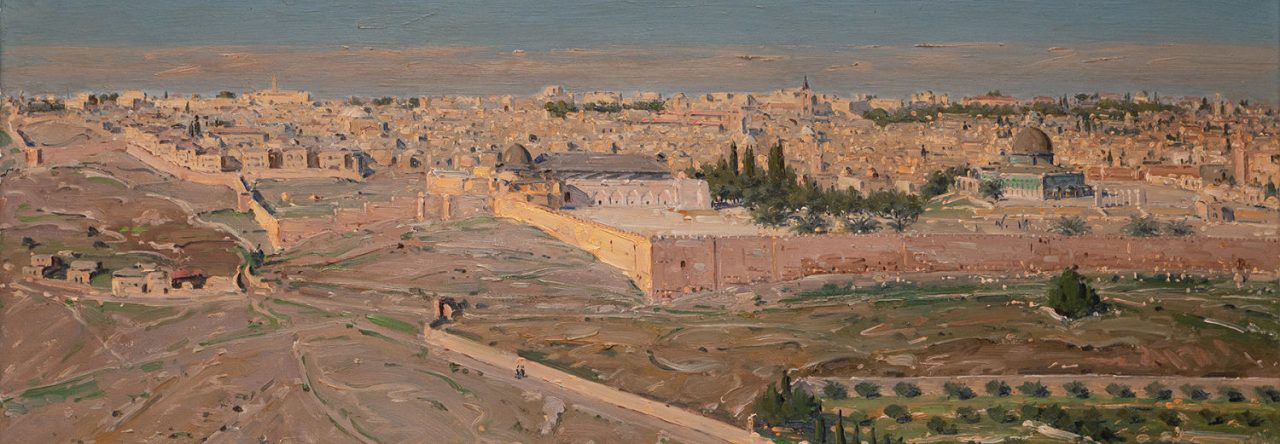
Bauernfeind, entrance to Temple MountIsrael has capitulated over the metal detectors (and surveillance cameras) that it installed last week at the entrances to the Temple Mount/Haram ash-Sharif. As anyone familiar with the long history of the “status quo” in Jerusalem knows, the “crisis” is wholly manufactured, and is but the latest chapter in a fifty-year Israeli-Palestinian struggle over sovereign authority.

The Palestinian aim has been to expand the autonomous administration of the Haram ash-Sharif, permitted them in 1967, and turn the esplanade into an extra-territorial enclave by leveraging Israeli and international fears of a wider conflagration. In this long-term campaign, they have had much success, and the latest “crisis” has produced yet another Palestinian “victory.”

The episode has raised the question of just what constitutes legitimate security measures at Islamic holy shrines and iconic mosques. We live in a time when the primary threat to the security of these sites arises from Muslims themselves—notably, extremists bent on using them as launching pads for violent acts designed to destabilize and terrorize. Across the Muslim world, governments are acutely aware of the vulnerabilities of these sites, and have taken measures to secure them. In particular, they have resorted to a very commonplace technology: metal detectors.

At this link, I provide some prime examples, from Egypt, Iran, Iraq, Saudi Arabia, Syria, and the United Arab Emirates. How do these states differ from Israel? They are effective and sole sovereigns over the holy shrines and major mosques in their territory. Israel apparently is not.

“The Metal Detectors of Islam,” here, for a quick trip to Islam’s bucket list of top sites. Please place your keys and camera in the basket.