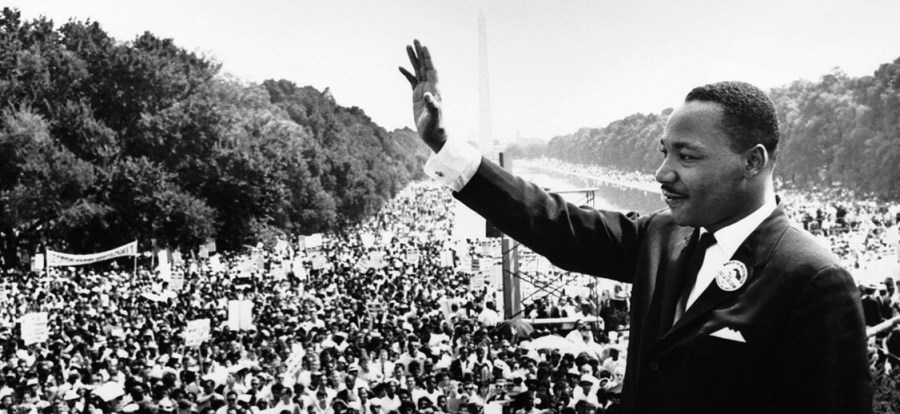
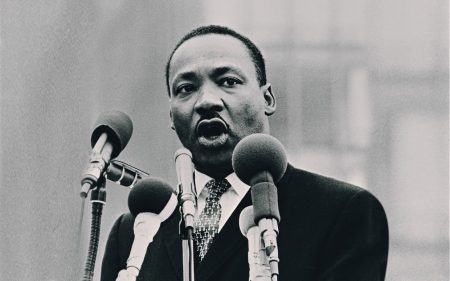
If so, then why didn’t MLK condemn Israel?

You’ll recall the piece by Michelle Alexander that ran in the New York Times this past Martin Luther King Day. Her money quote: “If we are to honor King’s message and not merely the man, we must condemn Israel’s actions.” It set me to thinking: why did MLK not condemn Israel’s actions in the twenty years between 1948 and 1968? It’s not as though there weren’t opportunities: Israel stood repeatedly in the dock during his lifetime. And why didn’t he say anything about the Palestinian “plight”? Especially as he got a high-level tutorial on the subject during a visit to East Jerusalem in 1959? I try to answer these questions in a new piece for Mosaic Magazine.

Read it here.

Trump’s Mideast strategy: disaster or opportunity?

Over at Mosaic Magazine, Michael Doran published a long essay on the preferred American strategy in the Middle East, a piece that’s been popular among supporters of Donald Trump’s plan for a smaller U.S. footprint in the Middle East. Elliott Abrams offered the first response, and I’ve offered the second, below. (Original title: “Is the American Withdrawal from Syria a Disaster, or an Opportunity, or Something Else?”) Be sure to return to Mosaic Magazine for additional responses, and for Doran’s “last-word” rejoinder.

I have immense respect for the judgment of Michael Doran. So it’s significant that he thoroughly opposes Donald Trump’s decision to withdraw U.S. forces from Syria.

Wait a moment, you say. Doran doesn’t write that in “The Strategy Washington Is Pursuing in the Middle East Is the Only Strategy Worth Pursuing.” If anything, in his latest essay for Mosaic, he acquiesces in Trump’s Syria decision, and indeed regards it as “inescapable.”

To which I’d answer yes—but, before Trump announced his decision, Doran was all against it. And since he was just as persuasive then as he is now, what’s a sworn Doran fan like me supposed to conclude?

Continue reading “Trump’s Mideast strategy: disaster or opportunity?”

Israel’s founding fathers

The annual Jewish Leadership Conference (JLC) is a new initiative, with which I’m proud to be associated. The JLC, in its own words, “aims to develop a new political and cultural vision for American Jewry, and to bring together Jews who believe that conservative ideas can help strengthen the Jewish people, the Jewish nation, and the American civic future.” I had the privilege of addressing a session of the JLC’s second annual conference in New York, on October 26. My topic: Israel’s founding fathers. As I noted in the synopsis,

No one can fail to detect the dominant role of individual leaders in the rise of Israel. Theodor Herzl stirred the Jews of Europe to see a Jewish state as a feasible project. Chaim Weizmann persuaded the world’s greatest power to shelter the movement. And David Ben-Gurion inspired a mere 600,000 Jews to win a war of independence. Subtract any one of the three, and Zionism may have fallen short of its goal of a sovereign Jewish state.

Most great national revivals are driven by one transformative champion, or a group belonging to a single generation (such as America’s founding fathers). How is it possible that, over three generations, three visionary geniuses arose to lead the Jews to restored national independence?

Now that I’ve posed the question, view the address here and see how I answer it, in 29 minutes.