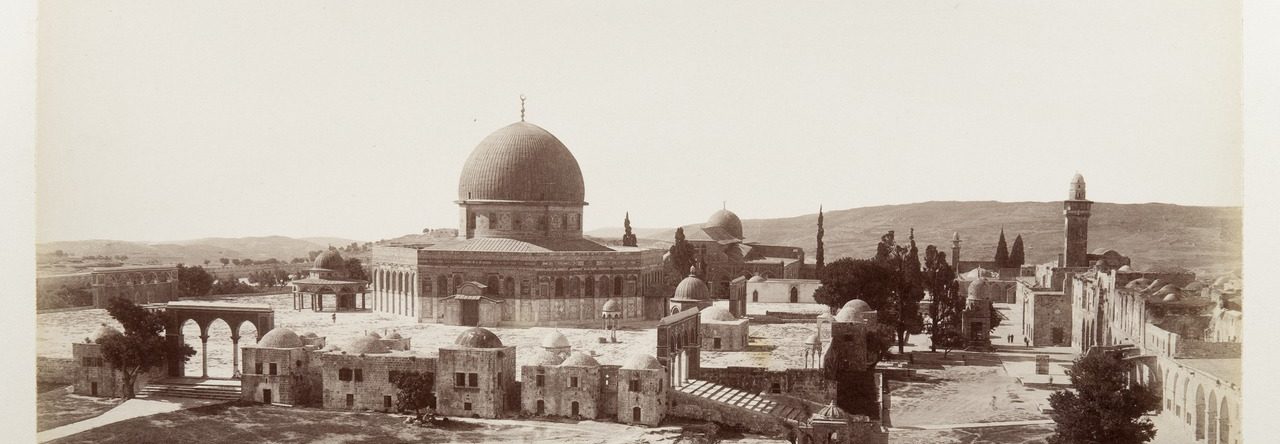
The metal detectors of Islam

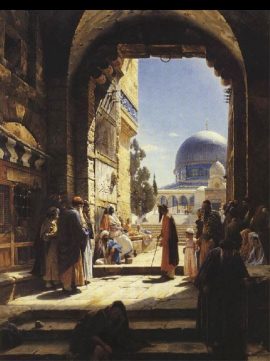
Bauernfeind, entrance to Temple MountIsrael has capitulated over the metal detectors (and surveillance cameras) that it installed last week at the entrances to the Temple Mount/Haram ash-Sharif. As anyone familiar with the long history of the “status quo” in Jerusalem knows, the “crisis” is wholly manufactured, and is but the latest chapter in a fifty-year Israeli-Palestinian struggle over sovereign authority.

The Palestinian aim has been to expand the autonomous administration of the Haram ash-Sharif, permitted them in 1967, and turn the esplanade into an extra-territorial enclave by leveraging Israeli and international fears of a wider conflagration. In this long-term campaign, they have had much success, and the latest “crisis” has produced yet another Palestinian “victory.”

The episode has raised the question of just what constitutes legitimate security measures at Islamic holy shrines and iconic mosques. We live in a time when the primary threat to the security of these sites arises from Muslims themselves—notably, extremists bent on using them as launching pads for violent acts designed to destabilize and terrorize. Across the Muslim world, governments are acutely aware of the vulnerabilities of these sites, and have taken measures to secure them. In particular, they have resorted to a very commonplace technology: metal detectors.

At this link, I provide some prime examples, from Egypt, Iran, Iraq, Saudi Arabia, Syria, and the United Arab Emirates. How do these states differ from Israel? They are effective and sole sovereigns over the holy shrines and major mosques in their territory. Israel apparently is not.

“The Metal Detectors of Islam,” here, for a quick trip to Islam’s bucket list of top sites. Please place your keys and camera in the basket.
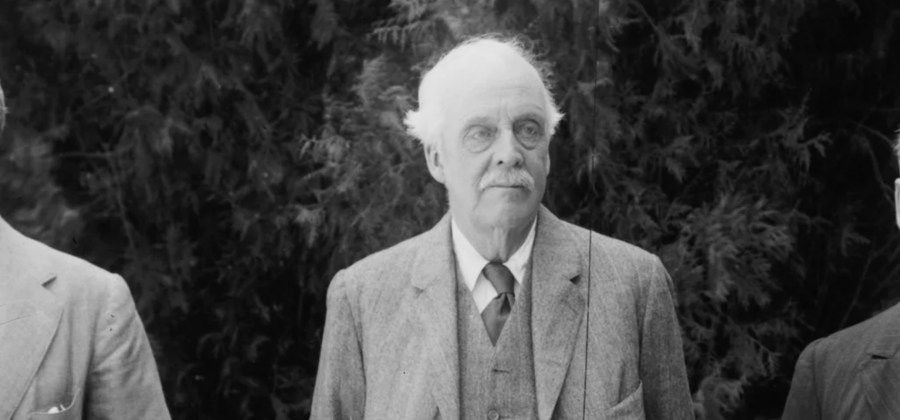
The Allied Balfour Declaration

My “final word” on the Balfour Declaration is published at Mosaic Magazine, here. Excerpt:

Had Nahum Sokolow not secured the assent of other powers in 1917 for the hoped-for British declaration, it would not have come about. And had he not returned to regain their approval in 1918, it would not have become binding international law. It is always crucial to “work” the great capital—London in 1917, Washington today. But a diversified diplomacy also aggregates the power that resides in other centers around the globe. Such aggregation gave Zionism the Balfour Declaration, the UN partition plan, and Security Council resolution 242. Absent it, Israel or its actions may yet be robbed of their international legitimacy, especially if the “unshakable bond” with its great friend begins to unravel.

Along the way, I write about the (lack of a) role of Christian restorationism in the declaration’s gestation, Britain’s failure to fulfill its commitment, and Sokolow’s forgotten finesse. As another Zionist leader once put it,

he had an amazing capacity for adjusting to his partner. Talking to a hasidic rabbi he turned into a Hasid; dealing with a French statesman he became a charming bel esprit, and, as somebody once said half in jest and half in malice, conferring with the Pope he became a Catholic.

Read my final word at this link.

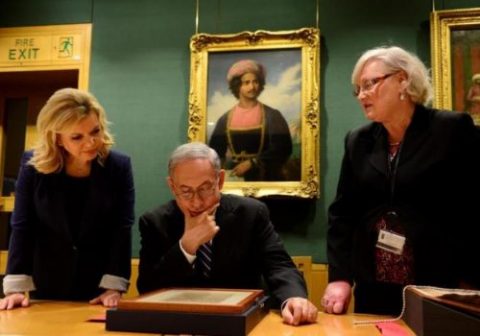
Photo below: Benjamin and Sara Netanyahu peruse the original Balfour Declaration at the British Library, September 2015 (Government Press Office).

The Netanyahus view the original Balfour Declaration.

Balfour Declaration: the responses

Three weeks ago, Mosaic Magazine published my essay on “The Forgotten Truth about the Balfour Declaration,” here. I argued that Britain would have never issued the declaration (a century ago this November) had any of the principal Allies opposed it. And I demonstrated that prior to the declaration, Zionists cleared the way by securing Allied buy-in. (A little-remembered Zionist leader, Nahum Sokolow, spearheaded this effort.) The French provided the Zionists with a letter of their own, Woodrow Wilson signed off on Balfour’s text, and the Zionists even got a nod from the Vatican. These pre-approvals made the Balfour Declaration possible.

In the day before the League of Nations and the United Nations, the Balfour Declaration thus had five-star international legitimacy. By contrast, commitments to the Arabs in the Hussein-McMahon correspondence had none. And that’s why the Balfour Declaration finally entered the mandate for Palestine, as an international commitment under law.

There have been three responses:

• Nicholas Rostow, authority on international law: “How the Balfour Declaration Became Part of International Law,” here.

• Allan Arkush, professor of Judaic studies and history: “How Gentile Zionism Affected the Statesmen Behind the Balfour Declaration,” here.

• Colin Shindler, historian of Israel and Zionism: “Jabotinsky’s Role, and the Jewish Legion’s, in Securing the Balfour Declaration,” here.

I’ll have the final word in a few days’ time. Until then, enjoy this unusual photograph. It features, left to right, Nahum Sokolow (in the thinker’s pose), Menahem Ussishkin (in bed), and Chaim Weizmann (hand on head). All three were in Paris in February 1919 to address the peace conference, so I would guess this was taken then, in Ussishkin’s hotel room. Credit: World Zionist Organization, here.

Sokolow, Ussishkin, and Weizmann in Paris, 1919