The Shiite crescent eclipsed

On March 4, a curious video clip from Syria appeared on the internet. It shows a large, gilt-framed double portrait of Ayatollahs Khomeini and Khameneh’i cast down on a stone floor. A man whose face is never shown steps repeatedly on the portrait, to the crunching sound of broken glass. (If you don’t see the embedded video below, click here.)

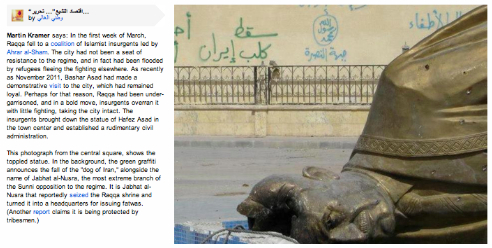
Four times in the 90-second segment, the camera pans up to focus on the ornate portal of an impressive building, inscribed with a verse of the Qur’an (13:24): “Peace unto you for that ye persevered in patience! Now how excellent is the final Home!” Someone off-camera mutters the name of Raqqa, a dusty provincial capital situated on the Euphrates about 200 kilometers east of Aleppo. It was seized by Sunni Islamist insurgents during the first week of March, and this clip clearly depicts an episode in the immediate aftermath of the city’s capture. But it doesn’t identify the specific place or explain the act of iconoclasm it depicts.

Had the camera panned up still further, it would have revealed the entire façade, completing part of the puzzle. The upper inscription identifies this site as the shrine of two figures from seventh-century Islamic history. The façade is striking, but just what is the connection of this shrine in Raqqa to Ayatollahs Khomeini and Khameneh’i, and why is their portrait being defaced at its entrance?

I answer that question in a new photo gallery, taking you on a visit to an impoverished far corner of Syria, and to the missing link in the so-called “Shiite crescent.” Go here to join me on the journey. I’ll get you back in time for lunch.
President Bashar will see you now!

Reports say that the fighting in Damascus is now “visible from the Presidential Palace,” which has prompted me to take you, my reader, on an exclusive tour of it. If the violence culminates in a revolution, the fall of the Presidential Palace would symbolize the endgame, so seizing it will become a prime objective. (But I wouldn’t expect a last stand there: that would take place far away, in the Alawite regions in the north of the country.)

So climb in the official limo, ascend the mountain, traverse the long boulevard, and enter the inner sanctum of the Assad regime! All you have to do is click here. Oh, you’re alarmed by that gunfire echoing down the marble-clad corridors? Pay no mind! The people love their leader!

October 1973: Panorama and myopia

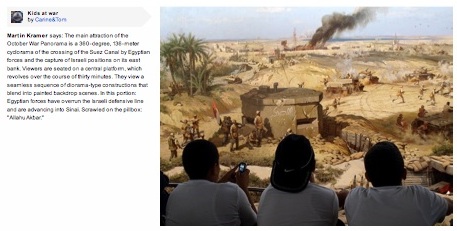
Another anniversary of the October 1973 Arab-Israeli war has passed. I’ve taken the occasion to experiment with a feature of the Flickr photo sharing site, allowing me to “curate” my own selection of photographs taken by others—in this instance, of the October war “panoramas” in Cairo and Damascus, which celebrate the Egyptian and Syrian “victories” over Israel. Click here.

It’s often said that the myth of the October “victory” made accommodation with Israel thinkable, by erasing the stigma of the 1967 defeat from Egyptian and Syrian consciousness. But a much more persuasive case can be made that Israel’s turning the tide of the 1973 war finally compelled Arab acceptance of Israel. Israeli forces overwhelmed Arab armies on two fronts, even from the most disadvantaged opening position. The lesson was not lost on the leaderships of Egypt and Syria, and it underpins their avoidance of war with Israel in the decades since.

In teaching the young only part of the story of 1973, these “panoramas” show much less than 360 degrees of the truth—and in some small way, erode the foundations of such peace as the Middle East enjoys. (They are also monuments to blind leader-worship, now challenged by the revolution in Egypt and the uprising in Syria.)

I’ve selected the most interesting photographs of these two attractions, put them in my preferred order, given them my own introduction, and put each image in its context. Again, to visit the gallery, click here. (Download pdf to print here.)