
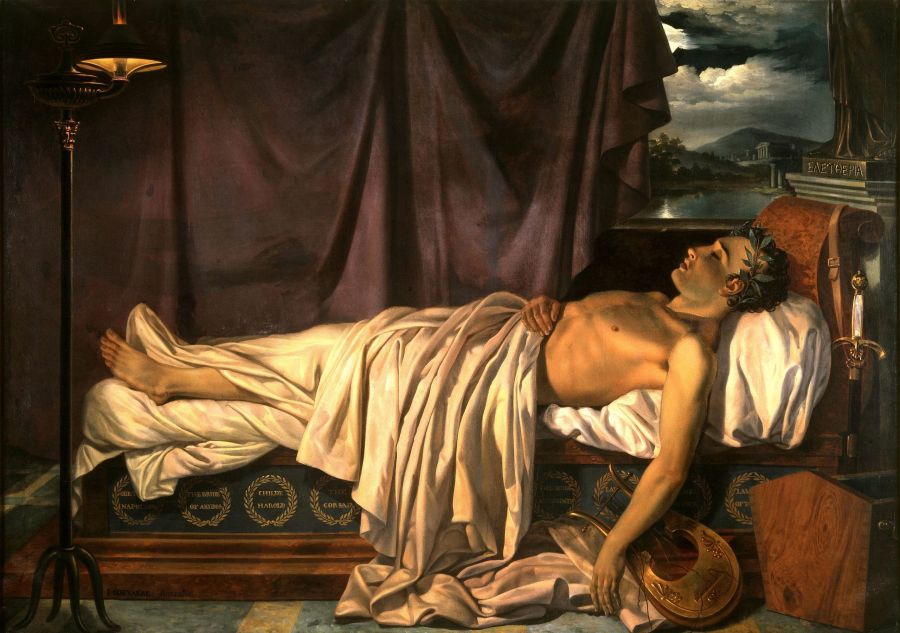
April 19 marks the 200th anniversary of the death of the English Romantic poet Lord Byron, at the age of 36. Byron was an acclaimed celebrity in his day, hailed for his literary genius and scrutinized for his notorious personal life, which gave rise to endless fascination and speculation. He died of a fever in Missolonghi, Greece, where he had lent his name, person, and what remained of his fortune to the Greek struggle for independence from Ottoman rule.
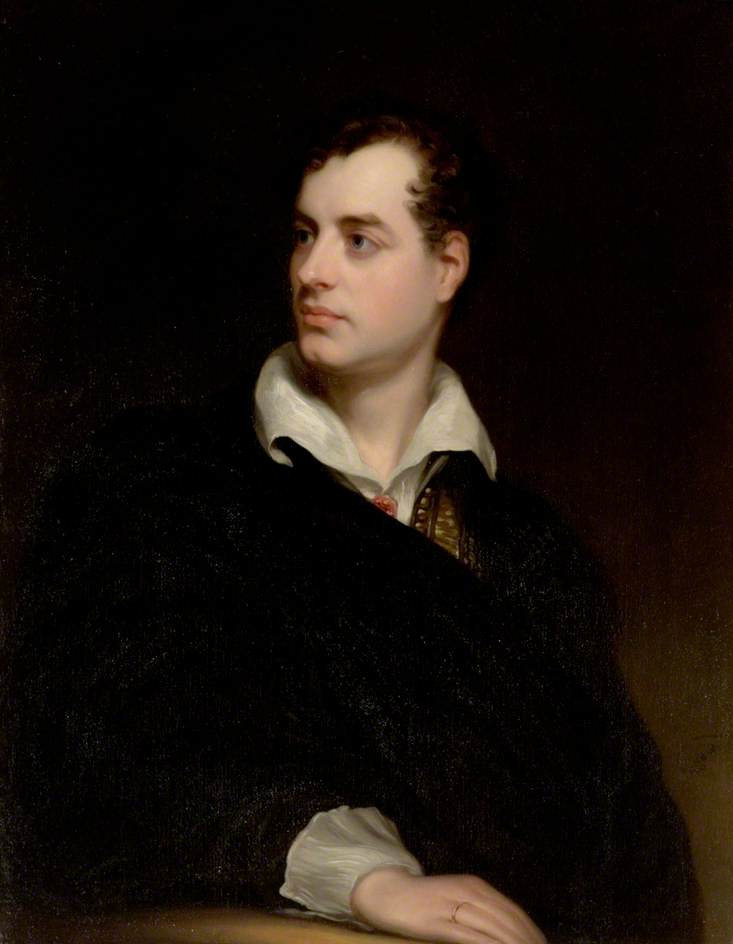
Byron may well be considered the secular saint of all Western enthusiasts for various foreign “liberation” struggles. He fit the description of such types offered by Tory statesman George Canning in 1821: “a steady patriot of the world alone, the friend of every country but his own.” Today, every American and European campus teems with would-be Byrons, though slogans have supplanted cantos in their repertoire.
Byron is identified above all with Greece and the philhellenes. But at various times he showed sympathy for Turks and Armenians, and seems to have been as promiscuous in his foreign attachments as he was in other aspects of his life.
He was also hugely popular with early Zionists, who imagined that had political Zionism gotten off to an earlier start, he might well have been its champion.
Zionist poetry
The most famous exponent of this view was Nahum Sokolow, a Zionist thinker and diplomat, whose overlooked contribution to securing the Balfour Declaration I’ve assessed elsewhere. In Sokolow’s two-volume History of Zionism (1919), he devotes a section to Byron within his discussion of non-Jewish supporters of Jewish national redemption. Sokolow made the case for Byron as a proto-Zionist by quoting his Hebrew Melodies, a collection published in 1815. Byron wrote these poems at the behest of the Jewish composer and musician Isaac Nathan, who wanted to set (supposedly) ancient Jewish music to contemporary verse.
“Zionist poetry owes more to Byron than to any other Gentile poet,” wrote Sokolow.
His Hebrew Melodies, which are among the most beautiful of his productions, have been translated several times into Hebrew, and there are no lines more popular and more often quoted than:
The wild dove hath her nest, the fox his cave.
Mankind their country, Israel but the grave.which might well have been a Zionist motto…. [Byron,] who died a martyr to his zeal in the cause of the freedom of Greece, might perhaps have been equally able to sacrifice his life for the freedom of Judaea, had the deliverance of Judaea offered scope for a similar struggle in his time. As it was he expressed the Jewish tragedy, not only in its poetical but also in its political aspect.
In this “what-if,” Sokolow engaged in a bit of fanciful appropriation. There is no evidence at all that Byron saw the Jewish “tragedy” as amenable to a political solution. Yet, there is no doubt that Jews, including Zionists, saw in Hebrew Melodies a validation. The poem “Oh, Weep For Those!” lamenting that the Jews have no home, was translated dozens of times into Hebrew and Yiddish. Jewish settlers as early as the First Aliyah sang it to their own improvised tune.
Indeed, no less than Theodor Herzl may have quoted it. Herzl and the thinker and critic Max Nordau were playing the lead roles in the Second Zionist Congress in 1898, and the press organized a banquet for them. A French newspaper, according to a witness, had just published an article expressing delight at Nordau’s phenomenal memory.
Dr. Herzl, it seems, wished to showcase this, using a strategy that turned out to be both a huge surprise and the highlight of the banquet. After Dr. Nordau finished speaking, Dr. Herzl took the stage. Suddenly, he mentioned a quote from Lord Byron. Looking distressed, he glanced towards Nordau. The help arrived just when needed. Nordau recited the quote, both in the original language and translated, as though reading from an open book.
I say “may have quoted it,” because the report does not specify which poem Herzl attempted to recall or pretended to have forgotten. We shall never know, but what is telling is that, eighty years after Byron’s death, learned European Jews were still quoting him, sometimes accurately. In 1904, the Zionist leader Vladimir (Ze’ev) Jabotinsky included Byron on a list of the ten authors whose works deserved to be preserved if all other books in the world had to be destroyed. According to Jabotinsky, Byron’s influence on his own generation of Russians surpassed that of Tolstoy.
Greeks and Jews
Much of Hebrew Melodies had little to do with the Hebrews at all, so Herzl, Nordau, and Sokolow didn’t have a massive amount to memorize. Indeed, in the case of Byron, there was certainly much they would have preferred to forget. His later poem, “The Age of Bronze” (1823), contains one of the meanest tirades against the Jews in all of English letters. There Byron portrays the Jews, and particularly the Rothschilds, as allies of tyranny against freedom:
All States, all things, all Sovereigns they controul,
And waft a loan “from Indus to the Pole.”
The banker – broker – Baron – Brethren, speed
To aid these bankrupt Tyrants in their need.
The rant escalates, culminating in this:
On Shylock’s shore behold them stand afresh,
To cut from Nations’ hearts their “pound of Flesh.”
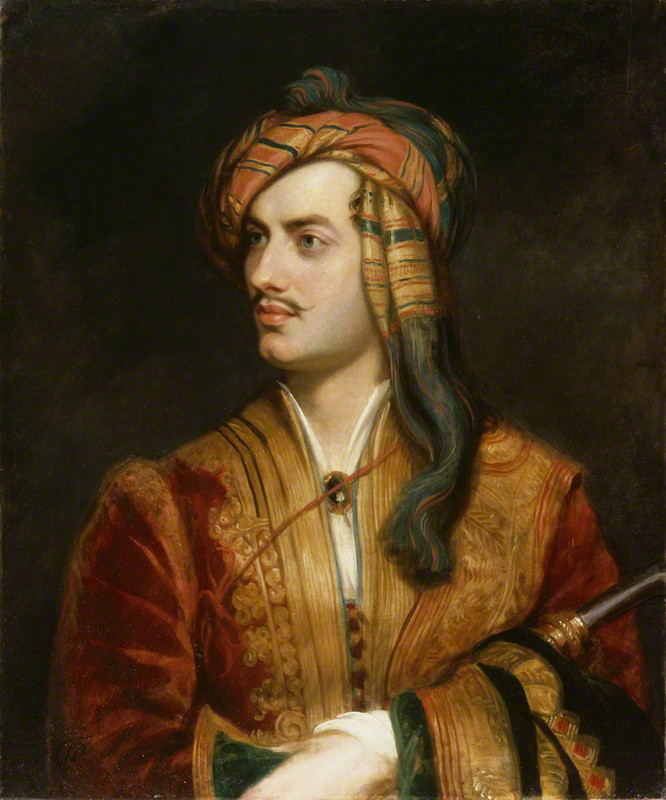
At most, it could be argued that Byron might have championed Jewish freedom as ardently as he did Greek independence, based on his remark to an acquaintance: “I am nearly reconciled to St. Paul, for he says, there is no difference between the Jews and the Greeks, and I am exactly of the same opinion, for the character of both is equally vile.”
It might also be noted (parenthetically) that the cause Byron did champion—Greek independence—was hardly favorable to Jews in its earliest phase. During the struggle, Greek Christians massacred Jews along with Muslims across the Peloponnese, most notoriously in 1821 at Tripolitsa, where all 1,000 Jewish inhabitants were slaughtered. Byron was well aware of the flaws in the movement he embraced. His willingness to look past them is another distinctive characteristic of the foreign friend of foreign causes.
Of course, Zionism owed a vast debt to Romanticism, and in that respect, it hardly matters what the Romantics thought of the Jews. After all, when Herzl wrote his manifesto Der Judenstaat (The Jewish State) in Paris, he refueled each evening by attending Richard Wagner’s opera Tannhäuser. So if Herzl and his disciples took inspiration from Byron, I suppose Israel owes him something.
On this bicentenary of his passing, then, let us reflect on the words of the nineteenth-century Hebrew poet Judah Leib Gordon, who also translated Hebrew Melodies. Just as Byron
was pained by the distress of the Greeks oppressed under the Ottoman yoke and rushed to their aid, he similarly felt compassion for the plight of Joseph and supported the children of Israel with his poetic charm. Byron was the pioneer in using his verses to awaken the love for Zion and a fondness for Jerusalem among his own people and in his land, a love that remains more deeply embedded in our people than in any other nation. Therefore, it is our duty to honor the name of this poet and cherish his memory among our people.
A selection from Hebrew Melodies
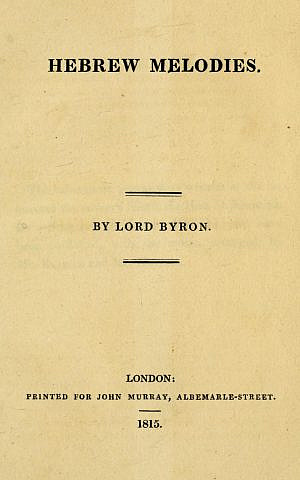
Oh! Weep For Those
Oh! Weep for those that wept by Babel’s stream,
Whose shrines are desolate, whose land a dream;
Weep for the harp of Judah’s broken shell;
Mourn—where their God that dwelt the Godless dwell!
And where shall Israel lave her bleeding feet?
And when shall Zion’s songs again seem sweet?
And Judah’s melody once more rejoice
The hearts that leap’d before its heavenly voice?
Tribes of the wandering foot and weary breast,
How shall ye flee away and be at rest!
The wild-dove hath her nest, the fox his cave,
Mankind their Country—Israel but the grave!
On Jordan’s Banks
On Jordan’s banks the Arabs’ camels stray,
On Sion’s hill the False One’s votaries pray,
The Baal-adorer bows on Sinai’s steep—
Yet there—even there—Oh God! thy thunders sleep:
There—where thy finger scorch’d the tablet stone!
There—where thy Shadow to thy people shone!
Thy glory shrouded in its garb of fire:
Thyself—none living see and not expire!
Oh! in the lightning let thy glance appear!
Sweep from his shiver’d hand the oppressor’s spear:
How long by tyrants shall thy land be trod!
How long thy temple worshipless, Oh God!
The Wild Gazelle
The wild Gazelle on Judah’s hills
Exulting yet may bound,
And drink from all the living rills
That gush on holy ground;
Its airy step and glorious eye
May glance in tameless transport by:—
A step as fleet, an eye more bright,
Hath Judah witness’d there;
And o’er her scenes of lost delight
Inhabitants more fair.
The cedars wave on Lebanon,
But Judah’s statelier maids are gone!
More blest each palm that shades those plains
Than Israel’s scattered race;
For taking root it there remains
In solitary grace.
It cannot quit the place of birth,
It will not live in other earth.
But we must wander witheringly,
In other lands to die;
And where our fathers’ ashes be,
Our own may never lie:
Our temple hath not left a stone.
And Mockery sits on Salem’s throne.
On the Day of the Destruction of Jerusalem by Titus
From the last hill that looks on thy once holy dome
I beheld thee, Oh Sion! when rendered to Rome:
’Twas thy last sun went down, and the flames of thy fall
Flash’d back on the last glance I gave to thy wall.
I look’d for thy temple, I look’d for my home,
And forgot for a moment my bondage to come;
I beheld but the death-fire that fed on thy fane,
And the fast-fettered hands that made vengeance in vain.
On many an eve, the high spot whence I gazed
Had reflected the last beam of day as it blazed;
While I stood on the height, and beheld the decline
Of the rays from the mountain that shone on thy shrine.
And now on that mountain I stood on that day,
But I mark’d not the twilight beam melting away;
Oh! would that the lightning had glared in its stead,
And the thunderbolt burst on the conqueror’s head!
But the Gods of the Pagan shall never profane
The shrine where Jehovah disdain’d not to reign;
And scattered and scorn’d as thy people may be,
Our worship, oh Father! is only for thee.
The Destruction of Sennacherib
The Assyrian came down like the wolf on the fold,
And his cohorts were gleaming in purple and gold;
And the sheen of their spears was like stars on the sea,
When the blue wave rolls nightly on deep Galilee.
Like the leaves of the forest when Summer is green,
That host with their banners at sunset were seen:
Like the leaves of the forest when Autumn hath blown,
That host on the morrow lay withered and strown.
For the Angel of Death spread his wings on the blast,
And breathed in the face of the foe as he pass’d,
And the eyes of the sleepers wax’d deadly and chill,
And their hearts but once heav’d, and for ever grew still!
And there lay the steed with his nostril all wide,
But through it there roll’d not the breath of his pride:
And the foam of his gasping lay white on the turf,
And cold as the spray of the rock-beating surf.
And there lay the rider distorted and pale,
With the dew on his brow, and the rust on his mail;
And the tents were all silent, the banners alone,
The lances unlifted, the trumpets unblown.
And the widows of Ashur are loud in their wail,
And the idols are broke in the temple of Baal;
And the might of the Gentile, unsmote by the sword,
Hath melted like snow in the glance of the Lord!
Header image: Byron on his Death-bed by Joseph Dionysius Odevaere, c. 1826, Groeninge Museum, Bruges. Wikimedia.
 Martin Kramer on the Middle East
You must be logged in to post a comment.