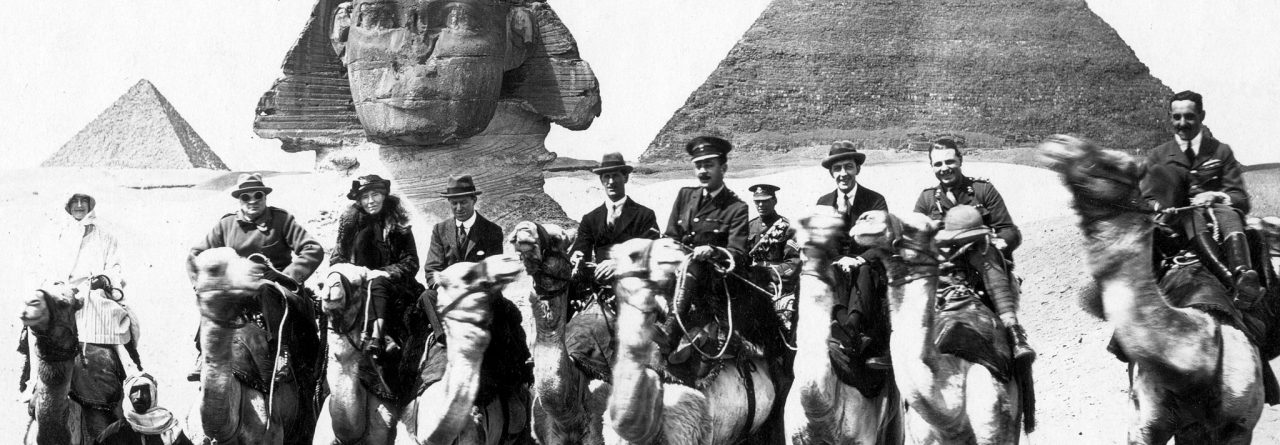
The General Islamic Congress for the Caliphate in Egypt, 1926
Martin Kramer
Over two years of intensive organizing effort preceded the Cairo caliphate congress of May 1926. Immediately following the abolition of the Ottoman caliphate in March 1924, the leading ulama of the mosque-university of al-Azhar met and issued a proclamation announcing their intention to convene a Muslim congress in a year’s time, an event to which representatives of all Muslim peoples would be invited. The congress, convened in Egypt, “the most excellent of Islamic lands,” would do no less than designate a new caliph, and so end the disarray into which the Turkish decision had cast the Muslim world.1 In Cairo, a preparatory committee of Azhar ulama planned the agenda of the congress and the invitation of delegates from throughout the Muslim world. Elsewhere in Egypt, there emerged a string of fourteen “caliphate committees,” working in support of the congress and the preparatory committee. Through additional branch committees, their reach extended to every major Egyptian population center, and their participants soon numbered in the hundreds.2 In line with a traditional policy of religious tolerance, Great Britain had declared the restoration of the caliphate a religious problem in the solution of which Britain would not interfere. The organizers thus were able to pursue their activities in Egypt without fear of hindrance.
But despite this declaration, the caliphate congress was not strictly a religious matter, for the royal palace had a hand in the effort. Much evidence suggests that the organizers hoped not simply to solve the problem of the caliphate, but to prepare the ground for an Egyptian caliphate in the person of King Fuʾad I (r. 1920-1936). These inclinations were impossible to conceal, and the congress was shadowed by the suspicion that its conclusions were foregone. The resulting domestic criticism by opponents of the monarchy led to a postponement of the congress for a year. Then the failure of the organizers to secure wide participation led to a modification of the agenda to exclude the actual selection of a caliph. A further blow was dealt by the simultaneous preparation of a rival Muslim congress in Mecca (see following chapter).
When the Cairo congress finally met, it was only to declare that the caliphate was still possible, and that the subject demanded further examination. The participants then dispersed in the anticipation that they would elaborate upon this verdict the following year. But no effort was made toward this end, and the congress never reassembled.
• •
Sources: The Cairo congress is the first for which extensive sources survive, among them proceedings and an archive. The Azhar preparatory committee even published a special periodical in Cairo, as a means for circulation of official proclamations and articles in support of the projected congress. The proceedings themselves were published serially in Arabic by Rashid Rida, in Urdu translation by the Indian Muslim activist and organizer ʿInayat Allah Khan Mashriqi, and in French translation by Achille Sekaly.3 On the basis of the proceedings as translated by Sekaly, and the periodical press, a number of contemporary observers wrote secondary studies, of which Arnold Toynbee’s was the most influential.4
In subsequent years, various relevant memoirs and published letters of participants appeared. A son of Shaykh Muhammad al-Ahmadi al-Zawahiri, who was a leading Egyptian participant and later Shaykh al-Azhar, published his father’s reminiscences concerning the event.5 Rashid Rida wrote a brief behind-the-scenes account, and in his published letters to Shakib Arslan he also discussed the congress and its antecedents.6 Documents from several state archival collections added much more to the picture from the perspective of those foreign governments which saw themselves affected by the Cairo proceedings. Some of these sources and others were combined by Elie Kedourie in his broader study of Egypt and the caliphate question, part of which was devoted to the Cairo caliphate congress.7 This was the first examination to press beyond the formal proceedings to arrive at another level of evidence and interpretation, and there to discover a complex web of rivalries that determined the course of the congress.
Two other archival collections then not available fully illuminate that further side of the congress. The first is the archive of the Egyptian royal palace, which contains several relevant files on preparations for the congress and the extent of palace involvement.8 The second is a collection of 133 documents which constitute what remains of the congress papers, and which were deposited in the library of al-Azhar.9
• •
The initiative was ostensibly that of the Shaykh al-Azhar, but was very much under the supervision of his personal secretary and president of the higher council of Azhar ulama, Shaykh Muhammad Faraj al-Minyawi. Planning the congress alongside him were members of an inner circle of initiates; beyond that working group was an outer circle of aides and supporters, who lent their names and time to the effort. Among the initial supporters was Rashid Rida, who only recently had described his vision of an elected caliphate in a compendium of his ideas on the subject, published in 1922. There he developed his earlier congress ideas (see chapter 3), and advocated a full-blown caliphal bureaucracy, under a caliph chosen by “those who loose and bind” and endowed with spiritual authority.10
For so massive an undertaking, the organizers required a budget. Although every opportunity was taken by the organizers and the king to deny any connection between them, the organizers turned to the royal palace for the necessary funds from the outset, and a solicitation letter from three of the principal congress organizers to an unnamed palace functionary gives details. The authors first dealt with the problem of creating a supportive domestic organization at the grass roots:
We believe that the spread of the appeal within Egypt will require organizations in the capital of each district (mudiriyya); the creation of branch committees for those organizations in the countryside; and the selection of able preachers (khutabaʾ) to spread the word, win hearts, and caress ears – all to gain approval for the idea of the congress, and then to prepare minds afterwards to accept whatever is decided, so that the appeal will be ultimately successful.
In discussing the requirements of the campaign abroad, the authors pointed to the considerable effort invested by supporters of Husayn’s Meccan caliphate in the propagation of their message:
As for spreading the word abroad, we believe that in principle this will require a special journal distributed free of charge throughout the Muslim world. The congress secretariat is prepared to edit this journal. Since we cannot count on the Egyptian press to publish the tracts of the congress secretariat, like they publish those in support of the other so-called caliphate [in the Hijaz], this requires haste in establishing a special journal at the congress secretariat. It is no secret that the Hijaz, as is clear from a glance at Palestinian, Syrian, and other newspapers, is pursuing its own appeal through several means. The newspaper al-Qibla has been especially designated for this propaganda. And emissaries have been sent to various lands, and will try to distribute publications to the pilgrims this year. This is how the situation appears to us. The opinion of your excellency is more sublime.11
The answer from the palace to this entreaty does not survive, but the periodical began to appear regularly in October 1924, in a format that required a substantial outlay of money. Shaykh Muhammad Faraj al-Minyawi, the principal signatory of the solicitation, was the journal’s editor, and his editorial line exactly reflected that of his letter:
A caliphate established in Mecca, among the barren rocks and amassed sands of the desert, would be an unstable caliphate parting at the seams. The beduin would plunder its strength and undermine its foundations. Egypt at present is more independent than others, better fortified against the raids of Beduin (al-aʿrab), and freer than any Muslim land in the East.12
The palace channeled the necessary funds through the government ministry responsible for religious endowments, which, unlike other ministries, fell under the direct supervision of the palace. The Shaykh al-Azhar wrote to the ministry requesting funds to cover an unexplained deficit, and in 1924 received £E2,500 for this purpose; the Shaykh al-Azhar accounted for the money as having been spent on the congress.13 This financial connection was concealed until well after the conclusion of the congress, permitting the organizers to maintain that the congress was strictly the initiative of a group of disinterested ulama.
It was not without cause, then, that those Egyptians opposed to the monarchy and its aggrandizement similarly opposed the congress. First, the royal family bared their internal dissensions. ʿUmar Tusun (1872-1944), an independently wealthy Alexandrian prince and prolific amateur historian, wrote to then-Prime Minister Saʿd Zaghlul upon the abolition of the Ottoman caliphate, asking the government’s opinion on the possibility of holding a Muslim congress in Egypt to settle the caliphate question. Tusun clearly envisioned himself as chief organizer, for he had maintained an interest in wider Muslim affairs throughout his career, and knew Turkish and Persian. Zaghlul, in his reply, deferred the decision to the king, so a short time later Tusun arrived at ʿAbdin Palace at the head of a delegation of supportive ulama to press their request.14 They met only the first secretary, and asked him to remind the king of their desire to organize a caliphate congress in Egypt. But the maverick prince was rightly considered less than sympathetic to the king’s ambitions, and so the palace threw its weight behind the far less independent Azhar committee. Tusun, once excluded from the congress plans, began to patronize a popular Sufi shaykh, Muhammad Madi Abu al-ʿAzaʾim (1869-1937), who had already organized a rival congress committee of Azhar ulama disaffected with their palace-oriented colleagues. While the Tusun-Abu al-ʿAzaʾim committee, with its few branches, was decidedly weaker than its rival, it nonetheless complicated the task of the Azhar committee both within Egypt and abroad, and became a convenient vehicle for others hostile to the royal palace.15
A group of religious zealots under the leadership of the blind Shaykh Yusuf al-Dijwi (1870-1946) made the task still more difficult. Dijwi had gained renown for his leading role in the trial and persecution of Shaykh ʿAli ʿAbd al-Raziq, and was convinced of the necessity of an active and vital caliphate.16 But his group, also formed immediately after the abolition of the Ottoman caliphate, opposed an Egyptian caliphate, because vice-ridden Egypt was not governed by Islamic law. Egypt as a geographic and cultural entity was certainly the Muslim land most worthy of the caliphate, wrote Shaykh Dijwi and his associates in a manifesto, but the “legal order in our country is invalid.” The Afghans, who maintained the holy law of Islam, were “the single community to preserve the principles of their religion,” and had succeeded the Turks to Muslim primacy. “If Afghanistan had what Egypt has, in geographic location and situation at the meeting point of east and west, and scientific and economic centrality, the Muslims from one corner of the world to another would be stirred to recognize its amir as caliph.” Egypt “could yet win for herself the affection once held for the Turks and now held for the Afghans,” but only if the king would enforce Islamic law throughout the land. Shaykh Dijwi guaranteed that he and his followers then would respond by promoting the caliphate of the Egyptian royal house.17 The palace was not enthusiastic about this suggestion, resented the unfavorable comparison of Egypt with Afghanistan, and later had the police open an investigation of Shaykh Dijwi’s group. According to an official communiqué, “they were occupied with a question that did not concern them.”18
Opposition then began to spread beyond the ulama in the Tusun-Abu al-ʿAzaʾim and Dijwi circles to various liberals and nationalists anxious lest the palace wield the caliphate to intimidate domestic rivals. The political struggle within Egypt had intensified in 1924, with the election and installation of a Wafdist government led by the nationalist leader Saʿd Zaghlul (1857-1927), who had just returned from exile. It was not long before tension developed between the Wafd and the palace, and between the two central actors in the Egyptian political arena, Zaghlul and King Fuʾad.
Zaghlul as prime minister initially wavered on the question of an Egyptian caliphate, but then decided against seeking the title for Egypt’s ruler.19 His interior minister issued orders to provincial governors that they withhold all assistance from the Azhar caliphate committees, and banned shariʿa court judges from serving as members.20 At a later date, after Zaghlul had resigned his ministry, his party went so far as to subsidize the Tusun-Abu al-ʿAzaʾim committees, so resolute was the Wafdist determination to thwart the palace’s designs.21 In such a charged political atmosphere, plans suffered from their association with the ambitions of the Egyptian ruling house. The appearance of serious domestic opposition was thus the most probable cause of the Azhar committee’s January 1925 decision to postpone the congress for one year.22
Domestic opposition could not forestall indefinitely a project which enjoyed the open support of Azhar ulama and the covert aid of the royal palace. The issue soon became not whether the congress would take place, but who would arrive from Muslim states and communities beyond Egypt to participate in a forum very likely to insist upon Egypt’s centrality in Islam. According to Rashid Rida, who served on the preparatory subcommittee for invitations, the Azhar committee appealed to kings, sultans, princes, and heads of important religious societies throughout the Muslim world, to respond and participate. Sectarian differences were disregarded: Wahhabis, Ibadis, Zaydi and Twelver Shiʿis, and even the Agha Khan of the Ismaʿilis, were invited, although the question of the caliphate was not posed to these sects by the Turkish act of abolition.23 Yet here again, the identification of the congress with the palace, and the fragmented state of Muslim opinion, worked to defeat the organizers.
One instance concerned the dissemination of the Azhar invitation in Shiʿi Iran. On his own initiative, the Egyptian minister to Iran, ʿAbd al-ʿAzim Rashid Pasha, lobbied at Teheran and Qumm to convince both the government and leading Shiʿi ulama to send authorized delegates to Cairo. The first evidence of ʿAbd al-ʿAzim’s activity dates from October 1925, when he inserted an article in a Baghdad newspaper strongly attacking the Abu al-ʿAzaʾim caliphate committee.24 By November, he had successfully planted a eulogistic front-page article about King Fuʾad in an Iranian newspaper; the piece, printed under a portrait of Egypt’s monarch, described Fuʾad as “defender of Islam.”25 In March 1926, a Soviet radio broadcast to Iran criticized the caliphate congress, and ʿAbd al-ʿAzim responded by inserting counter-propaganda in two Iranian newspapers.26 This service he paid for: “The newspapers do absolutely nothing without recompense,” for “the state of poverty in this country has a great effect on any service in all branches.” He lamented “the weak means that the foreign ministry has put in our hands—the sum of 150 pounds.”27
In January 1926, ʿAbd al-ʿAzim opened a round of personal diplomacy with a visit to Qumm for meetings with religious figures. The ulama expressed their concern about the recent territorial gains of the Saudi movement in Arabia, and this gave ʿAbd al-ʿAzim a chance to discuss in detail Egypt’s pursuit of an anti-Wahhabi policy “since the time of Muhammad ʿAli Pasha.”28 But it was not until February that the Egyptian minister heard that the caliphate congress was scheduled definitely for May. He immediately warned his superiors that “this country has a strange belief about the caliphate,” citing Twelver Shiʿi doctrine, but this did not deter him.29 During March, he received a batch of invitations to the congress from Husayn Wali, one of the Cairo organizers, with a request that the Egyptian minister distribute them. This he did, through the Iranian premier, all the while stressing that time was short and urging speedy replies.30
In fact, as Sir Percy Loraine reported, the Iranian government was “rather embarrassed” at the suggestion that Iran participate,31 and an elaborate game of evasion began. The Iranian premier informed ʿAbd al-ʿAzim that the decision rested with the ulama, but the ulama replied that the decision rested with the government. When ʿAbd al-ʿAzim pressed Iran’s minister of information, he was told that the ulama had agreed in principle to participation, but final word was delayed because of difficulties in contacting Shiʿi authorities in Najaf. Could the congress be postponed? ʿAbd al-ʿAzim countered that the ulama had told him that they were in total agreement, and that the matter was in the hands of the government. The Iranian minister replied that the ulama spoke what they knew to be false themselves, because the real difficulty was their inability to agree on who would represent them at Cairo.32 ʿAbd al-ʿAzim began to appreciate the futility of his efforts. An intimate of Riza Shah told him that the Shah preferred to see the congress convened in the Hijaz, as he was certain that the ruler of any other host country would be elected caliph. The holy cities were the qibla of all Muslims, and therefore neutral sites. ʿAbd al-ʿAzim tried at length to explain that Cairo was an equally neutral site, but parted discouraged. “The circumstances which I witness here weaken any hope that Iran will accept the invitation to the congress.”33
A prominent ʿalim then astonished ʿAbd al-ʿAzim with yet another counter-proposal: Najaf was a more appropriate site for the congress, since Egypt was under British influence. ʿAbd al-ʿAzim replied that Najaf was located in territory under British mandate, while Egypt was independent, and he saw in this a further sign that Iranian participation was unlikely.34 ʿAbd al-ʿAzim suggested to his own government that, in order to secure Shiʿi cooperation, the agenda of the congress be expanded beyond the caliphate question to matters of general Muslim interest.35 But by this time, the British authorities were rather annoyed with ʿAbd al-ʿAzim’s lobbying. Unenthusiastic themselves about the congress, they thought it better that Iran abstain from participation, and that ʿAbd al-ʿAzim be instructed that Iranian representation was a matter between Azhar shaykhs and Persian mullahs, not diplomats and foreign ministers.36 Within a month, ʿAbd al-ʿAzim was sent a reprimand from the Egyptian royal diwan, informing him that the invitation to the congress was solely the work of men of religion, and that the Egyptian government had no official connection with the congress.37
Perhaps the British insisted on the reprimand; perhaps some Egyptian authority decided that reluctant Iranian attendance was more a liability than an asset to the ultimate election of Fuʾad as caliph. ʿAbd al-ʿAzim could offer only this apology: “If I discussed the matter, it was because I saw it as my obligation toward an invitation issued from my country.”38 When the Shaykh al-Azhar finally wired an invitation, the Iranian government announced that the Shiʿi ulama had not had adequate time to study the caliphate question, and authorized Iran’s diplomatic representative at Cairo to attend only as a spectator.39
With the establishment of Saudi control over the holy cities of Arabia, reading Saudi attitudes assumed a new urgency. In a letter to the Shaykh al-Azhar, Ibn Saʿud had promised his support for the Cairo caliphate congress provided that the participants represented the majority of Muslims. He declared himself willing to recognize the decision of such a congress as binding, and denied any personal caliphal ambition.40 But he feared that an elected caliph—particularly an Egyptian one—might lay some claim to the holy cities only recently occupied by his forces. The Egyptians already had attempted to establish a religious protectorate over the Hijaz, shortly before the triumph of Saudi arms.41 The Cairo organizers thus could not have been surprised when Ibn Saʿud sent no delegate to their congress, for he had little to gain from its success, and much to lose from a decisive outcome.
The Azhar committee anticipated more from Muslim India, where the fate of the caliphate had evoked profound concern among Sunni and Shiʿi alike. The Indian Khilafat Committee, under the leadership of two brothers, Muhammad ʿAli (1878-1931) and Shawkat ʿAli (1873-1938), commanded a following which reached the proportions of a mass movement in the early 1920s, and the Azhar committee regarded the participation of the organization in the Cairo caliphate congress as critical if the resolutions of the projected congress were to bind this largest Muslim community. But the Khilafat Committee leaders were wary of Egyptian intentions. When rumors reached Delhi in late March 1924 that the Azhar ulama planned to proclaim Fuʾad caliph, Shawkat ʿAli cabled Saʿd Zaghlul from Delhi expressing the hope that Egyptian ulama “do not intend any hasty action regarding future of khilafate.” The Khilafat Committee was attempting to convince the Turks to appoint one of their own to the office, but should this effort fail, “future of khilafate should be left to be settled by proposed world muslim conference.”42 Shawkat ʿAli warned that “[a] matter of such grave importance is likely to be as dangerous as undue delay or neglect.”43 Later Shawkat ʿAli asked for details about the way in which the caliph would be selected. He hoped for unanimous agreement, but “Muslims of the far distant places would be fewer compared with local visitors who could swamp them easily. I think each country must be assigned votes on a population basis though it may send only fewer representative[s].” He anticipated the dispatch of a large Indian delegation, but “there have not been wanting men who suggested that Cairo would not be a suitable place for the Conference as there was a chance of official interference [which] would like to unduly influence its deliberations.”44
An opportunity to make the Egyptian case in person was presented to Azhar ulama in the summer of 1925, when two of the leading lights on the Khilafat Committee, Mukhtar Ahmad Ansari (1880-1936) and Hakim Ajmal Khan (1863-1927), reached Egypt during a trip to the Middle East. Ansari once had been an unrestrained Turcophile, and as a physician educated in England had led the All-India Medical Mission to aid Ottoman war wounded during the Balkan campaign in 1913. He was familiar with the charges leveled against the proposed congress, and so the task of the Egyptian organizers was not an easy one. Ansari had already made this plain. Attending a reception in his honor during a stopover in Jerusalem, he mentioned a number of congress sites preferred by Indian Muslims, but ruled out Egypt because of the presence there of a strong party determined to resolve the caliphate issue in favor of King Fuʾad.45
In Cairo, the Azhar ulama, Shaykh Minyawi foremost among them, encircled Ansari and Ajmal Khan from the moment they descended from their train. The Indian Muslim envoys were polite, but seemed to prefer the company of Shaykh Abu al-ʿAzaʾim, with whom they met often. By this, they gave cause to conclude that the Indian Khilafat Committee shared in the critique of those Egyptians opposed to the congress.46 Later, Shawkat ʿAli wrote to Abu al-ʿAzaʾim in a congratulatory tone, and the Tusun-Abu al-ʿAzaʾim committee began to speak of itself as if in close association with the Khilafat Committee.47 The final decision taken in Delhi was not unexpected. Once Ajmal Khan had returned to India and met with the ʿAli brothers, they together decided to formalize their abstention by declining the Azhar invitation. Ansari, who was still in the Middle East, gave this explanation:
The present circumstances are not propitious for holding the congress, in view of the political controversy and dispute over the constitutional rights of the [Egyptian] people, and the circulation of the rumor abroad that the ulama of al-Azhar are motivated in this course by a hidden force, employing spiritual, religious influence in a struggle against the nationalist parties that are demanding the rights of the people. I do not credit these rumors with truth for a moment. But the insistence of the ulama in holding this congress in Cairo despite the will of all the other Muslim lands encourages belief in these rumors and their expression as established facts. I would not want my Egyptian brethren, who deliberate and think over their every action, to damage their position of centrality in the Muslim world.
If the Egyptian ulama elected a caliph alone, Ansari warned that this figure would become “the laughingstock of the Muslim world.” He instead advocated an annual Muslim congress, based upon what he described as proportional representation and so empowered to elect a truly popular caliph.48 Muslim India was ultimately represented at the Cairo congress by a single participant, ʿAllama ʿInayat Allah Khan Mashriqi (1888-1963), a Cambridge-trained mathematician, teacher, and later founder of the militant pro-Axis Khaksar movement. Although later a man of influence, he was not yet well known, and the lack of an authoritative Indian Muslim voice at the congress was an unconcealed blemish.49/p>
The participation of an important Indonesian delegation would also have done much to enhance the findings of a caliphate congress held in Cairo, for in the Indo-Malay periphery was a populous Muslim community which had drawn closer to Egypt, al-Azhar, and the ideas of Islamic reform as propounded by Muhammad ʿAbduh and Rashid Rida in al-Manar.50 An alliance of political activists and ulama in Java had succeeded in creating and directing a mass organization, the Sarekat Islam, under the leadership of Umar Sayyid Tjokroaminoto (1882-1934).51 Rashid Rida, who had his own correspondence with Java, dispatched the congress invitations to Sarekat leaders. In December 1924, four to five hundred Sarekat activists met at Surabaja to select the movement’s delegates to Cairo and to determine the policy which they were to represent. Three members from Java were selected to proceed to Cairo and convey the Sarekat plan, which argued that the powers formerly exercised by the caliph should be delegated to a council, the members of which would be chosen from various Muslim countries. The president of this council, elected by its members, would assume the title of caliph.52
It soon became known that the smaller but expanding Muslim reformist movement, the Muhammadijah, based both in Java and western Sumatra, had also been invited to send a delegation to Cairo, and planned to do so.53 Now the Sarekat Islam was experiencing a period of heightened rivalry, so that Tjokroaminoto began to disparage the rival delegation’s mission, and to insinuate that the Sarekat Islam might not participate in the Cairo congress after all. By the time of embarkation, he had heard rumors that King Fuʾad would be declared caliph at Cairo, and this he made the pretext for possible abstention. “As matters stand,” he declared once embarked, “we have heard nothing as yet from the Committee at Cairo which sent out the invitations. It is not impossible that the English may endeavor to bring their influence to bear by causing King Fuʾad to be proclaimed Caliph. If such a thing should occur—in other words if the Caliphate is to have its seat at Cairo—then, so long as I am a representative of Dutch India, I will never give my consent to the proposal, which would be in conflict with the Koran.”54
During a stopover in Arabia, Tjokroaminoto allowed himself to be convinced that such a development would be the inevitable outcome of a caliphate congress held in Cairo, and he did not bother to proceed to Egypt. The Azhar caliphate committee had to rest content with a two-man Muhammadijah delegation, led by the Sumatran reformer Abd al-Karim Amrullah [Hadji Rasul] (1879-1945).55 This was a disappointment, one which assured that the decisions of the caliphate congress would become embroiled in the divisive domestic politics of one of the most populous quarters of the Muslim world.
It was also hoped to attract Muslims from another important and populous region, the Soviet Union. An invitation was extended to Musa Carullah Bigi[yev] (1875-1949), a Tatar colleague of Ismail Gasprinskii’s, and a reformist publicist and theologian who had studied many years earlier in Egypt. While there, Musa Carullah had known ʿAbduh personally, and wrote a lengthy study of Afghani and ʿAbduh.56 Musa Carullah had no sympathy for national communism, but chose nonetheless to remain in the Soviet Union and attempt to reconcile his faith with communism. There he received four invitations to the caliphate congress from the Azhar organizers, and he decided to attend.57 But shortly before his departure the mufti of Ufa denounced the impending caliphate congress as under the thumb of “imperialist” (British) domination.58 Musa Carullah almost certainly did not intend to denounce the congress, but Egyptian consular authorities in Istanbul did not know this; and when Musa Carullah arrived on his way to Egypt, they apparently became concerned lest a Soviet Muslim delegate appear at the congress and disturb the proceedings by making a similar accusation. The Egyptian consul refused to issue Musa Carullah a visa, leaving him much perplexed and unable to attend the proceedings.59
The presence in Egypt of influential North African and Syrian communities had led Egyptians to consider these regions as immediate cultural and political hinterlands.60 The participation of Muslims from North Africa and Syria in the Cairo congress was probably regarded as a minimal requirement for success, and it was perhaps for this reason that the Azhar committee took an unusual step to assure participation. A secret appeal was made to France, which ruled Algeria, Tunisia, and Syria.
This subject was first raised in discussion with the French ambassador in Cairo, Henri Gaillard, in November 1924: “The persons who are preparing the congress have spontaneously asked me to single out, on their behalf, those Muslim figures in Algeria, Tunisia, and Syria, who seem to me the most suited for participation in the congress.” In Gaillard’s opinion, France stood to benefit from compliance with this request, for if French authorities did not provide a list of names, the selection “risks being guided by those Syrian and North African elements in Cairo or Alexandria who are the least favorable to France.”6162 Gaillard’s argument was discussed at length by the Commission Interministerielle des Affaires Musulmanes sitting in Paris. On the one hand, some held the view that too much was at stake for France to adopt a policy of nonintervention in a question as important as that of the caliphate. The Cairo congress might emerge as a significant political event directly affecting French interests. Critics of this opinion held that the congress, if left alone, was liable to fail to agree on the selection of a caliph and so collapse, and that France could best contribute to this result by preventing the dispatch of delegates from her Muslim possessions. Eventually the Commission settled on a compromise. If, despite all the apparent obstacles, the congress seemed about to take place, then France would communicate a list of participants to the organizers at the last minute. These participants would not really participate at all, but would act strictly as informants, for it would be hazardous to impart precise instructions to them in favor of one or another policy. The Quai notified Gaillard that he would receive a list of participants. He was instructed to use his judgment in choosing the moment for transmitting the list to the Azhar committee, and was cautioned that this moment be deferred as long as possible, to avoid the controversies likely to arise from the selection.636465 Gaillard agreed. But no such lists were ever compiled. The Governor General of Algeria, when asked to supply names, expressed himself certain that the congress would not meet or would fail if it did, “the Muslims not having proven, at any time, their aptitude in the organization of a council on this scale.” He therefore did not now wish to transmit such a list, for he felt that no precaution could prevent its being leaked, thus provoking an unhealthy public discussion concerning those selected. A list of qualified Algerian Muslims would be submitted if the congress seemed inevitable, but communication of a list of names from Algiers would be deferred until the last possible moment. At the same time, the Governor General prevented the rise of a sympathetic movement in Algeria. ʿAbd al-Hamid Ibn Badis (1889-1940), Algeria’s leading Muslim activist, wrote to the organizers in Cairo that the French did not want Algerian notables to participate in the congress, and that he doubted whether he could represent Algeria because formation of a local committee was “impossible.”66
The French High Commissioner in Beirut felt otherwise. He believed that Syrian Muslim participation was inevitable, and that prudent preparation was essential. From Syria he proposed to send to Cairo only religious personalities of indisputable character, chosen with discretion and uninvolved in agitation against the French. “Without imposing categorical instructions on the delegates, it would be politic to direct them toward the candidature [for the caliphate] that seems most advantageous to the interests of Syria and those of France in the East. In order that the actions of these delegates not be contested, it is essential that they appear to have escaped our direction.”67 But here again no list was prepared, for once the postponement of the congress was announced by the organizers, Gaillard wrote to Beirut that the collection of names had become “pointless.”68 The Azhar committee, despite having gone so far as to solicit the names of participants from a non-Muslim power, thus had achieved nothing, and once left to its own devices achieved no success at all in the matter of Syrian participation. The émigré Syrian activist Shakib Arslan showered advice upon the committee from his European exile, but he would not attend.69 The self-exiled Tunisian reformist and activist ʿAbd al-ʿAziz al-Thaʿalibi, then in Iraq, did accept an invitation, but he preferred to be admitted as a member of the Iraqi delegation, for reasons which he did not make clear. The caliphate committee which did function in Tunis sent no representative, for it had been deterred by Abu al-ʿAzaʾim’s campaign against the congress.70
Shortly after the renewal of the Azhar committee’s activities, the vice rector of al-Azhar wrote a letter to ʿAbd al-Karim (1883-1963), leader of the Riffian resistance against the Spanish protectorate in northern Morocco and the French-supported ruling ʿAlawi dynasty, requesting that the resistance movement send delegates to the congress.71 Further letters from ʿAbd al-Karim to the Azhar committee, intercepted by British postal authorities at Tangier, indicated that the correspondents were on close terms, and that funds were being dispatched secretly by the Azhar committee to ʿAbd al-Karim.72 By their cultivation of ʿAbd al-Karim, the Azhar committee hoped to attract a delegation of some standing from a distant region, an aspiration still unfulfilled only three months before the rescheduled congress. In ʿAbd al-Karim, the committee found a willing party from a major geographic periphery, one who, because of his embattled position, enjoyed a prestige in the wider Muslim world conferred by a continuing resistance to foreign encroachment.
Upon learning of this invitation, Gaillard immediately complained to his contacts at al-Azhar. “I have informed the committee that to invite or accept delegates from Abdelkerim is not admissible, for the double reason that Abdelkerim has revolted against the sovereign of his country, and because that sovereign is recognized as caliph in Morocco.”73 The committee replied to Gaillard defensively and untruthfully, claiming that ʿAbd al-Karim had solicited the invitation himself, and Gaillard did not pursue the matter further.74
Far more persistent, and ultimately successful, was Spain, ʿAbd al-Karim’s principal battlefield adversary. A note verbale delivered to the Egyptian legation in Madrid by the Ministerio de Estado spoke of the “profound displeasure that would be caused in Spain by anything which would signify official or semi-official recognition of this political personality, or would demonstrate deference toward representatives of a chief in rebellion against the legitimate authority of the Spanish Protectorate of Morocco.”75 While the Egyptians considered this request, the Spanish ambassador in London pressed British authorities to make British influence in Egypt felt among the members of the Azhar committee.76 Asked for his comments on this Spanish request, the British representative in Cairo argued that, “while realising that the presence of Riff delegates at Cairo might be inconvenient to the Spanish Government, I venture to deprecate any intervention on our part in such a delicate matter,” on account of British neutrality in all that was related to the issue of the caliphate.77 A British Foreign Office official thus informed his opposite number that “to our regret we cannot usefully take any such action as that suggested.”78 But this exchange was overtaken by events, for the Egyptian government decided on its own accord to satisfy Spanish desiderata in a note verbale disclaiming all connection with the congress, and professing nonrecognition of the “rebel” ʿAbd al-Karim. “In order to bear witness to its desire to maintain the best relations with the Spanish government, the Egyptian government is disposed to refuse entry to delegates of this rebel into Egyptian territory.”79 Egyptian authorities adhered to this policy, and the interests of Morocco were defended at Cairo by a shaykh of a religious order, described explicitly in a French diplomatic source as a Spanish political agent.8081
With the approach of the revised congress date, the organizers of the Cairo congress, in surveying the results of their campaign abroad, were bound to concede that an attempt to elect a caliph on such a narrow base would invite profound embarrassment. Yet the Azhar and the congress were far too intertwined for the committee, after nearly two years of highly publicized work, to cancel the event without even greater embarrassment. Resort to the option of another postponement would have opened the committee to intensified charges of political incompetence and organizational ineptitude. At a meeting of the preparatory committee in late April 1926, Shaykh Mustafa al-Maraghi sought an honorable exit from this impasse by suggesting a fundamental revision of the congress agenda. No longer would the congress aspire to elect a caliph. Instead, it would define the caliphate, determine whether it was necessary, determine the personal requirements of the office, and decide whether it was now possible to establish such a caliphate. If the caliphate was deemed impossible in this age, the congress would determine what measures to take. If it was deemed possible, the congress would search for the appropriate means of selection. But the committee would delete from the agenda the discussion of the candidates and the selection or election of one as caliph. This probably reflected the discouragement of King Fuʾad, who told Gaillard two months before the agenda revision that the congress would be a short one and would not designate a caliph because the Muslim world was too thoroughly divided over the issue.82
With the opening of the congress, the extent of the defeat in the matter of participation became embarrassingly manifest. The Egyptian organizers were there in force, and a sizable delegation of notables descended from Palestine by train. Otherwise, attendance was meager. Even Rashid Rida, who actively participated in the organizing committee, and later published the proceedings, did not attend in person, and privately predicted disaster for the impending congress.83 At an early stage, he diagnosed the faults of his fellow organizers, to which he made this allusion: “The important thing is that our colleagues, the members of the preparatory committee here, lack everything that is essential in both intelligence and initiative for this project. I cannot say more than this.”84
• •
To these two years of controversy and negotiation, the actual proceedings of the congress proved anticlimactic. The congress divided into three committees, which prepared reports for the plenum on various theoretical aspects of the caliphate. But the preparatory committee had set down a charter (see appendix 5) which established procedures, and the discussion of the constitutional gaps left by this document occupied much of the time of the plenary sessions. The argument revolved around the manner in which resolutions were to be adopted. The Egyptian organizers were eager to pass on to substantive questions, but other participants insisted that internal regulations be set down with greater clarity. “The congress has already held three sessions, and this is the fourth [and last],” said Shaykh Minyawi urgently, “yet we have still done nothing. We did not assemble to discuss secondary questions, but to present Muslims with useful work.”85 The constitutional problems were never fully sorted out, but were left aside at Egyptian insistence. On substantive issues, the congress essentially divided along Egyptian and non-Egyptian lines. The former group was led by the Azhar organizers, and the latter by ʿAbd al-ʿAziz al-Thaʿalibi, who had once before played this role of opposition-bloc organizer. During the Pilgrimage Congress of 1924 in Mecca he had thwarted Husayn of Mecca, and for this reason probably was invited to Cairo. But now he turned his organizing skills as spoiler on the Azhar organizers themselves. Thaʿalibi was overheard by a police agent in his hotel lobby planning with other non-Egyptians to disturb the work of the congress, the moment it touched on the issue of candidacy for the caliphate.8687 The object of the Egyptian organizers was to avoid such a disturbance, yet prevent any decision that precluded a future caliphate of the Egyptian ruling house. To those who claimed that Qurashi descent was an essential attribute of the caliphate—a condition which would have ruled out an Egyptian caliphate—the Egyptians insisted that historical practice had invalidated the requirement. To those who claimed that the caliphate was no longer possible at all, given the sorely divided state of the Muslim world and the inability of any one Muslim ruler to defend it, Shaykh Zawahiri responded in force: A candidate elected by a subsequent congress, if that congress were more representative, would meet the requirements of the shariʿa by virtue of his election by a consensus of Muslims.88
In this manner, the congress, after only four plenary sessions held over less than a week, resolved itself into a decision to convene again the following year, in what it was hoped would be a more representative fashion. The participants, without apparent enthusiasm, committed themselves to establishing branches in their own countries, and they assented to a proposal that the next congress take place in Cairo. It seems that the agenda for the following year was then to be determined at the banquet which closed this first congress, but a reporter wrote that the participants passed the banquet in eating rather than discussion, and most went home without any idea of what the next caliphate congress would undertake.899091
• •
Even before the first congress, Rashid Rida had proposed that it meet a second time, and each Muslim territory would have one vote in the reconvened assembly. He even offered to write a tract on the caliphate specifically for submission to such a congress. But there is no evidence that any attempt was made by the organizers to reconvene the congress the following year. For all intents and purposes, the General Islamic Congress for the Caliphate had folded. The experience was not wholly without a sequel, for Shaykh Mustafa al-Maraghi apparently felt himself capable of achieving what the Azhar committee had not achieved. He had contributed something to the gestation of the congress idea, with his proposal of 1915 (see chapter 5). He had also participated in the preparations for the 1926 congress, although the failed event was essentially the work of others. In later years, with the elevation of a young, charismatic king in the person of Faruq I (r. 1936-1952) his former tutor Maraghi rose in stature. As Shaykh al-Azhar, he began once more to work discreetly for the emergence of an Egyptian king-caliph, and to campaign openly for a Muslim congress.
The congress suggestion this time reappeared not in the formal context of the caliphate—an invitation to certain defeat—but in the less controversial framework of Sunni-Shiʿi reconciliation. In this initiative, Shaykh Maraghi had an active ally. “For more than a year, I have been trying to lay the foundations for an accommodation between the Sunna and the Shiʿa.” ʿAbd al-Rahman ʿAzzam, Egypt’s minister to Iraq in 1938, justified his overtures by pure raison d’état, in a diplomatic dispatch to Cairo:
Al-Azhar would become the principal school of Islam in the world, in which the people of the various Islamic schools could study their fiqh. This would strengthen Egypt’s religious influence among the Shiʿa of Iraq, Yemen, Iran, Afghanistan, and India, and naturally would be followed by an enhancement of Egypt’s political centrality. Experience shows that the political influence drawn by a state from a religious appeal is a sturdy and strong one, resistant to the vicissitudes of time. ʿAzzam Pasha reported that he already had approached influential Iraqi politicians and ulama, including three of the most prominent mujtahids: Shaykh Muhammad al-Husayn Al Kashif al-Ghitaʾ, Shaykh ʿAbd al-Karim al-Jazaʾiri, and the marjaʿ al-taqlid, Ayat Allah Abu al-Hasan Isfahani. To them, he spoke of Muslim unity, the need for a Muslim congress to examine religious issues, and the role of al-Azhar as a university for all the sects of Islam.
Where had these ideas originated? A year earlier in Egypt, ʿAzzam had raised these issues with Shaykh Maraghi, who had been in full agreement. The diplomat now asked his foreign ministry to present three concrete proposals to the Shaykh al-Azhar. ʿAzzam suggested first that Maraghi visit Najaf and Karbala, an act which ʿAzzam expected would have a tremendous effect; second, that al-Azhar accept students from madhahib other than the Sunni four, and allow these students to study fiqh from ulama of their own madhahib; and last, that Shaykh Maraghi “call for a general Islamic congress among the ulama, whose purpose will be religious,” and whose task would be the reconciliation of the various sects (al-taqrib bayna al-madhahib).92 The foreign ministry acceded, and sent a copy of ʿAzzam’s dispatch to Shaykh Maraghi.93
But the initiative had already been taken. In late October 1936, ʿAbd al-Karim al-Zanjani, a Najafi ʿalim, arrived in Egypt for a stay which lasted nearly two months. Shaykh Maraghi held a tea party for him, and the Shiʿi rapidly became a popular speaker around Cairo’s Muslim activist circuit.94 Zanjani’s theme was the identity of Sunni and Shiʿi interests, and his biographer devotes a chapter to a comparison of Zanjani and Jamal al-Din al-Afghani.95 After Zanjani’s return to Iraq, Shaykh Maraghi began to correspond with him. Maraghi’s hope, he once confided to Lord Lloyd, was that Muslim countries would send delegates “to sit on a permanent sort of Supreme Islamic Council, eventually to be established at Cairo, where all questions affecting any one of them as a member of the Islamic Union, would be considered and a common policy formulated.”96 To this end, Shaykh Maraghi began to speak openly of a reconciliation of the sects,97 and decided to involve the Shiʿi Twelver community in this plan through his new acquaintance. Zanjani does not appear to have counted for much at Najaf, and certainly there were ulama of far higher standing and distinction to whom Shaykh Maraghi might have turned. That the Shaykh al-Azhar chose to cultivate Zanjani was perhaps related to the Iraqi ʿalim’s past flexibility in matters concerning the caliphate. In 1924, Zanjani offered his allegiance to Husayn of Mecca as caliph.98 This act, unconventional by any Twelver Shiʿi standard, placed Zanjani squarely on the side of political expediency in matters of the caliphate.
And to Shaykh Maraghi this was essential. For at exactly the same time, he had won over the leader of Ismaili Shiʿism to a radical proposition: “Before his departure [from Egypt],” wrote Lampson in Cairo, “the Aga Khan informed me on February 11th of the gist of his conversation with Sheikh el Maraghi. He said that the Sheikh had quoted historical precedents for local rulers assuming local Caliphate titles in the past. Sheikh el Maraghi had urged that the same thing could properly be done in Egypt today, and if done by one Muslim ruler, it would doubtless be done by others.”99 Shaykh Maraghi first asked Zanjani’s opinion of the proposed Muslim council in February 1938.100 Zanjani replied favorably, but then added two reservations. He first stressed that the Shiʿi public believed that government appointees were removed from divine favor, and so representation on the council had best be nongovernmental. His second point was that a site free from foreign influence was essential to the success of the plan.101 Maraghi answered that he too preferred men of religion as delegates, but saw no reason not to include some prominent figures who were not ulama. He avoided the question of the proposed site by not mentioning it, and went to some pains to assure Zanjani that he had not made an attempt through official channels to transform Najafi religious institutes into appendages of al-Azhar, although he did hope for closer ties.102103
Just below the surface of the correspondence was an evident tension. Zanjani had successfully conveyed to Maraghi that he understood the Shaykh al-Azhar’s centralizing aim, and was not much in sympathy with an Egyptian bid for ascendancy. Another source reported that Zanjani “did not commit himself to any opinion regarding the suggestion that King Faruq should be proclaimed caliph.” Zanjani had drawn his line on the wrong side of Shaykh Maraghi’s plans; with the collapse of his scheme for a Muslim council, Maraghi severed his Najaf connection.104 The Shaykh al-Azhar did not visit that city, and appears to have made no further initiative to secure a Shiʿi constituency. During the subsequent six years until his death, Shaykh Maraghi occasionally returned to the congress theme, but did not pursue it actively, and no serious attempt was ever again made in Egypt’s era of constitutional monarchy to convene a Muslim congress in Cairo. There were those in the palace who continued to covet the caliphate for Egypt, but they sought to win their prize by guile, as in January 1939, when a palace-inspired crowd acclaimed Faruq caliph as he departed from Friday prayers.105
This expressed the loss of self-assurance caused al-Azhar by the Cairo caliphate congress. Much of the argument for Egyptian primacy rested on the claim that Cairo, as the cradle of al-Azhar and modern Muslim reform, was entitled to the deference accorded the capital city of a faith. This assertion substituted theological preeminence for military prowess as the principal attribute of centrality in Islam, and then insisted upon the absolute supremacy of Egypt in the field of Muslim learning. Neither assumption had made much headway beyond Egypt. Military prowess still counted for a great deal, and made for the continued prestige among Muslims enjoyed by republican and secular Turkey. And even those who recognized the importance of cultural and theological primacy were not bound necessarily to Egypt. At the turn of the century, al-Azhar, undermined by self-imposed isolation and state neglect, was still roughly equal in stature to institutions of Muslim learning in Tunis, Damascus, and Deoband. The subsequent transformation in the Egyptian perception of Egypt’s relative standing in Islam owed much to the extensive reform of al-Azhar. It was also tied to the emergence of the Shaykh al-Azhar as the preeminent religious dignitary within Egypt, finally superseding the leaders of the two great Egyptian religious confraternities.106
But the effects of these changes had not been felt beyond Egypt when the Cairo caliphate congress put them to a rigorous test. The results were unfortunate, for al-Azhar’s preeminence was not widely acknowledged, a fact which the congress exposed but could not rectify. The impact in Cairo, both in al-Azhar and the royal palace, was chastening. Egypt’s bid for the caliphate and primacy in Islam survived the setback of 1926. But the technique of the Muslim congress was shed in favor of outright self-assertion, in what one diplomat called Egypt’s “pursuit of the Caliphate Grail.”107
Appendix: The General Islamic Congress for the Caliphate in Cairo
Charter adopted by the preparatory committee of the Congress in its session of Sunday, Shawwal 12, 1344 / April 25, 1926.
Art. 1. — The Congress shall be presided over by His Eminence, the Shaykh al-Azhar.
Art. 2. — The Congress shall have a vice president, who shall be named by the administrative committee of the Congress, and who shall carry out the duties of the president in the event of his absence.
Art. 3. — The president of the Congress shall preside over the sessions, give the floor, direct questions, announce the resolutions, and speak in the name of the Congress.
Art. 4. — The maintenance of order shall be the responsibility of the Congress participants, under the supervision of the president on behalf of the Congress.
Art. 5. — The Congress secretariat shall consist of the secretary general and his assistants, who must know the languages of the participants in order to make the necessary translations, should circumstances require this.
Art. 6. — The secretary general shall examine the credentials of the delegates, in conformity with the invitations issued by the Congress. He shall record their names, and their addresses in Egypt and in their own countries, in a special register. He shall issue each delegate with a pass indicating his name, title, and country.
Art. 7. — The secretariat shall establish the agenda of each of the sessions of the Congress, shall transcribe the proceedings, record the resolutions, take attendance, and keep a list of those delegates who desire the floor.
Art. 8. — The secretariat shall edit the proceedings and the resolutions of the commissions, and submit reports to the president of the Congress.
Art. 9. — The president shall open and close the sessions, and set the date of the next meeting at the close of each session.
Art. 10. — Arabic shall be the official language of the Congress. Those who do not know it well may speak and comment in their own languages, after the secretariat has translated and distributed their speeches and papers to the other members. As for ordinary remarks, they shall be translated during the sessions themselves.
Art. 11. — The first meeting of the Congress shall be an inaugural session for the presentation of members. At that time, a commission shall be named, chosen from among the members, to examine the speeches, proposals, and papers before they are read to the Congress. This Commission shall submit the results of its examination to the Congress president, indicating which communications may be delivered to the Congress, and a schedule for their presentation.
Art. 12. — In its second session, the Congress shall examine the agenda, and determine the number of sessions as well as the agenda of each session. The Congress may form commissions to study certain questions, should it so choose.
Art. 13. — The commissions shall examine the matters submitted to them, and each shall separately submit a report containing the results of their deliberations. Each commission shall appoint one of its members as rapporteur, and his report shall be presented to the Congress at a predetermined time.
Art. 14. — The president shall transmit proposals and other communications received by him to the relevant commissions.
Art. 15. — Every member of the Congress has the right to speak during a session, after having requested and obtained the permission of the president, on a first-come, first-served basis, following the scheduled speakers.
Art. 16. — Remarks shall only be addressed to the president or the Congress assembly.
Art. 17. — The speaker shall not stray from his subject, repeat something that has already been said, or speak twice on the same subject.
Art. 18. — Interruption of the speaker shall not be permitted, except to call him to order, which is the prerogative of the president.
Art. 19. — The president shall conclude the discussion if no member desires the floor to present a new point of view.
Art. 20. — Should a group of members request that discussion be closed, the president shall solicit the advice of the Congress.
Art. 21. — Votes shall be conducted by alphabetical roll call.
Art. 22. — Resolutions regarding the questions on the agenda and specific propositions shall be passed by a majority of those members present. In the event of a tie, the president’s vote shall be decisive.
Art. 23. — The secretariat, under the supervision of the president, shall count the votes and determine the results, which shall be announced by the president.
Art. 24. — The secretariat shall edit the minutes of each session’s deliberations, and shall read them at the beginning of the following session. If there are no objections, the text shall be considered approved. It shall be signed by the president of the session and the secretary general or his representative, then transcribed in a register and signed again.
Art. 25. — The president shall communicate letters and correspondence of any importance to the Congress.
Art. 26. — The sessions of the Congress shall be public, and admission shall be by personal pass.
Endnotes
- For the text of the proclamation, see Majallat al-muʾtamar al-islami al-ʿamm fi’l-khilafa bi-Misr (Cairo), no. 1 (October 1924), 20-23; Achille Sekaly, Le Congrès du Khalifat et le Congrès du Monde Musulman (Paris, 1926), 29-33; and Arnold J. Toynbee, Survey of International Affairs 1925, vol. 1, The Islamic World since the Peace Settlement (Oxford, 1927), 576-78. ↩
- There exists in ʿAbdin Palace an exhaustive list, nearly sixty pages long, of the names of all the members of the principal and branch committees; see Mahfuzat Riʾasat al-Jumhuriyya (Archives of the Presidency of the Republic), Cairo, file 761, “Lijan al-khilafa al-islamiyya bi-Misr.” On the organization of committees in Upper Egypt, see Fakhr al-Din al-Ahmadi al-Zawahiri, al-Siyasa wa’l-Azhar, min mudhakkirat Shaykh al-Islam al-Zawahiri (Cairo, 1364/1954), 210. ↩
- Rashid Rida, “Mudhakkirat muʾtamar al-khilafa al-islamiyya,” al-Manar (Cairo), June 11, 1926, 27(3):208-32; July 10, 1926, 27(4):280-94; August 18, 1926, 27(5):370-77; September 7, 1926, 27(6):449-58; ʿInayat Allah Khan Mashriqi, Khitab-i muʾtamar-i khilafat (Rawalpindi, 1974); Sekaly, Congrès du Khalifat, 4-11, 29-122. For complaints about the integrity of the official proceedings, which are the basis for all these published versions, see al-Siyasa (Cairo), June 21, 1926. ↩
- Toynbee, Survey of International Affairs 1925, 1:281-91; and F. Taillardat, “Les congrès interislamiques de 1926,” L’Asie française (Paris) 27, no. 246 (January 1927):9-13; 27, no. 247 (February 1927):54-60. ↩
- Zawahiri, al-Siyasa wa’l-Azhar, 207-17. ↩
- Al-Manar (Cairo), March 14, 1926, 26(10):789-91; Shakib Arslan, Sayyid Rashid Rida aw ikhaʾ arbaʿin sanna (Damascus, 1356/1937), 335 ff. ↩
- Elie Kedourie, “Egypt and the Caliphate, 1915-52,” in The Chatham House Version and Other Middle Eastern Studies (London, 1970), 183-89, 193-95. ↩
- On this archive, see Martin Kramer, “Egypt’s Royal Archives, 1922-52,” American Research Center in Egypt Newsletter, no. 113 (Winter 1980):19-21. ↩
- These papers had been kept by Husayn Wali, the congress secretary, and were presented to the library of al-Azhar mosque in 1967 by one of his nephews. The correspondence concerning the file itself gives cause to doubt that the collection is complete. For a preliminary study of the material, see Mahmud Sharqawi, “Dirasat wathaʾiq ʿan muʾtamar al-khilafa al-islamiyya 1926,” al-Katib (Cairo) 10, no. 113 (August 1970):115-22; 10, no. 114 (September 1970):132-37; 10, no. 115 (October 1970):156-61; 11, no. 119 (February 1971):151-58. ↩
- These ideas are discussed by Malcolm H. Kerr, Islamic Reform: The Political and Legal Theories of Muhammad ʿAbduh and Rashid Rida (Berkeley, 1966), 183-85. ↩
- Muhammad Faraj al-Minyawi and ʿAbd al-Baqi Surur Naʿim to unnamed addressee, May 20, 1924, Dar al-Wathaʾiq al-Qawmiyya (Egyptian National Archives), Cairo, ʿAbdin: al-khilafa al-islamiyya, uncatalogued box. ↩
- Majallat al-muʾtamar al-islami al-ʿamm fi’l-khilafa bi-Misr (Cairo), no. 7 (1925), 167-68. ↩
- According to the minister, as quoted in al-Manar (Cairo), May 31, 1927, 28(4):316. Further details in al-Manar (Cairo), May 2, 1927, 28(2):156-57. ↩
- Text of Tusun’s letter and Zaghlul’s reply in al-Muqattam (Cairo), March 20, 1924. On Tusun, see Gaston Wiet, “Son altesse le Prince Omar Toussoun,” Bulletin de l’Institut égyptien 26 (1944):1-19. ↩
- The meeting which ended in the creation of this committee is described in al-Muqattam (Cairo), March 22, 1924. A thorough account of Abu al-ʿAzaʾim’s campaign, with extensive citations from his personal correspondence, is given by ʿAbd al-Munʿim Muhammad Shuqayr, al-Imam Muhammad Madi Abu al-ʿAzaʾim (Cairo, 1972), 219-46. On his career, see F. de Jong, “Abu’l-ʿAzaʾim, Muhammad Madi,” Encyclopaedia of Islam, 2nd ed., Supplement (1980), 18. ↩
- See Yusuf al-Dijwi, al-Islam wa-usul al-hukm wa’l-radd ʿalayhi (Cairo, n.d.). ↩
- Handwritten Arabic text of manifesto, undated, signatories Yusuf al-Dijwi et al., Mahfuzat Riʾasat al-Jumhuriyya (Archives of the Presidency of the Republic), Cairo, file 763. ↩
- Details on the investigation in Ahmad Shafiq, Hawliyyat Misr al-siyasiyya, vol. 4 (Cairo, 1348/1929), 40; H. Gaillard (Cairo), dispatch of February 9, 1926, Archives of the French Embassy, Cairo, carton 71, file 13/4. ↩
- According to diplomatic sources, Zaghlul, immediately following the decision of the Turks to abolish the caliphate, urged Fuʾad to declare himself caliph, and to use this caliphate as a lever against the British. See H. Gaillard (Cairo), dispatch of March 12, 1924, Archives of the French Embassy, Cairo, carton 71, file 13/4; High Commissioner (Cairo), dispatch of March 29, 1924, Foreign Office Archives, Public Record Office, London, FO 141/587, file 545. According to another account, Zaghlul did no more than ask Fuʾad about his intentions; see Shafiq, Hawliyyat, 4:149-50. ↩
- Al-Siyasa (Cairo), September 15, 1925. ↩
- Gaillard (Cairo) to High Commissioner (Beirut), March 26, 1926, Archives of the French Embassy, Cairo, carton 71, file 13/4. ↩
- Text of January 17, 1925 decision in Arabic, Turkish, Persian, French, and English, in Majallat al-muʾtamar al-islami al-ʿamm fi’l-khilafa bi-Misr (Cairo), no. 4 (January 1925). ↩
- Al-Manar (Cairo), March 14, 1926, 26(10):789-90. ↩
- ʿAbd al-ʿAzim Rashid (Teheran), dispatch of October 12, 1925, Mahfuzat Riʾasat al-Jumhuriyya (Archives of the Presidency of the Republic), Cairo, file 763. All correspondence from and to ʿAbd al-ʿAzim is from this file, unless another reference is given. ↩
- ʿAbd al-ʿAzim dispatch, November 16, 1925, Mahfuzat Riʾasat al-Jumhuriyya (Archives of the Presidency of the Republic), Cairo, file 763. The dispatch includes the relevant issue of the newspaper, dated November 16, 1925. ↩
- French translations from the Persian newspapers, in Mahfuzat Riʾasat al-Jumhuriyya (Archives of the Presidency of the Republic), Cairo, file 763. ↩
- ʿAbd al-ʿAzim dispatch, March 16, 1926, Dar al-Wathaʾiq al-Qawmiyya (Egyptian National Archives), Cairo, ʿAbdin: al-khilafa al-islamiyya, uncatalogued box. ↩
- ʿAbd al-ʿAzim dispatch, January 11, 1926, Mahfuzat Riʾasat al-Jumhuriyya (Archives of the Presidency of the Republic), Cairo, file 763. ↩
- ʿAbd al-ʿAzim dispatch, February 18, 1926, Mahfuzat Riʾasat al-Jumhuriyya (Archives of the Presidency of the Republic), Cairo, file 763. ↩
- ʿAbd al-ʿAzim dispatch, March 25, 1926, Mahfuzat Riʾasat al-Jumhuriyya (Archives of the Presidency of the Republic), Cairo, file 763. ↩
- Sir Percy Loraine (Teheran), telegram of March 4, 1926, Foreign Office Archives, Public Record Office, London, FO 371/11476, E1511/1511/65. ↩
- ʿAbd al-ʿAzim dispatch, April 13, 1926, Mahfuzat Riʾasat al-Jumhuriyya (Archives of the Presidency of the Republic), Cairo, file 763. ↩
- ʿAbd al-ʿAzim dispatch, March 25, 1926, Mahfuzat Riʾasat al-Jumhuriyya (Archives of the Presidency of the Republic), Cairo, file 763. ↩
- ʿAbd al-ʿAzim dispatch, April 13, 1926, Mahfuzat Riʾasat al-Jumhuriyya (Archives of the Presidency of the Republic), Cairo, file 763. ↩
- Unattributed note, n.d., Political and Secret Archives, India Office Records, London, L/P&S/11/261, P. 838 (in file 3125). ↩
- Minute (author’s name illegible), March 5, 1926, Foreign Office Archives, Public Record Office, London, FO 141/587, file 545. ↩
- Tawfiq Nasim (Cairo) to ʿAbd al-ʿAzim (Teheran), April 4, 1926, Mahfuzat Riʾasat al-Jumhuriyya (Archives of the Presidency of the Republic), Cairo, file 763. ↩
- ʿAbd al-ʿAzim dispatch, April 22, 1926, Mahfuzat Riʾasat al-Jumhuriyya (Archives of the Presidency of the Republic), Cairo, file 763. ↩
- Oriente Moderno (Rome) 6 (1926):268. ↩
- ʿAbd al-ʿAziz Ibn Saʿud to the Shaykh al-Azhar, December 9, 1925, Records of the General Islamic Congress for the Caliphate in Egypt, Azhar Mosque Library, Cairo, document 111. ↩
- On this attempt, see Martin Kramer, “Shaykh Maraghi’s Mission to the Hijaz, 1925,” Asian and African Studies 16, no. 1 (March 1982):121-36. ↩
- Shawkat ʿAli and Kifayat Allah (Delhi), telegram to Saʿd Zaghlul (Cairo), March 27, 1924, Dar al-Wathaʾiq al-Qawmiyya (Egyptian National Archives), Cairo, Prime Ministry: al-khilafa al-islamiyya, uncatalogued box. ↩
- Shawkat ʿAli (Aligarh) to Shaykh al-Azhar (Cairo), March 14, 1924, Records of the General Islamic Congress for the Caliphate in Egypt, Azhar Mosque Library, Cairo, document 4. ↩
- Shawkat ʿAli (Bombay) to Husayn Wali (Cairo), January 15, 1925, Records of the General Islamic Congress for the Caliphate in Egypt, Azhar Mosque Library, Cairo, document 117. ↩
- District Commissioner (Jerusalem) to Chief Secretary, August 21, 1925, Political and Secret Archives, India Office Records, London, L/P&S/10/1155, P. 3908. ↩
- See the note on the visit, “described by Police as coming from a usually reliable source,” in G. Lloyd (Cairo), dispatch of October 25, 1925, Political and Secret Archives, India Office Records, London, L/P&S/11/261, P. 3921. ↩
- Text of letter from Shawkat ʿAli to Abu al-ʿAzaʾim, in al-Watan, October 8, 1925. See also the report on a meeting of the committee under Abu al-ʿAzaʾim in al-Akhbar, October 17, 1925. ↩
- Al-Liwaʾ al-misri (Cairo), March 31, 1926. On the failure of the Azhar organizers to sway Hakim Ajmal Khan as well, see Shakib Arslan (Lausanne) to ʿAbbas Hilmi, October 3, 1925, Abbas Hilmi II Papers, Durham University Library, Durham, 118:160. ↩
- On Mashriqi and the Khaksars, see Shan Muhammad, The Khaksar Movement in India (Meerut, 1973). ↩
- See William R. Roff, “Indonesian and Malay Students in Cairo in the 1920’s,” Indonesia (Ithaca), no. 9 (April 1970):73-87. ↩
- On Tjokroaminoto, see Amelz, H.O.S. Tjokroaminoto (Jakarta, 1952); on the Sarekat Islam, see Deliar Noer, The Modernist Muslim Movement in Indonesia, 1900-1942 (Kuala Lumpur and Oxford, 1973), 101-53. ↩
- Crosby (Batavia), “Note on the Native Movement and on the Political Situation in the Netherlands East Indies Generally,” January 3, 1925, Foreign Office Archives, Public Record Office, London, FO 371/11084, W1038/156/29; Tjokroaminoto (Jogjakarta) to Husayn Wali (Cairo), January 2, 1925, Records of the General Islamic Congress for the Caliphate in Egypt, Azhar Mosque Library, Cairo, document 78. ↩
- On the Muhammadijah, see Noer, Modernist Muslim Movement, 73-83. ↩
- Java Bode, March 24, 1926, as translated in Crosby (Batavia), dispatch of March 25, 1926, Foreign Office Archives, Public Record Office, London, FO 371/11476, E623/1511/65. ↩
- On Hadji Rasul, see Noer, Modernist Muslim Movement, 37-38. On the delegation and its role in Cairo, there is an account in Hadji Rasul’s biography by his son, Hamka (Hadji Abdul Malik Karim Amrullah), Ajahku: Riwayat hidup Dr. Abd. Karim Amrullah dan perdjuangan kaum agama (Jakarta, 1950), 91-101. ↩
- On Musa Carullah, see A. Battal-Taymas, Musa Carullah Bigi (Istanbul, 1958); Azade-Ayse Rorlich, “Transition into the Twentieth Century: Reform and Secularization among the Volga Tatars,” PhD diss., University of Wisconsin-Madison, 1976, 58-62. ↩
- Interview in Istanbul with Musa Carullah, in al-Liwaʾ al-misri (Cairo), May 25, 1926. ↩
- Text of letter from mufti to Kalinin, Izvestia, March 18, 1926. ↩
- Musa Carullah sent a lengthy letter of protest to the Azhar committee, which apparently is preserved in Shaykh Zawahiri’s papers; see Zawahiri, al-Siyasa wa’l-Azhar, 214. ↩
- See André Raymond, “Tunisiens et Maghrébins au Caire au dix-huitième siècle,” Cahiers de Tunisie 7, nos. 26-27 (1959):335-71; and Albert Hourani, “The Syrians in Egypt in the Eighteenth and Nineteenth Centuries,” Colloque international sur l’histoire du Caire (Cairo, 1972), 221-33. ↩
- Gaillard (Cairo), dispatch of December 12, 1924, Archives of the French Embassy, Cairo, carton 71, file 13/4. ↩
- Minutes of meeting of November 7, 1924, Archives of the French Embassy, Cairo, carton 71, file 13/4. ↩
- Ministry (Paris) to Gaillard (Cairo), January 13, 1925, Archives of the French Embassy, Cairo, carton 71, file 13/4. ↩
- Gaillard (Cairo), dispatch of January 31, 1925, Archives of the French Embassy, Cairo, carton 71, file 13/4. ↩
- Governor General Steeg (Algiers) to Foreign Ministry, November 19, 1924, Archives of the French Embassy, Cairo, carton 71, file 13/4. ↩
- ʿAbd al-Hamid Ibn Badis (Constantine) to Husayn Wali (Cairo), October 4, 1924, Records of the General Islamic Congress for the Caliphate in Egypt, Azhar Mosque Library, Cairo, document 37. On Ibn Badis, see Ali Merad, Ibn Badis, commentateur du Coran (Paris, 1971), 23-51. For his attitude toward the congress, and his demand that Algerian Muslims participate, see al-Shihab (Constantine), April 22, 1926. ↩
- General Sarrail (Beirut), dispatch of January 7, 1925, Archives of the French Embassy, Cairo, carton 71, file 13/4. ↩
- Gaillard (Cairo) to Sarrail (Beirut), February 24, 1925, Archives of the French Embassy, Cairo, carton 71, file 13/4. ↩
- Arslan (Berlin) to Shaykh Faraj al-Minyawi (Cairo), November 29, 1924, Records of the General Islamic Congress for the Caliphate in Egypt, Azhar Mosque Library, Cairo, document 71; memorandum by Minyawi, January 27, 1926, quoting letter from Arslan dated January 6, 1926, Records of the General Islamic Congress for the Caliphate in Egypt, Azhar Mosque Library, Cairo, document 127. ↩
- This is implied by the sort of questions submitted in a letter by the committee chairman Ahmad Tawfiq al-Madani (Tunis) to Husayn Wali (Cairo), Rabiʿ II, 3, 1343, Records of the General Islamic Congress for the Caliphate in Egypt, Azhar Mosque Library, Cairo, document 48. ↩
- Letter from Husayn Wali (Cairo) to ʿAbd al-Karim, February 18, 1926, in al-Muqattam (Cairo), February 20, 1926. ↩
- Correspondence, translations, in Archives of the French Embassy, Cairo, carton 71, file 13/4. ↩
- Gaillard (Cairo), telegram of February 20, 1926, in Archives of the French Embassy, Cairo, carton 71, file 13/4. ↩
- Gaillard dispatch of February 22, 1926, Archives of the French Embassy, Cairo, carton 71, file 13/4. ↩
- Note verbale, March 12, 1926, Mahfuzat Riʾasat al-Jumhuriyya (Archives of the Presidency of the Republic), Cairo, file 763. ↩
- Marquis de Merry del Val to Sir William Tyrrell, March 17, 1926, Foreign Office Archives, Public Record Office, London, FO 371/11920, W2249/2249/28. ↩
- Lloyd (Cairo), dispatch of April 10, 1926, Foreign Office Archives, Public Record Office, London, FO 371/11920, W3227/2449/28. ↩
- R. H. Campbell to Manuel de Ynclan, April 28, 1926, Foreign Office Archives, Public Record Office, London, FO 371/11920, W3227/2449/28. ↩
- Foreign Ministry (Cairo) to Legation (Madrid), March 28, 1926, Mahfuzat Riʾasat al-Jumhuriyya (Archives of the Presidency of the Republic), Cairo, file 763. ↩
- Urbain Blanc (Rabat), dispatch of April 23, 1926, Archives of the French Embassy, Cairo, carton 71, file 13/4. ↩
- Lloyd (Cairo), dispatch of May 25, 1926, Foreign Office Archives, Public Record Office, London, FO 371/11476, E3178/1511/65. ↩
- Gaillard (Cairo), dispatch of February 28, 1926, Archives of the French Embassy, Cairo, carton 71, file 13/4. ↩
- Rida to Arslan (n.p., n.d.), in Arslan, Sayyid Rashid Rida, 367. ↩
- Rida (Cairo) to Arslan, January 1, 1925, in Arslan, Sayyid Rashid Rida, 352. ↩
- Sekaly, Congrès du Khalifat, 96. ↩
- Cairo City Police report of May 16, 1926, in Foreign Office Archives, Public Record Office, London, FO 141/587, file 545. ↩
- The argument against the possibility of the caliphate belonged to that committee on which the Egyptian presence was negligible. The assumptions of its report were proven largely accurate. For texts, see al-Manar (Cairo), August 18, 1926, 27(5):370-77; Sekaly, Congrès du Khalifat, 102-10; Toynbee, Survey of International Affairs 1925, 1:578-81. ↩
- For his response to the committee report mentioned in the previous note, see al-Manar (Cairo), September 7, 1926, 27(6):449-53; Sekaly, Congrès du Khalifat, 110-15. For his logic in pursuing this approach, which essentially adjourned the congress, see Zawahiri, al-Siyasa wa’l-Azhar, 216-17. ↩
- Al-Siyasa (Cairo), June 21, 1926. ↩
- Al-Manar (Cairo), May 13, 1926, 27(2):143. ↩
- ʿAbd al-Rahman ʿAzzam (Baghdad), dispatch of April 10, 1938, Mahfuzat Riʾasat al-Jumhuriyya (Archives of the Presidency of the Republic), Cairo, file 1243. ↩
- Ibid. ↩
- Foreign Minister to Chief of the Royal Diwan, May 5, 1938, Mahfuzat Riʾasat al-Jumhuriyya (Archives of the Presidency of the Republic), Cairo, file 1243. ↩
- His stay in Egypt is chronicled exhaustively by Muhammad Hadi al-Daftar, Safha min rihlat al-imam al-Zanjani wa-khutabuhu fi’l-aqtar al-ʿarabiyya wa’l-’awasim al-islamiyya (Najaf, 1366-77/1947-57), 1:41-88, 293-488. ↩
- Ibid., 190-260. In contrast, a British diplomat at Baghdad with whom the shaykh sometimes conferred found him “an oily creature and not at all trustworthy.” V. Holt (Baghdad) to J. A. de C. Hamilton (Alexandria), June 28, 1938, Foreign Office Archives, Public Record Office, London, FO 371/22004, J3026/2014/16. ↩
- Sir Miles Lampson (Cairo), dispatch of March 25, 1938, Foreign Office Archives, Public Record Office, London, FO 371/21838, E1114/1034/65. ↩
- For an example from April 1938, see Ahmad Shafiq, Aʿmali baʿda mudhakkirati (Cairo, 1941), 289. ↩
- Al-Qibla (Mecca), July 7, 1924, for text of pledge. ↩
- Lampson (Cairo), dispatch of February 17, 1938, Foreign Office Archives, Public Record Office, London, FO 371/21838, E1114/1034/65. ↩
- Maraghi (Cairo) to Zanjani (Najaf), February 26, 1938, reproduced by Muhammad Saʿid Al Thabit, al-Wahda al-islamiyya aw al-taqrib bayna madhahib al-muslimin (Baghdad, 1384/1965), 68-71. ↩
- Zanjani (Najaf) to Maraghi (Cairo), April 9, 1938, in Thabit, al-Wahda, 72-76. ↩
- Maraghi (Cairo) to Zanjani (Najaf), May 3, 1938, in Thabit, al-Wahda, 77-79. ↩
- V. Holt (Baghdad) to J. A. de C. Hamilton (Alexandria), June 28, 1938, Foreign Office Archives, Public Record Office, London, FO 371/22004, J3026/2014/16. ↩
- Zanjani did appear at a Damascus congress of ulama later in 1938. There he successfully proposed a resolution endorsing cooperation between madhahib, and the congress decided to create a committee to consider a more general congress of ulama devoted to the sectarian problem. The Damascus congress, a local affair, was never reconvened. See Muqarrarat muʾtamar al-ʿulamaʾ al-awwal (Damascus, 1357/1938), 14; Oriente Moderno (Rome) 18 (1938):552-53. ↩
- On this incident and the events surrounding it, see Kedourie, “Egypt and the Caliphate, 1915-52,” 204-5; and Dar al-Wathaʾiq al-Qawmiyya (Egyptian National Archives), Cairo, ʿAbdin: al-khilafa al-islamiyya, uncatalogued box, file on the “supposed oath of allegiance.” ↩
- See Daniel Crecelius, “The Emergence of the Shaykh al-Azhar as the pre-eminent Religious Leader in Egypt,” Colloque international sur l’histoire du Caire (Cairo, 1972), 109-23. ↩
- In comments on Egyptian aspirations by Sir Percy Loraine (Ankara) to Ronald Campbell, March 11, 1938, Foreign Office Archives, Public Record Office, London, FO 371/21838, E1527/1034/65. ↩
 Martin Kramer on the Middle East