by Martin Kramer
Published in The Middle East in Turbulent Times: Tribute to Prof. Itamar Rabinovich, edited by Meir Litvak and Eyal Zisser (Tel Aviv: The Moshe Dayan Center, 2026), pp. 57-71.
The Middle East recently marked the double anniversary of two battle royals between two men who reviled one another, and who shaped today’s relationship between Israel and the Palestinians: Ariel (Arik) Sharon and Yasir Arafat. In 1982, Sharon led Israel’s armies into Lebanon to crush the Palestine Liberation Organization and Arafat, its leader. In 2002, Sharon sent Israel’s armies into the West Bank to do exactly the same thing.
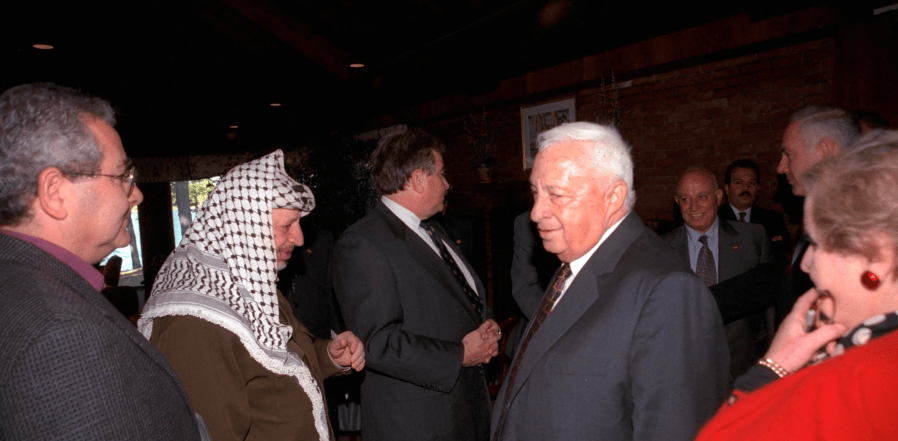
In between, the two men met. When Sharon was foreign minister in Benjamin Netanyahu’s first government, Sharon found himself in the same room with Arafat. It happened at the Wye Plantation in Maryland in 1998, in talks held under U.S. auspices. Arafat later recalled: “I tried to shake hands with Sharon, during the negotiations at Wye River. He refused. He was the only one to refuse!”1
Arafat felt slighted. Yet this still might be regarded as the high water mark in their relationship. Both before and after, Sharon and Arafat exchanged blows as sworn enemies. In 1982, Sharon as defense minister in Menachem Begin’s government laid siege to Arafat in Beirut, and eventually succeeded in driving him out of Lebanon, where he had been embedded for a decade. Sharon would have preferred to kill Arafat. Later, when asked whether he regretted not doing so, he said: “Certainly, yes. But we had a commitment not to do it.”2
At that time, Sharon perhaps thought that he had removed Arafat from the chessboard. But in the next decade, Arafat not only came back politically, he also established himself in the West Bank and Gaza – the result of the Oslo Accords concluded with him by Yitzhak Rabin and Shimon Peres. Arafat moved to Gaza City and Ramallah.
Sharon bided his time. When Oslo unravelled into the terror of the second intifada in 2002, Sharon, now elected prime minister, laid siege to Arafat yet again, in his Ramallah compound. This time, it would be checkmate for Arafat. Reduced to a prisoner in his own headquarters, he eventually fell ill, and was evacuated to France for treatment, where he died.
This, in a nutshell, is the history of the Sharon-Arafat feud. It arguably defined the present relationship between Israelis and Palestinians even more than the Oslo Accords did. Those agreements, and the return of Arafat, had created a wild West on the West Bank and in Gaza – a mess of violent armed Palestinian factions bent on mayhem. This was exactly what Arafat had created in Jordan in the 1960s, and in Lebanon in the 1970s. In the second intifada, with its parade of suicide bombers, the chaos Arafat had sown in Amman and Beirut came to Jerusalem and Tel Aviv.
Sharon, in winning his final duel with Arafat, did what Oslo failed to do: force the Palestinian Authority to act as a responsible partner in keeping order, if not peace. It was Sharon who cleared the way for Arafat’s successor, Mahmud Abbas (Abu Mazen): a man who did rein in terrorism, and with whom Sharon readily shook hands.
But this wasn’t the only way Sharon forged the reality we know today. In 2003, he surprised the world by announcing his intention of dismantling Israeli settlements in Gaza, and withdrawing from Gaza altogether. The man who had reduced parts of Beirut and Ramallah to ruins in pursuit of Arafat, now reduced the Jewish settlements of Gaza to ruins. In the end, this cleared the ground for another sort of mayhem: the rise of the Islamist statelet of Hamas, and its arsenal of rockets aimed at Israel. The resulting split among the Palestinians left the “peace process” in permanent disarray.
So from the status quo on the West Bank to the tense standoff in Gaza, we live in a reality created by Sharon, and by his contest with Arafat.
Born Into Conflict
Why did the two men become such determined foes? Was it only their differences? Or were there parallels in their lives that accentuated those differences?
The argument was made superficially by the Israeli author Amos Oz. He called Sharon and Arafat “Siamese twins” – he named them “Sharafat” – and added this:
Fear and stagnation stifle them both. They are living under the dominion of a bloodstained past. They are hostages to one another, so much so that the entire historical dynamic of the conflict of the Middle East has become captive to their fears, their immobility.3
This was a polemical framing of the question. But there is a less passionate way to approach it, especially as both are now long gone.
In what follows, I will look at some parallels in the lives of both men, and ask whether they help to explain the intensity of their feud. Let it not be thought that these parallels establish an equivalence between the two: parallel lines can be of completely different length, width, and color. But they can contrast and accentuate one another. In this case, I believe they do.
The first parallel is that both of these leaders were born into the conflict between Jews and Arabs. Neither David Ben-Gurion nor Jordan’s King Abdullah, neither Menahem Begin nor Anwar Sadat, were born into the conflict. They came from Plonsk (Ben-Gurion) and Brisk (Begin), from Mecca (Abdullah) and the Nile Delta (Sadat), before Jew and Arab had clashed.
Not so for Sharon and Arafat. From the very beginning, even in childhood, they experienced the passions, violence, and hatreds that infused the conflict between the two sides.
Sharon was born and raised in an agricultural settlement, a moshav named Kfar Mallal. It lies on the eastern edge of that narrow coastal strip that formed the very heart of Zionist agricultural settlement before 1948, the Sharon plain. In Arik Sharon’s youth, there was a sprinkling of Arab villages there, and a substantial Arab town, which served as bases for constant incursions and attacks on what were then rather meager settlements.
As Sharon would later recall, his mother slept with a gun under her bed. He was a baby in 1929 when the farmers of Kfar Mallal expected an attempt by nearby Arabs to overrun their settlement, and to inflict on them a pogrom such as Arabs had inflicted on the Jews in Hebron. Sharon grew up distrusting the Arabs, and convinced that the only response to their treachery and violence was the gun.
In 1948, he fought in Israel’s war of independence as a twenty-year-old recruit, and narrowly escaped death when he was wounded in a battle against the Jordanian Arab Legion on the road to Jerusalem. The chaos of that battle left him with an abiding distrust of commanders who sat in rear headquarters. He would always be out front.
Arafat was also born into the conflict, a year after Sharon. His father was a small-time textile trader from Gaza, his mother a Jerusalemite. When he was born, they were living in Cairo. At the time, both Palestine and Egypt were under British rule, and merchants often moved their families back and forth. While he was basically raised in Egypt, he did spend a few years with family in the Old City of Jerusalem.
In 1948, while a student in Egypt, he joined the Muslim Brotherhood, which was launching operations against the Jews in Palestine in advance of the Egyptian army. The defeat of 1948 didn’t personally displace him, but like many Arabs, he was seared by the humiliation and failure of Arab armies.
So both Sharon and Arafat grew up in the midst of conflict, the birth of Israel, and the abortion of Palestine. This would be their shared starting point.
Still, there is a very sharp difference between the two, in the nexus of family and land that defines a home and a homeland. Sharon came from a tight-knit, loving family. His parents had come from Russia; his father was a trained and innovative agronomist. They fiercely protected their small estate, fencing it in when neighbors didn’t bother to do so.
Sharon had a strong attachment to both family and land. He had roots, and in later years, whenever he faced frustrations and setbacks in public life, he found compensation in family life and farming. His first wife died in a traffic accident, but his second, Lily (sister of his first), was a staunch pillar of support throughout her life. A neighbor once recalled how Arik would call Lily from the battlefront, and she sang to him, soothing him and giving him fortitude. In his later years, he relied also upon his own sons as advisers and supporters.
Sharon had devoted parents, a loving wife, and fiercely loyal sons, and he brought them all together in a large ranch in the northern Negev called Havat Shikmim, “Sycamore Ranch,” which he leased in 1972. This was his safe retreat.
Arafat lived an entirely different life, without roots to speak of. His childhood home was dysfunctional. His father seems to have been abusive, both towards his mother and towards him. When she died, his father sent him away from Cairo to Jerusalem to live with an assortment of relatives. In his own life, Arafat would never establish a real family or a home.
He remained unmarried, often saying that he was married only to the Palestinian revolution. Only at the age of 61 did he eventually take a wife, Suha, from a notable Christian family from Ramallah. She was 27, and she later bore him a daughter. But Suha Arafat wasn’t a source of support for him. She was regarded more as a decoration, whom he married in a calculated attempt to be perceived as domesticated.
Nor did he have a home. In the many years he operated in Jordan, Lebanon, and Tunisia, he didn’t have a fixed address. In fact, it was customary for him not to spend two consecutive nights in the same bed, for security reasons. He had only headquarters, no residences. There is a Yasir Arafat museum in Ramallah. There it recreates the digs where he spent his last years, in the Muqata’ah, a British-built fortress that served as his headquarters in Ramallah. It is a spartan room with a bed and some piles of clothing. This is how he lived for most of his life – while many of his subordinates inhabited luxurious villas.
This difference between the two men manifested itself in another way. For Sharon, the Land of Israel was a real and tangible place, and he knew its every topographical twist. People said of Sharon that he could look at a map and actually envision the terrain, much as a composer can hear music while reading and writing notes. This gave him a huge advantage as a battlefield commander. There was nothing abstract in the way he thought about war on the ground. He knew every slope and dip in the terrain.
This would later also carry over into his planning of Jewish settlements. For many Israeli cabinet ministers, the settlements were mere points on a map. Sharon, however, would visit each location, take note of the high ground, and evaluate any security problems. Sharon was a man of the land, and a man of maps.
Arafat was a very different story. Although he had spent some time in Jerusalem as a child, he really knew Palestine only as a nostalgic vision of something lost. The land was something tangible for the actual refugees of 1948. But for their children, who became Arafat’s recruits after 1967, Palestine was an abstract cause more than a real place. They knew the terrain of the refugee camps in Jordan, Lebanon and Syria, and they knew the names of villages and towns now in Israel from which their parents had come. But they had no precise sense of the topography or the geography of the land left behind.
If Sharon was a man of the land, Arafat was the man of the imagination; and if Sharon was a man of maps, Arafat was a man of memories. This would only change after the Oslo Accords, when Arafat learned the terrain and held out for every inch.
Living on the Edge
The second parallel: both first made their mark in forms of warfare that departed dramatically from the conventional. They started out as believers in reprisal and terror, and in killing enough people to have a psychological impact on the enemy. They did this along the ragged, unmarked borders left behind by 1948 and 1967.
In the 1950s, Israel’s towns along the armistice lines with Jordan experienced unceasing infiltration by Arabs bent on theft or murder. Sharon was entrusted with forming a crack unit, Unit 101, with the express purpose of crossing the lines at night and carrying out reprisals.
These nocturnal operations in populated villages behind enemy lines weren’t very discriminating. In one case, Sharon’s sappers blew up stone houses and killed perhaps seventy hiding villagers, most of them women. There were international remonstrations. But Ben-Gurion looked the other way, for a very simple reason: reprisal had to be painful and disproportionate to serve as an effective deterrent. Sharon went on to command conventional forces on a large scale. But he always pushed the envelope, sometimes with results that created crises.
Arafat also founded a strike force, called Fatah. There had been Palestinian infiltration and attacks against Israelis all through the 1950s and early 1960s, but they didn’t have a political framework. Arafat didn’t establish the PLO in 1964, but his own creation, Fatah, soon came to dominate it.
Arafat specialized in attacks across the border on installations, military targets, and civilians. After the defeat of Arab states in 1967, he built up a guerrilla army in the Palestinian refugee camps in Jordan, and launched daring cross-border operations. When King Hussein threw him out of Jordan, in the “Black September” of 1970, he moved the operation to Lebanon, where it duplicated the same routine. And when direct attacks on Israel became difficult, the emphasis moved to targets around the world, from Israeli embassies to civil aviation.
Arafat, too, used this tactic to create a psychological effect. Until the 1960s, the Palestinians and their cause didn’t occupy any place on the international agenda. Through terrorism, Arafat put it there. And by his dashing dress and his revolutionary rhetoric, as well as his Soviet connection, he positioned the Palestinian movement on the radical chic side of the 1960s, much like an Arab Che Guevara or a Castro. He came so far, so fast that in 1974, he was invited to speak to the UN General Assembly, where he wore a gun belt and holster.
Sharon believed in the effectiveness of reprisal, and Arafat the effectiveness of terrorism, and both of them could point to ample instances to support their conclusions.
Elastic Truth
Third, both Sharon and Arafat had a strong aversion to authority, a reluctance to accept it, and a propensity for misleading their “superiors” if not lying outright.
This was a problem that dogged Sharon throughout his military career. He was admired, especially by Ben-Gurion, for his daring and boldness. He was precisely the kind of soldier Ben-Gurion imagined would have carried Israel to victory in biblical times: bold, imaginative, resourceful. In some ways, Sharon was a kind of next-generation incarnation of Moshe Dayan, who shared some of the same qualities. Dayan, for his part, thought highly of Sharon for just that reason.
But there was an edginess to Sharon that went even beyond Dayan’s. Sharon’s independence in the field sometimes bordered on insubordination, and he turned it into a principle. He was once asked whether he believed one should always follow orders. His answer: yes, unless those orders contradicted the well-being of one’s soldiers. In that situation, he said, the soldiers came first.4 It was this attitude that created a fierce loyalty to Sharon among those he commanded.
His most famous act of disobedience took place during the 1973 war. Egypt’s surprise attack had bloodied Israel’s nose, face, and body in the first round of fighting. Sharon went down to the Sinai and organized a counter-offensive. In mounting an invasion across the Suez Canal and into Egypt proper, he defied the chief of the southern command and the chief of staff. The former later accused Sharon of dereliction, and said that the success of the counter-offensive was no reason not to court-martial him. But nothing succeeds like success, and Sharon emerged from the war as one of its only heroes.
While disobedience might be excusable, many of Sharon’s superiors couldn’t excuse the way he repeatedly misrepresented what he had done. Ben-Gurion wrote in his diary: “The lad [Sharon] is a thinker, an original. Were he to be weaned of his faults of not speaking the truth in his reports … he would make an exemplary military leader.”5 Many of his superiors came to view him as less than trustworthy, and time and again he found himself in the doghouse or worse, for having economized with the truth.
The most infamous instance was the most consequential: the Lebanon war of 1982. Sharon as defense minister presented a war plan to the cabinet and the prime minister, Menachem Begin. It called for a limited intervention of a few days, that would go no deeper than forty kilometers into Lebanon, to sweep the PLO from the country’s south. In fact, the actual plan became a rolling one, to drive the PLO out of Lebanon. This required the Israeli army to push far beyond forty kilometers, attack Syrian forces across the country, and lay siege to an Arab capital, Beirut.
Sharon would always claim that he was up-front, and that the cabinet approved every stage. Whether he was or wasn’t that truthful is a debate that continues to this day.6 One might be charitable and say that Sharon didn’t so much lie to the cabinet as wear it down. As one officer in the know put it: “Sharon simply exhausted them. When you are so overwhelmed with details, you get completely lost. You are left with Sharon standing there before you in his full force, and you agree to anything just to get out of the room.”7
Thus did Sharon steer Begin, and the rest of the cabinet, to his preferred outcome, while carefully covering his own back. It didn’t help: in the end, the Lebanese Phalangists massacred Palestinians under Israel’s umbrella in two Beirut refugee camps, Sabra and Shatila. There were mass protests, also in Israel, and Sharon had to resign. The debacle sent him into the political wilderness.
Deceptive cunning was, even more so, one of the principal traits of Arafat. Who were his superiors? In the earlier years, the leaders of Arab states who bankrolled him, provided him with diplomatic support, and attempted to use him, each for his own purposes. Arafat would give them the impression that he would take orders, then make off with their resources, and head out in a direction he thought best. No Arab leader succeeded in corralling Arafat into total obedience. His technique was to embed himself and his followers in an Arab state, on the promise that he would adhere to its rules. Then he would swiftly build up his own power base, and bite the hands that fed him.
Later he lied to Israel too. From the beginning, he cut corners on the terms of the Oslo Accords. Ehud Barak, who negotiated with him at Camp David for a final status agreement, denounced him as a “liar and rogue.” But lying to Israelis seems to have been within the rules. He finally went too far when he lied to everyone’s “superior,” the president of the United States – in this case, George W. Bush. In 2002, in the midst of the second intifada, Israel intercepted a ship bound for Gaza, sent from Iran, full of fifty tons of rockets and other weaponry: the Karine-A. It was a smuggling operation in violation of every agreement.
Arafat sent a letter to then-president Bush, denying involvement. It was a blatant lie, and Israel could prove it. As Bush later wrote in his memoirs, “Arafat had lied to me. I never trusted him again. In fact, I never spoke to him again. By the spring of 2002, I had concluded that peace would not be possible with Arafat in power.”8
Machiavelli regarded lying as a legitimate tool of statecraft, with one proviso: “Do it in such a way that it does not become known, or, if it does become known, that you have a ready and quick defense.”9 Both Sharon and Arafat used words to veil the facts. Both of them at times paid a price for doing so when caught out. But as a rule, Sharon had better defenses, and so managed to evade the consequences more adroitly than Arafat.
Reversing Course
A fourth parallel is that both of them did turnarounds: Arafat in the Oslo Accords and their sequels, Sharon in the Gaza withdrawal. The reasons for both were entirely pragmatic.
Arafat, trapped in Tunis, managed to climb back through the window by accepting a vague agreement with Israel that didn’t guarantee much of anything. Arafat traded on his symbolic persona to get back on the ground in Palestine, because he saw his return through concessions as the only avenue left to a Palestinian state. For a while he seemed committed to the path. He even shared a Nobel Peace Prize, along with Rabin and Peres.
Sharon did something similar in the Gaza withdrawal. The man who had been focused on geography and topography, for whom every piece of territory was high ground or a security zone, suddenly gave priority to demography. He had read the projections of one of Israel’s leading geographers. If Israel kept Gaza, it would be stuck with its Arab inhabitants, and Israel’s Jewish majority would vanish. Better to get out, settlements and all.
This was the same Gaza he had pacified after the 1967 war. The man who had defeated Arafat now ordered Israel out of Gaza, lock, stock, and barrel, in a traumatic operation of uprooting that left scars visible to this day. And there was no handshake photo op, either: it was done unilaterally, so it gained few accolades in the world.
Both men, in these later phases, would be attacked for allegedly betraying their principles.
Arafat’s signature on the Oslo Accords stirred huge controversy among some Palestinians. Critics charged that he had cast aside the revolutionary vision of a Palestine liberated from the river to the sea, just to save himself personally from oblivion. He gave away the Palestinian dream in return for little more than a foothold in Palestinian territory, and even that foothold didn’t have the potential to become a viable state.
The Islamists of the Hamas movement said the same. They revered the early Arafat, for his role in launching the Palestinian resistance movement. But then, they argued, he succumbed to the temptations offered by the United States and Israel, and sacrificed Palestine, and especially the refugees, to satisfy his ambitions.
Secular Palestinian intellectuals also turned against him. Before Oslo, Edward Said had called him “much misunderstood and maligned.”10 In 1983, Said wrote an op-ed in the New York Times entitled “Solidly Behind Arafat.” Arafat, he wrote, was “always open and personally incorruptible. His commitment to his people and cause had no limits. He seemed both fearless and gentle to those who encountered him.”11 But in 1993, Said denounced the Oslo Accords as “an instrument of Palestinian surrender, a Palestinian Versailles.”12 Said couldn’t find enough words to denounce Arafat’s incompetence and corruption.
The same notion of betrayal came to cloud the reputation of Arik Sharon. After having been the patron of the settlements for so long, providing them with resources and participating in countless ribbon-cuttings, his supposed betrayal in the Gaza withdrawal shocked the Israeli right. Rabin before him had been called a traitor by settlers, but he had never been their godfather. And it wasn’t just Gaza. Sharon went still further, evacuating a number of settlements in the northern West Bank, and declaring himself in favor of a Palestinian state.
People who had walked the long walk with Sharon no longer spoke to him. Sharon at the time was under investigation on corruption charges, and critics claimed he ordered the withdrawal to save himself. As the army chief of staff Moshe Yaalon put it, the withdrawal “contravened Sharon’s whole worldview; and yet, to save himself politically… he realized that he had to pursue this misguided measure to its end.”13
Were the transformations of Arafat and Sharon sincere and complete? It’s debated. But as any biographer knows, rare is the leader who doesn’t change over a long career, in a lifetime’s encounter with changing circumstances.
And it is also crucial to remember that politicians aren’t intellectuals. The latter pride themselves on remaining consistent, because their positions supposedly reflect some deeper philosophical commitment. But in politicians – and leaders are politicians – this sort of consistency is deemed a vice: positions inevitably reflect a constant reassessment of what is desirable and doable. As Ralph Waldo Emerson wrote, “With consistency a great soul has simply nothing to do.” It may not be true of every great soul, but it is certainly true of most great leaders.
Legacies
Arafat died in 2004, at the age of 75. Sharon suffered a debilitating stroke in 2006, less than two years later. He was 77 at the time. Both men were still in office, but by the time they reached the end, they were worn out. Arafat had numerous ailments, and visitors to his besieged compound in Ramallah saw him shuffling about, failing to complete sentences. Sharon was morbidly obese and tired. Yaalon said that toward the end Sharon would doze off in meetings, and didn’t have the stamina to read important intelligence reports.
In death, Arafat and Sharon diverged. Arafat was buried in Ramallah, in what would become a national shrine. It has a museum alongside it (with an audio guide), displaying some of Arafat’s artifacts, including his pistol. It is guarded around the clock, and visiting heads of state leave wreaths there. The pattern for European leaders is to lay a wreath at the Holocaust Museum of Yad Vashem, and then lay another one at Arafat’s grave.
In 2012, Arafat was exhumed in an effort to prove he was poisoned by Israel. The findings were open to interpretation, but Palestinians are certain Arafat was “martyred” at Sharon’s orders. Dov Weisglass, Sharon’s chief of bureau, denied it: “We did not physically hurt Arafat when he was in his prime … so all the more so we had no interest in this kind of activity when he was politically sidelined.”14
Sharon lingered on in a vegetative state for eight years. On his death, he was buried in a plot on his ranch, alongside his wife Lily – far from Mount Herzl in Jerusalem, where every former prime minister has the right to be buried. Rabin, Peres, and Begin all have heritage centers and museums in their memories. The principal memorial to Sharon is a scenic park, laid out on the massive hill that was once the municipal garbage dump of Tel Aviv. So there isn’t much to remind young Israelis of who Sharon was, or to put him in context. At most, they might have a vague notion that he was somehow responsible for Gaza turning into a rocket base.
In memory and legacy, then, there is a sharp divergence, and it isn’t surprising. Arafat was the founding father of whatever political autonomy or quasi-statehood the Palestinians have today. Sharon was an Israeli general and politician who, until he became prime minister late in life, was one of many politicians competing for office.
And yet in many ways, Sharon’s legacy is greater than Arafat’s. His duels with Arafat, and especially his success in bringing Arafat down, defined Israeli-Palestinian relations, and arguably still do. No one would have nominated Sharon for a Nobel Peace Prize. But no one did more to hold the Palestinian Authority to its commitments, and to shunt aside the man who evaded them. Through Oslo, Arafat seemed to have triumphed over Sharon. But by prompting the terror of the second intifada, Arafat paved the way for Sharon’s unexpected return and his own demise, well short of his goal of Palestinian statehood.
Did the parallels I’ve outlined destine them to clash? The case can be made. The early experience of war, as soldiers and commanders; the resort to extreme tactics for psychological effect; the scant regard for truth-telling – all these drew them, arguably, into a mutual pattern of terror and reprisal, which persisted even in changed circumstances. Yes, they were as different as two men could be. But their similarities amplified their feud. Each knew the other’s strengths and vulnerabilities, precisely because they shared them.
Notes
- In a meeting reported by Helena Cobban, “Fenced In,” Boston Review, June 1, 2002, https://www.bostonreview.net/articles/helena-cobban-fenced/. ↩ Back to text
- Interview with Ma’ariv, reported by Brian Whitaker, “Sharon Regrets Not Killing Arafat During Israeli Invasion of Lebanon,” The Guardian, February 1, 2002. ↩ Back to text
- Amos Oz, “Two Stubborn Men, and Many Dead,” New York Times, March 12, 2002. ↩ Back to text
- In an interview with a British television reporter. The segment appears in the documentary “Sharon,” episode 1, “Catastrophe,” directed by Levi Zini, Kan 11, first broadcast on February 17, 2021, https://youtu.be/4HeBu34-vck, at min. 42. ↩ Back to text
- David Ben-Gurion’s diary, January 29, 1960, quoted by Michael Bar-Zohar, Ben-Gurion, Vol. 3 (Tel Aviv: Zmora, Bitan, 1987), p. 1436. ↩ Back to text
- The decision-making is documented exhaustively by Shimon Golan, Sheleg b’Levanon (Israel’s War in Lebanon) (Ben Shemen: Modan and the Ministry of Defense, 2017). ↩ Back to text
- Unnamed senior official quoted by Thomas L. Friedman, “Sharon, Replying to Critics, Opens Lebanon War Scars,” New York Times, August 13, 1987. ↩ Back to text
- George W. Bush, Decision Points (New York: Random House, 2010), p. 401. ↩ Back to text
- Niccolo Machiavelli and Allan H. Gilbert (trans.), Machiavelli: The Chief Works and Others (Durham, NC: Duke University Press, 1989), pp. 116-117. ↩ Back to text
- Edward W. Said, The Question of Palestine (New York: Vintage, 1979), p. 165. ↩ Back to text
- Edward Said, “Solidly Behind Arafat,” New York Times, November 15, 1983. ↩ Back to text
- Edward Said, “The Morning After,” London Review of Books, October 21, 1993. ↩ Back to text
- Moshe Yaalon, Derech Aruka Ketzara (The Longer, Shorter Path) (Tel Aviv: Yediot Aharonot-Sifrei Chemed, 2008), p. 157. ↩ Back to text
- Quoted in The Week, January 9, 2015, https://theweek.com/articles/472748/week-glanceeurope. ↩ Back to text

