Once again, it’s Martin Luther King Jr. Day, and time to bundle my studies of MLK’s relationship to Israel and the Palestinians.
1. What about this quote, attributed to King around the time of the Six-Day War? “When people criticize Zionists, they mean Jews. You’re talking anti-Semitism!” Is it authentic, and if so, what did he mean? What did he think of that war, and why didn’t he ever visit Israel? I answer these questions in this article. Update: And here is the previously-unpublished Six-Day War interview of MLK.
2. If King left no quote in favor of the Palestinian cause, it’s because he didn’t know much about it, correct? Wrong: he saw it up close, in Jerusalem and the West Bank, and still left no quote. I explain, in this article.
3. Well, if King tilted toward Israel, it’s because he depended on Jewish donors, didn’t he? Well, he did, but that isn’t the whole story, or even the main story. I look at King’s closest rabbinic allies, and their positions on Israel, in this article.
Let’s be clear: no one knows what King would say about Israel or the Palestinians today. Polemicists on both sides have cooked answers, but for a historian, it’s not even a legitimate question. All that a historian can do is demonstrate what King said, and perhaps infer what he thought, all those many years ago. Some of the issues which were then on the table still sit there today, although much of the context has been transformed by subsequent events.
So share this bundle with your friends, and if you think your elected representatives might benefit from it, send it to them too. The purpose of the day is for thoughtful people to reflect, and to draw conclusions for the present and future. But they should do that in full awareness of the known facts of the past.
Mosaic has asked its regular contributors to recommend three books: two new ones published in 2020, and a classic. Below is my contribution. For all of them, go here.
Just when we think we know all there is to know about the modern history of Zionism and Israel, a new book deflates our confidence. Here are two new ones that did just that in 2020, and a classic that did that long ago.
Shimon Peres remains one of the great enigmas of Israel’s history. He was a high-flying statesman of international caliber who kept falling to earth. Israelis saw in him the glimmer of a visionary à la Herzl, so they kept him in public life. But this indulgence came with a condition: he would always be “number two” to someone else, and he would have to propitiate this “number one” to get his work done.
Avi Gil, trained as a diplomat, ended up as an adviser to Peres for 28 years. His Shimon Peres: An Insider’s Account of the Man and the Struggle for a New Middle East (I.B. Tauris, 264pp., $26.95) caused a stir when it appeared in Hebrew in 2018. Other advisers had written reverential memoirs about their political bosses. Gil, by contrast, is admiring of Peres’s strengths, but unsparing when it comes to his faults, above all his preening ego. It wasn’t always clear what drove him: vision or vanity.
Whatever one thinks of the Oslo Accords (Gil thinks more of them than you probably do), they represented a double triumph for Peres. To maneuver Yasir Arafat into an agreement, he first had to outmaneuver his nemesis, Yitzḥak Rabin. The backstory of how Oslo got made isn’t pretty, replete as it is with lies and betrayals. But it’s also riveting.
This year was the 60th anniversary of Israel’s 1960 capture of Adolf Eichmann. (I wrote about an aspect of it for Mosaic back in June.) But that wasn’t the end of Israel’s hunt for Nazis. In 1965, Herbert Cukurs, a Latvian collaborator involved in the murder of 30,000 Jews, turned up dead in Uruguay. A statement attached to his body, stuffed in a trunk, denounced him for his crimes against Jews. Years later, the Israeli who lured him to his death revealed that it had been a Mossad assassination.
The journalist Stephan Talty has retold the story with verve in The Good Assassin: How a Mossad Agent and a Band of Survivors Hunted Down the Butcher of Latvia (Houghton Mifflin Harcourt, 320pp., $28). The chief Israeli agent, Jacob (“Mio”) Medad, whose parents perished in the camps, first revealed the details in a memoir published over twenty years ago. But Talty greatly enriches the context of the Mossad operation. We learn in depth about the Holocaust in Latvia, the inspiring life story of a key witness, and the strange personality of Cukurs. A famed long-distance aviator before the war, he descended into unspeakable cruelty. Suffice it to say, he was no desk murderer. So he got what Talty calls “a certain kind of killing. . . . [T]here would be no trial, no lawyers or judges, no legal niceties, no essays by Hannah Arendt in The New Yorker.” The deception involved in the operation was ingenious, but the denouement wasn’t very tidy. No more spoilers.
And something classic? The Balfour Declaration by Leonard Stein appeared in 1961. (Simon and Schuster published the American edition.) I still find its 700 pages invaluable, despite the appearance of later studies based on archives that weren’t open to Stein in the 1950s.
This was meticulous history, written by an amateur. Stein, a graduate of Balliol College, Oxford, and a veteran of World War I service in Palestine, became a tax lawyer and a Zionist activist. Yet he deftly uncovered and untangled the interests that converged in the declaration. His main discovery, obvious today but not realized 60 years ago: British interests, not pro-Jewish sentiment, underpinned the declaration. Indeed, some of the Balfour Declaration’s chief British proponents were (shall we say?) less than enamored of Jews.
Stein died in 1973, at the age of eighty-five. The Balfour Declaration is a sturdy monument.
Three years ago this month, Israel marked not one but two major anniversaries: the centennial of the Balfour Declaration, announcing British support for a Jewish national home in Palestine (November 2, 1917), and 70 years since the UN General Assembly partition resolution calling for separate Jewish and Arab states in Palestine (November 29, 1947). Both are widely recognized as landmarks on the road to Israeli independence.
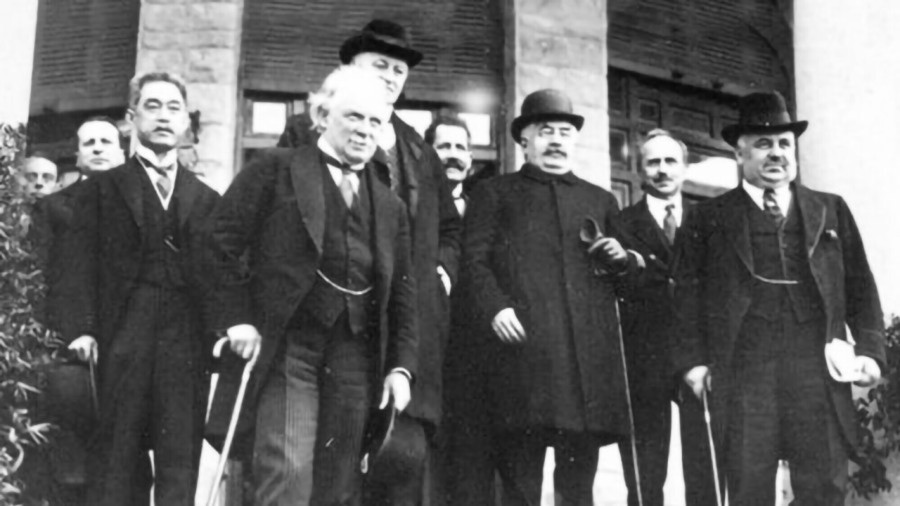
This year, though, we’ve been told by Zionist organizations, Israeli officials, and political activists that we should really be celebrating a different date entirely: namely, this year’s centennial of an international conference held in San Remo on the Italian Riviera in late April 1920. At that conference, a sequel to the post-World War I Paris peace conference of 1919, Britain and France (along with Italy and Japan) agreed on the division of the post-Ottoman Levant and Mesopotamia into League of Nations mandates.
As any glance at an Israeli calendar shows, this event is not something that’s usually been commemorated. Is it nevertheless really the case, as some insist, that San Remo was and remains more important to Israel’s legitimacy than the Balfour Declaration and the UN resolution? Advocates of this idea say things like this:
At San Remo, “the title to Palestine was given to the Jewish people.”
The San Remo agreement is “the best proof that the whole country of Palestine and the Land of Israel belongs exclusively to the Jewish people under international law.”
“San Remo explains why Israel’s borders include Judea and Samaria.”
Indeed, in the judgment of one pundit, so important is San Remo that the street in Jerusalem named for the 1947 UN resolution—it’s called the 29th of November Street—should be renamed for the San Remo accords.
A reasonably informed supporter of Israel could be excused for not knowing any of these claims—and for good reason, since none of them is true. That doesn’t make San Remo any the less interesting, but its real significance lies in the opposite direction: in, to be precise, Britain’s history of imperial self-dealing, which at San Remo and as a consequence of San Remo nearly undermined any prospect of a Jewish state.


 Martin Kramer on the Middle East
You must be logged in to post a comment.