 My Columbia lecture has been published in the Middle East Papers series of Middle East Strategy at Harvard. My core argument is that the Obama administration is thwarting itself, by seeming reluctant to uphold American primacy in the region. More troops in Afghanistan are unlikely to change the Middle Eastern perception that the United States is something less than it was. That’s because Iran is seen as the true test of American resolve. Download the paper here.
Tag: Barack Obama
Kissed to death by America
People in and around the Obama administration are taking the position that his low key on Iran is carefully calculated. It’s not that he doesn’t sympathize with the protesters, he just doesn’t want their cause to be identified with the United States. That would be a kiss of death. I’m not persuaded, and as I’ve suggested already, his real problem with Iran’s turmoil is that it’s just so inconvenient to a Palestine-first approach. Laura Rozen at her blog The Cable quoted an “Iran hand in touch with the administration” as saying that Obama “is dedicated to diplomacy in a manner that is almost ideological,” that he’s already decided what he wants to do in the Middle East “over the next eight years” (bit of presumption there), and that he doesn’t want to be “distracted” from the “larger strategic objective” or “let himself get shaken by stuff like this”—”stuff” referring to the reality in the streets of Iran and the Middle East more generally. If this spectacular hubris isn’t a formula for failure in the Middle East, what is?
Let’s begin with the claim that an American embrace of Iran’s struggle for freedom would harm rather than help the cause. Call it “1953 and all that,” and color me skeptical. I think most young Iranians are fed up with creaky mullah double-talk about America destroying Iranian democracy in 1953 (as if Iran has had democracy since 1979), Perfidious Albion (as though Britannia still ruled the waves), and the Zionist conspiracy (as if the mullahs weren’t conspiring daily with Hezbollah and Hamas). They’ve identified the threat to their freedom, and it’s their own unelected class of clerical overlords, driven by a will to total power. Just because the “Supreme Leader” repeats one of these archaic themes ad nauseum doesn’t mean Iranians believe it, and we shouldn’t assume they do.
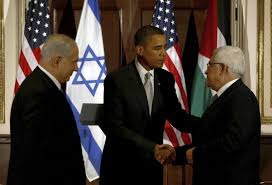
However, there is an American (and Israeli) “kiss of death” elsewhere in the Middle East. Why is there a correlation between U.S. and Israeli endorsements of a “two-state solution” and the Palestinian stampede away from it, both Islamist and secular? Every time an American president or an Israeli prime minister declares that a two-state solution is a vital U.S. or Israeli interest, more Palestinians conclude it can’t possibly be in their interest.
“If the day comes when the two-state solution collapses,” then-prime minister Ehud Olmert told an interviewer, “then, as soon as that happens, the state of Israel is finished.” Could one devise a more diabolical way to delegitimize a two-state solution in Palestinian eyes than that? Obama claims that “it is not only in the Palestinians’ interest to have a state. I believe it is in the Israelis’, as well, and in the United States’ interest, as well.” For Palestinians, that’s one reason to support it, and two reasons to oppose it. Are the Olmerts and Obamas of the world completely ignorant of history and psychology? And even if Obama believes this (personally, I think it’s untrue—a Palestinian state isn’t in everybody’s interest), why say it? Each time he does, he undercuts his own “larger strategic objective.”
A smarter president would deploy the word “intolerable” not for the situation of the Palestinians (whose “president” has described that same situation as “good” and “normal”), but for the repression in Iran, whose courageous young people genuinely crave support. A smarter president would tell the Palestinians that the United States can uphold its Middle East interests forever and a day without a “Palestine,” but that it’s willing to try if Palestinians show the grit and unity that statehood requires.
Unfortunately, everything young man Obama knew about the Middle East before coming to the White House came from tainted sources. Now that his eight-year plan has run aground—in month five—acknowledging and adjusting to the “stuff” of reality will be a test of his smarts. If he refuses to let reality “distract” him, he’ll fail the test, and leave the Middle East worse than he found it.
Obama’s Middle East map in shreds
 There is nothing at all surprising about Barack Obama’s reluctance to embrace the surge for freedom in Iran. As I’ve shown, he received his primer on the Middle East from Rashid Khalidi, who facilitated Obama’s formation as a Palestine-centric Third Worldist. In this view of things, only the situation of the Palestinians deserves to be described as “intolerable” —the word Obama used in Cairo—and action is promised only to them. Iranians are defrauded and assaulted by the bizarre dictatorship of the “Supreme Leader” and his Basiji minions? America, Obama says, is “watching.” Why? Obama’s master plan for the Middle East is supposed to commence with his entry to Jerusalem as the messiah of peace, godfather of the Palestinian state. Everything is supposed to follow from that.
Well, the Middle East doesn’t revolve around the Palestinians, and young Iranians don’t intend to wait for Mahmoud Abbas (emir of Ramallah, where there is a “good reality“) to get off his derrière before demanding their freedom. Iranians rightly think they’re no less worthy of the world’s sympathy than the Palestinians. (One of the chants of Iran’s protesters: Mardom chera neshastin, Iran shode Felestin! “People, why are you sitting down? Iran has become Palestine!”) Events in Iran have left Obama’s simplistic mental map of the Middle East, first learned from a few Palestinian activists and an old Hyde Park rabbi, in shreds.
We’re fortunate that this has happened now, and not a year down the line. The collapse of the Obama strategy has occurred early enough in his presidency to create an opening for alternative strategies. In October, I predicted that such alternatives “will become relevant in another two years, when reality sinks in and illusions are shed.” But it’s happened in only the five months since the inauguration. The reeducation of Barack H. Obama has to begin now.
Update: A friend of mine writes: “Comme on dit en français, tu vas un peu vite en besogne…” In other words, I’ve cut corners. Quite possibly. If I’d taken more time, I would have pointed out that Obama has also been taken in by the myth, to which he alluded in his Cairo speech, that all Iranians remain incensed by what the United States did to the “democratically-elected” Mossadegh government in 1953, as opposed to what has happened to them during the thirty years of democracy-deprivation since 1979.
 Martin Kramer on the Middle East
You must be logged in to post a comment.