The Jewish ban (Arab version)

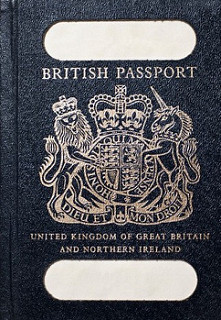
British passportAs I followed the fierce debate over President Trump’s executive order, denounced by its opponents as a “Muslim ban,” my thoughts turned the Jewish ban that changed the career of my mentor, Bernard Lewis.
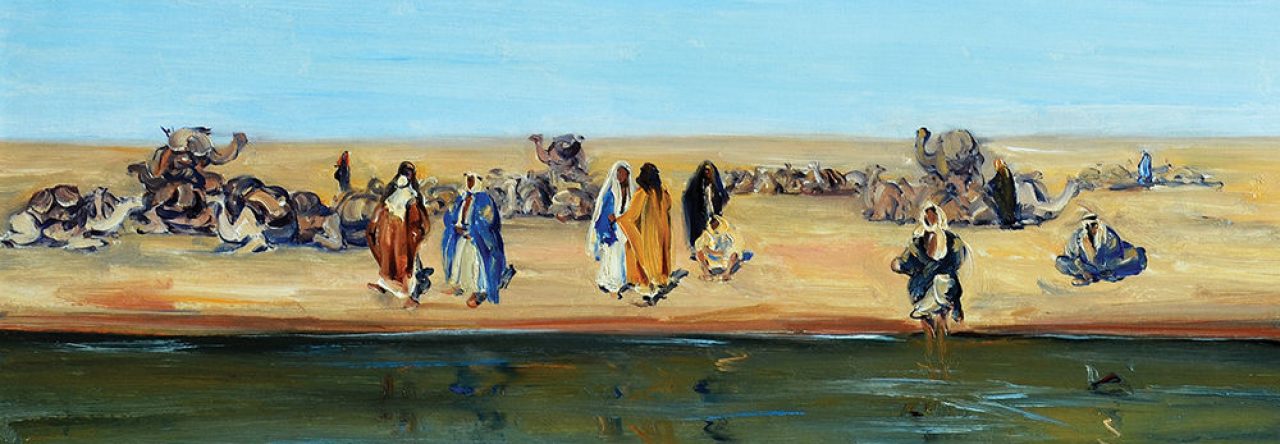
Lewis, the great historian of the Middle East who last May turned 100, travelled extensively in Arab countries in the late 1930s and 1940s. Born in Britain to British-born parents, he traversed French-ruled Syria for his doctoral work, and then served in the British army in Arab lands during the Second World War. In 1949, at the age of 33, he was already a highly-regarded academic authority on medieval Islam and a full professor at the University of London. The university gave him a year of study leave to travel in the Middle East. But the Arab reaction to the creation of Israel derailed his research plans. Lewis explained what happened in an article published in 2006:

Virtually all the Arab governments announced that they would not give visas to Jews of any nationality. This was not furtive—it was public, proclaimed on the visa forms and in the tourist literature. They made it quite clear that people of the Jewish religion, no matter what their citizenship, would not be given visas or be permitted to enter any independent Arab country. Again, not a word of protest from anywhere. One can imagine the outrage if Israel had announced that it would not give visas to Muslims, still more if the United States were to do so. As directed against Jews, this ban was seen as perfectly natural and normal. In some countries it continues to this day, although in practice most Arab countries have given it up.

Neither the United Nations nor the public protested any of this in any way, so it is hardly surprising that Arab governments concluded that they had license for this sort of action and worse.

According to Lewis (in his memoirs), some Jews fudged their religious identification on visa applications. (“One ingenious lady from New York City even described herself as a ‘Seventh Avenue Adventist.'”) Others simply lied.

But most of us, even the nonreligious, found it morally impossible to make such compromises for no better reason than the pursuit of an academic career. This considerably reduced the number of places to which one could go and in which one could work…. At that time, for Jewish scholars interested in the Middle East, only three countries were open—Turkey, Iran and Israel…. It was in these three countries therefore that I arranged to spend the academic year 1949-50.

In retrospect, it is fortunate that Lewis had to make the adjustment: he became the first Western historian admitted to the Ottoman archives in Istanbul, and his pioneering work in this area opened up a vast field of study. Yet his exclusion as a Jew clearly rankled. It was something he hadn’t experienced in Britain, yet Western governments now failed to stand up for their Jewish citizens by insisting that they be accorded equal treatment. And in the 1950s, it got worse: not only did Arab states not admit Jews, they drove their own Jews into exile. This may have been the animating force behind Lewis’s 1986 book Semites and Anti-Semites, one of the first to analyze the continuing mutations of antisemitism in the Arab world.

Today, Arab states don’t ban Jews as such. They do ban Israelis. In fact, six of the seven states featured in Trump’s executive order ban entry of Israeli passport-holders: Iran, Iraq, Libya, Sudan, Syria, and Yemen. (So, too, do another ten Muslim-majority states.) Those same six states also won’t admit anyone whose non-Israeli passport includes an Israeli visa. I’m not aware that the international community regards this as a particularly egregious affront to international norms. The governments of these countries regard every Israeli, whether Jewish or Arab, or any past visitor to Israel of any nationality, as a potential security threat. That’s not irrational, since some of these governments have a record of threatening Israel through incitement, sponsorship of terrorism, and dubious weapons projects.

Trump’s limited executive order doesn’t resemble the sweeping Jewish ban that changed the career of Bernard Lewis. It’s more in line with the Israel bans implemented in the very same countries he’s named. Trump regards holders of certain nationalities as potential security threats, and has excluded them on that basis. There’s plenty of room to debate the wisdom, efficacy, and even morality of the executive order. While the United States may not be as great an exception to the rule as it sometimes claims to be, it still isn’t Sudan or Yemen. And one would hope that the United States, which has invested untold billions (or is it trillions?) in intelligence collection and vetting since 9/11, would be capable of telling friend from foe, and victim from victimizer, within nations.

But the governments of states like Iran have no cause to profess outrage. No one has practiced blanket exclusion on the basis of nationality as unremittingly, decade after decade, as they have, and they aren’t likely to give it up any time soon. It would be unfortunate if this became the norm in the world. But it wouldn’t mark much of a change in the Middle East.

Bernard Lewis: master historian

Today I offer the last word in the exchange of tributes to Bernard Lewis, prompted by my June 1 essay on the occasion of his 100th birthday, and the four responses that followed (by Itamar Rabinovich, Robert Irwin, Eric Ormsby, and Amir Taheri). Highlights: I recall Bernard’s admission of an error, and reveal the secret of how he managed to belt out a book a year during “retirement.” Click here to read in full.

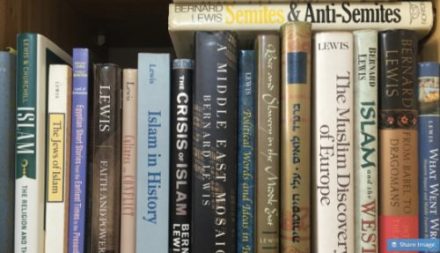
Books by Bernard Lewis

Bernard Lewis and the return of Islam

Bernard Lewis: London yearsYesterday was the 100th birthday of Bernard Lewis, preeminent historian of the Middle East and Islam. Today, Mosaic Magazine has published my essay for the occasion. I take as my point of departure an article Lewis wrote for the January 1976 issue of Commentary, entitled “The Return of Islam.” That article defied conventional wisdom and heralded the advent of a new era in the history of the Middle East. Lewis was pilloried for writing it, but subsequent events, from the Iranian revolution to 9/11, utterly vindicated him. Mine is the monthly essay at Mosaic Magazine, which means that responses will be published there throughout June, and I’ll have the final word at the end of the month.

The latest manifestation of “the return of Islam” is the Islamic State, and one wonders what Lewis would write about it were he still an active scholar. The Islamic State, with its deliberate attempts to mimic the early Islamic conquests, would provide a rich lode. It isn’t hard to imagine the themes Lewis would elucidate: the jihad mode of warfare, the meaning of the caliphate, the restoration of slavery, the symbolism of beheading and other forms of execution in Islamic history, the Islamic concept of the apocalypse, and on and on.

It would be the sort of exercise he accomplished in 1967, when he published a lively and lightly erudite book on the medieval Assassins, a group whose violence became so infamous that it gave us our word for murderous treachery. The Assassins sold more briskly, in many editions and translations, than just about any work on early Islamic history, and for an obvious reason: the back jacket of one new edition described it as “particularly insightful in light of the rise of the terrorist attacks in the U.S. and in Israel.”

In the original book, Lewis drew no comparisons, but he added a preface to later editions, in which he cautiously did just that, pointing to “interesting resemblances and contrasts.” Most of these related to Iran and its Shi’ite extensions, an obvious parallel. (The Assassins were an offshoot of Isma’ili Shi’ism, with bases in Iran and Syria.) But no resemblance appears closer than that between the Assassins and the Islamic State today.

“Of all the lessons to be learnt from the Assassins,” Lewis concluded,

perhaps the most important is their final and total failure. They did not overthrow the existing order; they did not even succeed in holding a single city of any size. Even their castle domains became no more than petty principalities, which in time were overwhelmed by conquest.

If that’s the main lesson, then it’s sobering to realize that the Islamic State, entrenched for the last two years in the cities of Raqqa and Mosul, has already achieved more than the medieval Assassins, against a much more formidable alliance than the Assassins ever faced. While the Obama administration has vowed to defeat the Islamic State, most analysts are busy explaining why inflicting “final and total failure” on the Islamic State is impossible, at least for now.

The Assassins didn’t peter out. Their enemies decided to extirpate them. That the Islamic State has managed to carve out its own principality on such a scale, and hold it for so long, doesn’t speak well of the resolve of its enemies. At some point, it will probably suffer a blow from which it won’t recover (although one doubts that its leftovers will become “small and peaceful communities of peasants and merchants,” as was the case with the Isma’ili descendants of the Assassins). But by that time, it may well have metastasized to many other places.

All of which is to emphasize, if any emphasis were needed, that the writings of Bernard Lewis remain a useful stimulus for thinking and lesson-learning about the Middle East, still in the throes of the “return of Islam.” Events will prompt readers to consult his works again and again.

Happy birthday, Bernard! To 120, and then some.