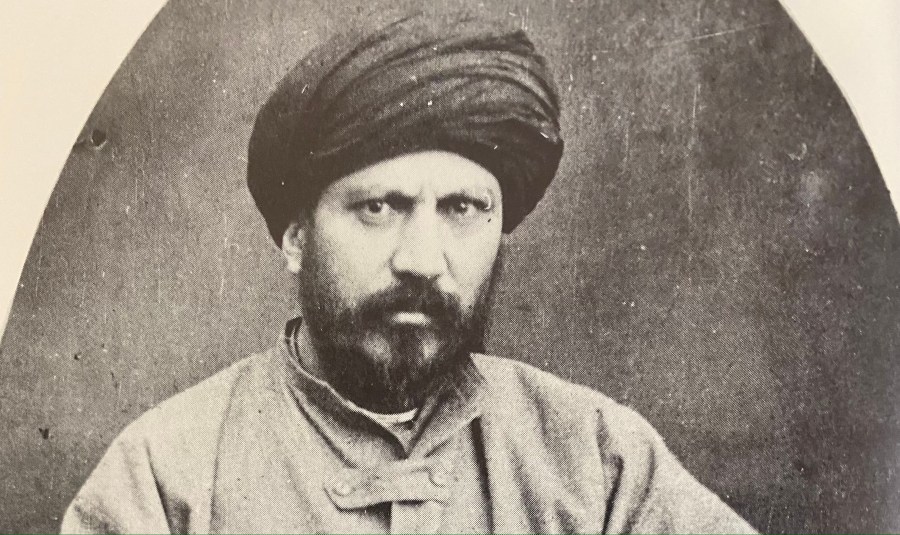
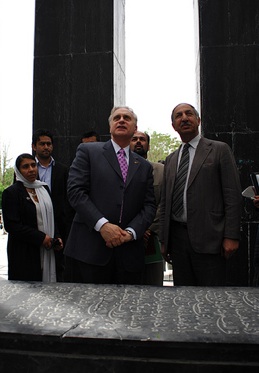
This photograph caught my eye the other day. It’s Ambassador Frank Ricciardone, number two at the U.S. embassy in Kabul, paying his respects last May at the mausoleum of Sayyid Jamal al-Din al-Afghani on the campus of Kabul University. Afghani (1838-1897) is revered in Afghanistan as a native son who inspired the modern revival of Islam, and who championed both internal reform and resistance to Western imperialism. Reformists and Islamists around the Muslim world equally claim him as their precursor. In the course of his peripatetic career, he preached in Iran, Egypt, the Ottoman Empire, India, Russia, and Europe. His famous Paris-based newspaper, al-Urwa al-wuthqa, spread his ideas far and wide.
This was not the first time the United States had paid tribute to the memory of Afghani. In 2002, then-U.S. ambassador Robert Finn came to the dilapidated mausoleum and pledged $25,000 from his government to restore it. Finn said this about Afghani:
This is, in a sense, a double tribute by my country. In doing so we honor the memory of an Afghan and Muslim intellectual giant of the 19th century: a scholar, journalist, political thinker, advisor to kings and a revolutionary who inspired Muslims from Egypt to India.
This was a man steeped in the learning of the Qur’an who called for freedom, reason and scientific inquiry. He was a learned man, a skilled writer and debater, he had the moral courage of strong convictions, criticizing the West for its materialism but not shying away from criticizing the Muslim rulers of the day and what he saw as self-destructive tendencies in his own religion.
Finn concluded: “This donation is also a recognition that the day will come when Afghanistan will again produce great leaders and thinkers that will shake the world and inspire hope and reform.”
No doubt it made diplomatic sense for the United States to help restore this Afghan national monument, and for its ambassador to praise Afghanistan’s national hero. At the same time, it is ironic in more ways than one can count.
First, Jamal al-Din al-Afghani is not exactly the sort of Muslim role model the United States usually promotes. He was what used to be called an agitator, someone who hated the great Western power of the era (Britain) not just for its materialism but for its imperialism, and who didn’t just criticize Muslim rulers but actively plotted against them. On both counts, Osama bin Laden could just as readily claim Afghani’s mantle.
In particular, Afghani believed that the rulers of the day had to be removed, if necessary by the bullet. A disciple once found him pacing back and forth, shouting, “There is no deliverance except in killing, there is no safety except in killing.” These were not idle words. In 1896, he inspired a disciple to assassinate Nasir al-Din Shah, ruler of Iran. Afghani said this about the assassination:
Surely it was a good deed to kill this bloodthirsty tyrant, this Nero on the Persian throne… who nonetheless knew how to throw sand in the eyes of civilized Europe so that it did not recognize his deeds. It was well done then to kill him, for it may be a warning to others. This is the first time that a Shah has found his death not in a palace revolution but at the hand of an ordinary man, and thus for a tyrant to receive just recompense for his deeds.
It is no accident, then, that Afghani is regularly honored by the Islamic Republic of Iran, where his name graces a public square in the capital and his image appears on a postage stamp.

So Afghani is not exactly an exemplar of someone who tried to “shake the world” peacefully, and one cannot help but imagine that were he alive today, he would be on some agency’s no-fly list. He also died a wanted man. At the time of the Shah’s assassination, Afghani resided in the Ottoman capital, Istanbul, and Iran sought his extradition. The Ottoman authorities refused, but they put Afghani under house arrest. He died there less than a year later, and the Ottoman authorities buried him without ceremony in an unmarked grave, the fate reserved for subversives.
But that’s not the only irony. Afghani wasn’t an Afghan. He called himself Afghani in his travels around the Muslim world, but he was born and raised in a small town near Hamadan in Iran. As a young man, he spent some years in the Shi’a academies in Iraq. In his travels to Sunni lands, his origins would have been held against him, so he took to calling himself “Afghani,” leaving Muslim listeners to presume him to be a Sunni. The documentary record on this point is clear, and the irrefutable evidence is marshaled in an appendix to the definitive biography of Afghani by UCLA historian Nikki Keddie.
Afghani’s Iranian nationality was well known to intelligence agencies and Orientalists in his own day. The State Department later established it as well. In 1936, J. Rives Childs, an American diplomat then stationed in Cairo, visited Tehran, and in an official despatch laid out the evidence, which included the presence in Iran of Afghani’s family. The historian Elie Kedourie described Childs as “probably the first Westerner conclusively to establish Afghani’s Shi’ite and Iranian origin.” Afghans obviously believe otherwise, but it’s still odd that a U.S. ambassador, even to Afghanistan, should take a position in favor of the Afghan claim, which the State Department disproved even before scholars debunked it.
I have referred to Afghani’s putative remains, and for good reason. There is no certainty that Afghani is buried in Afghani’s tomb. This is due to yet another American, the wealthy philanthropist Charles Crane, best known for his role on the King-Crane Commission. In 1924, Crane set out to find Afghani’s grave in Istanbul, to satisfy his penchant for “visiting the graves of men who have made a deep impression on humanity.” He explored several cemeteries but had no luck until “a fine old green-turbaned sheikh appeared,” showed him an “absolutely flat and unmarked” spot, and proclaimed it to be Afghani’s grave. In 1926, Crane erected a tombstone and iron balustrade on the plot. As Afghani’s reputation grew, Muslims began to make pilgrimages to the grave marked by Crane. This was also the grave from which, in 1944, remains were removed for transfer to Kabul, via Iraq and India. Elie Kedourie later put it succinctly: “Whether what was moved from Istanbul to Kabul was Jamal al-Din’s body, or whether the monument at Kabul, in seeking to do honour to someone who, in any case, was not an Afghan, was merely sheltering the remains of some unknown Muslim, God alone knows.”
The final irony in this story of America and Afghani may be found in the account of the British ambassador to Afghanistan who, in 1944, witnessed what he called the “pious fraud” of Afghani’s reburial in Kabul. In his report on the event, the British diplomat described how the U.S. ambassador to Afghanistan, Cornelius Van H. Engert, succumbed to the chaos that accompanied the historic occasion: “My American colleague who was sitting on a chair somewhat in the background was completely overwhelmed by the mob. He had borne the previous delay and the lack of organization with scant patience, but this was the last straw, and he left the proceedings in disgust.” So Americans have twice refurbished Afghani’s tomb, but didn’t have the patience to stay through his funeral.
The United States had nothing to do with Afghani while he lived, but has become his present-day patron out of necessity, given the dearth of neutral symbols on which to built an Afghan identity. Afghani is serviceable precisely because he wasn’t an Afghan at all. But if a moral lurks in this story, perhaps it is that in Afghanistan, where the truth is a rare commodity, be especially careful not to deceive yourself.
Below I reproduce two of the documents quoted above, neither published before, which make for interesting reading.
• Charles Crane’s unpublished memoirs, Institute of Current World Affairs, pp. 288-89. Crane begins by noting that while in Istanbul, in December 1924, he met “a splendid young Afghan by the name of Abdul Rahman.”
For a long time I had been searching the world for a really great Moslem but without much success. Everywhere, however, I kept hearing the remark, “Oh, you ought to have been here a generation earlier when Jemal Al din el Afghani was alive.”
I like to visit the graves of men who have made a deep impression on humanity, so I decided to search for the grave of Jemal Al din el Afghani. Abdul Rahman was greatly touched that I showed appreciation of his fellow-countryman and said that he, too, would like to search for the grave and would try to find out where Jemal Al din el Afghani was buried.
In the previous year at San Remo I had seen the last of the Sultans of Turkey, who is living there in exile, and he had told me that el Afghani had been his tutor; he knew he had died in Chislis, a suburb of Constantinople, and was buried in that vicinity. Abdul Rahman volunteered to find the place for me and we visited the larger cemeteries in Chislis, and searched them from end to end without result. None of the old men who worked around the cemeteries had ever heard of el Afghani.
One day a fine old green-turbaned sheikh appeared and said, “They tell me you’re looking for the grave of el Afghani.”
“Yes,” I said, “I’ve been hunting a long time for it and am rather surprised that a man of so much distinction could have lived here in the capital of the Caliphs without anyone knowing where he was buried.”
“My father,” he said, “was his sheikh in Balkh and later when el Afghani it came to Constantinople from Cairo, he became my sheikh, and I was very close to him all the time he was here. When he died I, unhappily, was in a hospital and he was carried to his grave by only the porters of the cemetery. The cemetery is in Chislis and if you would like me to take you there I would be glad to do so.”
As we went to the cemetery the old sheikh said, “There is no mark on the grave of el Afghani but I know its place by the line from two trees which I noted when I first found it.”
We found the two trees and on taking our bearings came to the little plot of ground, absolutely flat and unmarked, where this man, one of the most distinguished Moslems that ever lived, was buried.
• The National Archives, Public Record Office, London, FO371/45210, despatch by Giles Frederick Squire, British minister to Afghanistan.
British Legation, Kabul.
6th January 1944 [read: 1945]
Sir,
1. For the past fortnight the attention of the Afghan Government has been largely devoted to the ceremonies connected with the arrival from Turkey and reinterment at Kabul of the coffin of Sayyid Jamaluddin Afghani. The whole procedure had been planned with a view to promoting Afghan solidarity and stimulating Afghan nationalism by laying emphasis on the example of one of their own countrymen who was also one of the protagonists of Islam in the 19th century and who undoubtedly passed several years of his early manhood in Afghanistan. It is of course unfortunate that, although in India and Afghanistan he appears to be accepted without question as having been a native of Afghanistan, Persian historians state categorically that he was in fact a Persian by birth, having been born near Hamadan.
2. I am told that ever since the time of Amir Habibullah Khan the Afghans have made periodical attempts to have the remains brought back to Afghanistan, but it is only with the recent decision on the part of the Turkish Government to remove the original tomb in Istanbul to make room for a road improvement scheme that they have been successful.
3. Preliminary arrangements were made by the Afghan Ambassador at Ankara in consultation with his Government with some secrecy in order if possible to avoid arousing the opposition of the Persians in time for them to sabotage the project. This object appears to be achieved but by a somewhat narrow margin. The coffin, accompanied by the Afghan Minister in Iraq, was brought first to Baghdad, and thence by air to Karachi. From there it was brought by train successively to Lahore, Peshawar, Jalalabad and finally to Kabul. After being met at Dakkar [read: Dakka] by a deputation specially sent from Kabul for the purpose, the coffin was brought to Jalalabad where, the Prime Minister, who is in residence there, took the leading part in its reception. The last stage of the journey to Kabul was made on December 30th. The cortege was met at Bagrami some 6 miles out of town by Cabinet Ministers, important civil and military officials, members of [the] National Assembly and other notables, and escorted in state to the Assembly Hall of the Faculty of Law which is temporarily housed in Habibiya College where the coffin remained for the night guarded by students. The streets were lined by police and military and the population of Kabul and the surrounding villages were turned out by order to view the procession.
4. The final scene was enacted on December 31st when the coffin was interred in state in a plot of open ground in the suburb of Aliabad, some 3 miles out of the town. The grave was covered for the occasion by a temporary awning but presumably a suitable building will in due course be erected over it. I understand that it will eventually be the central feature of a public garden. Although the most elaborate official programme for these two days was drawn up, the Afghans felt somewhat diffident in inviting the diplomatic corps officially to take part in the ceremonies as, except in the case of the Persian Embassy of whose hostility they were assured, they were by no means certain of the reception that might be accorded to their invitation. They therefore merely informed the Legations by telephone some two or three days in advance that the coffin was expected shortly in Kabul, that the interment would take place at 10.30 A.M. on the morning after its arrival, and that if members of the diplomatic corps would like to attend they would be welcome. Subsequently messages were sent to the effect that we were not expected to go in morning coats but that if we wished to take wreaths for the grave, the Protocol Department would be happy to provide them! In the event the Turkish Ambassador and Egyptian Charge d’Affaires both met the cortege at Bagrami and accompanied it on the following morning from the Habibiya College to Aliabad. The Axis Legations were content to be represented only at Aliabad by the German Chancellier, Schmidt (the only person to wear a top hat for the occasion) and by two secretaries from the Japanese Legation. All the heads of missions of Allied nations, with the notable exception of the Persian Embassy, attended, accompanied by one or more members of their staff, the Russian Embassy in particular turning out in force.
5. I have never yet seen a funeral ceremony in the East carried out with order and dignity and this was no exception. We were told that the interment would take place at 10.30 A.M. and were on the ground at the appointed time. It transpired however that the procession was not even due to leave Kabul until 10.15, and as it was to be accompanied by a mounted police escort and an infantry guard of honour it was hardly to be expected that it would cover the three miles to Aliabad in a quarter of an hour. It was in fact not until 11.30 that the head of the procession made its appearance in the distance. Fortunately it was a sunny day without much wind and the snow that had recently fallen had melted so that the hour’s wait was no great hardship.
6. When the cortege at last arrived the coffin was taken from the hearse and carried to the grave by members of the Cabinet, the procession being headed by the Minister of Court and Minister of Education. The Minister of Defence, in the absence of the Prime Minister, was expected to be the principal personage at the ceremony and his absence has since excited some comment. Immediately the coffin reached the graveside the crowd of spectators, which had hitherto been kept at a respectful distance by a rope barrier, surged forward and crowded round to get a closer view of the proceedings. Fortunately those of us who were standing fairly close to the grave were not seriously incommoded but my American colleague who was sitting on a chair somewhat in the background was completely overwhelmed by the mob. He had borne the previous delay and the lack of organization with scant patience, but this was the last straw, and he left the proceedings in disgust. Eventually some policemen were found to restore some sort of order and the proceedings continued with a recital from the Koran, a sermon in Persian, a lengthy oration by M. Najibullah Khan and finally a poem by Khalili, the Afghan poet laureate. The great services of the deceased Sayyid to Islam were eulogized in glowing terms and stress was laid on his abiding affection for his native country and his longing to return to it, a desire which had now at last been fulfilled. Afghanistan was congratulated in having received back one of her most distinguished sons into her bosom. To those of us who were by no means convinced that the Saint’s native country was not in reality Persia the proceedings could not but seem somewhat farcical. Wreaths were then brought forward and deposited on the grave, the German Chancellier accompanying his with a fine Nazi salute, and the proceedings ended with an undignified scramble for our waiting cars which, without any attempt at any police control, were left to make their way as best they could through the crowd. On the following day January 1st His Majesty the King visited the grave and placed a wreath on it.
7. Is not easy yet to gauge the political effect of the action taken by the Afghan Government in this case. The bitter opposition aroused in Persia and especially in the Persian press, has been carefully concealed from the public who are quite unaware that there is any doubt as to the Sayyid’s real origin. And in fairness to Afghanistan it must be admitted that, since their failure to secure the extradition and execution of his living person, the Persians have never shown the least interest in their countryman during all the years that his remains have been reposing in Turkey, nor do they appear hitherto to have insisted that “The Afghan” was in fact a Persian. The Afghans, on the other hand, have always taken it for granted that he was an Afghan and as such have venerated his tomb. The wide publicity which has recently been given to his life and political activities in the Afghan press appears to have had considerable effect and all classes seem to be highly satisfied at the arrival of his remains in their country, and to give their Government full credit for what they have done. From this point of view therefore the policy of the Government seems to have been vindicated.
8. I admit having been myself at one time doubtful of the wisdom of assisting the Afghan Government too openly in what may be held to be their pious fraud, but from the point of view of our political relations with Afghanistan the provision of facilities for bringing the coffin by air from Baghdad to Karachi and the attention paid to it during its passage through India have been amply rewarded. The Afghans are highly gratified and I have received the most cordial letter from the Minister for Foreign Affairs expressing the appreciation of his Government for all the assistance afforded by the Government of India and for the respect paid to the coffin in India. They were particularly touched by the fact that the Premier of the North West Frontier Province with his Finance Minister accompanied it to the Indian border. The Afghan Minister to Baghdad has made repeated reference in public speeches to the courtesies offered by the Indian Government and the Indian public and the press has freely echoed these sentiments. The whole affair has in fact done a great deal to bring all classes of Afghans in the Eastern Province and in Kabul itself to a realization of the genuine friendliness with which “our Indian brothers” are now regarded by their Government.
9. I am sending copies of this despatch to the Secretary of State for India, the Government of India and to His Majesty’s Ambassador in Tehran.
I have the honor to be,
with the highest respect, Sir,
Your most humble obedient servant,
G.F. Squire
HIS MAJESTY’S MINISTER,
KABUL.
 There is nothing at all surprising about Barack Obama’s reluctance to embrace the surge for freedom in Iran. As I’ve
  Martin Kramer on the Middle East
You must be logged in to post a comment.